Within Davis
Why The Wilson Davis Memo Still Divides Readers
The Wilson-Davis memo is central to Davis's UAP reputation because it is dramatic, detailed and unresolved.
On this page
- What the memo appears to describe
- The provenance problem
- Three questions careful readers should separate
Page outline Jump by section
Introduction
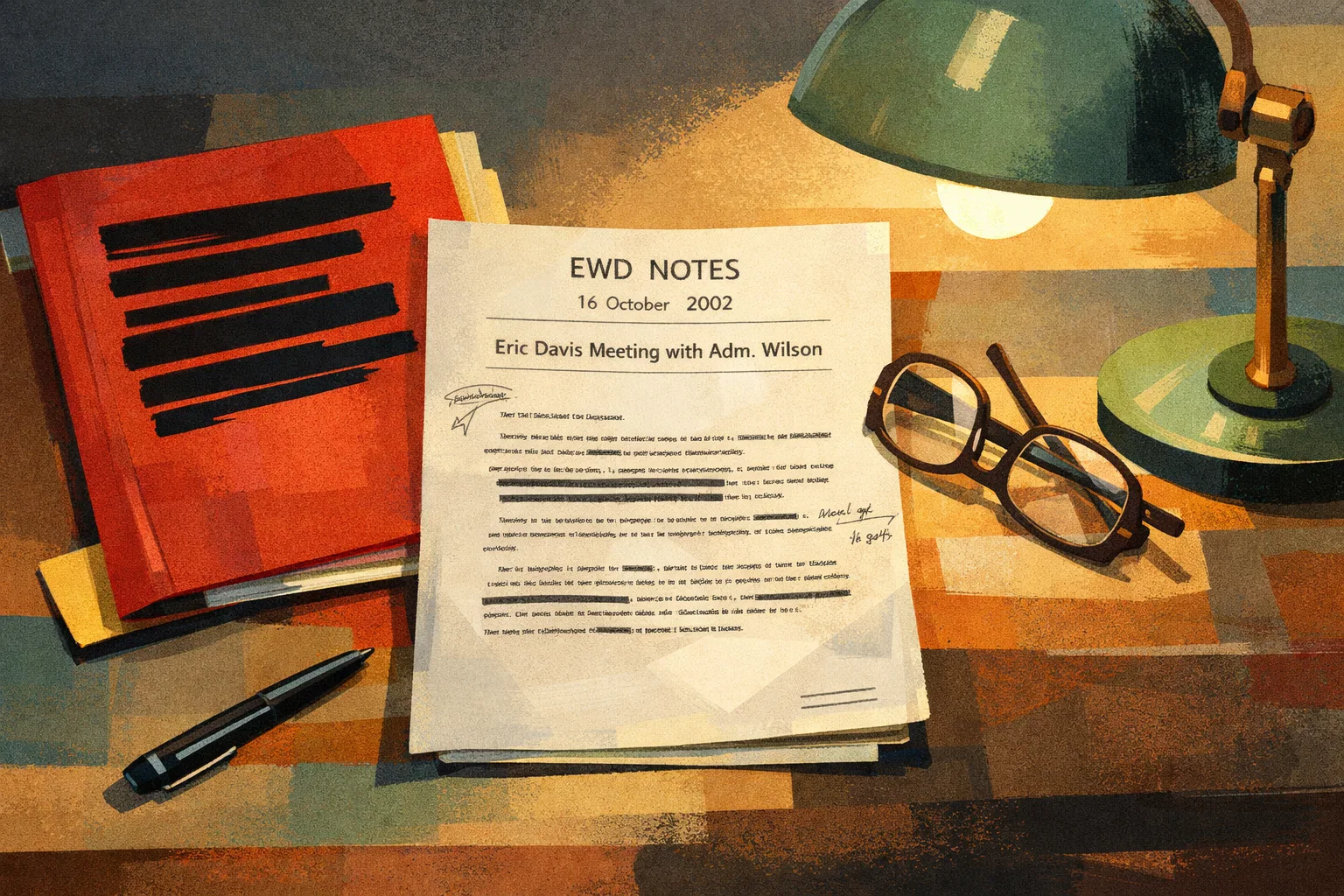
The Wilson-Davis memo still divides readers because it sits in an awkward evidential category: dramatic enough to matter, detailed enough to resist easy dismissal, but weak enough in provenance that it cannot carry the weight placed on it. The document purports to be Eric Davis’s notes of an October 2002 meeting with former Defense Intelligence Agency director Vice Admiral Thomas R. Wilson, in which Wilson allegedly described being blocked from a hidden UAP crash-retrieval and reverse-engineering programme. The problem is not only whether the story is true. The harder problem is chain of custody: who had the notes, how they left private hands, whether the text is complete, and whether the people named in it confirm the events. The memo is therefore central to Davis’s UAP reputation, but it is not proof. It is a contested document whose value depends on separating authorship, provenance, institutional plausibility and factual accuracy.[Congress.gov]congress.govSource details in endnotes.[2Enigma Labs | Report a UFO sighting]enigmalabs.ioEnigma Labs | Report a UFO sighting The Wilson Memo | Enigma LabsEnigma Labs | Report a UFO sighting The Wilson Memo | Enigma Labs
What the memo appears to describe
The document entered into the US congressional hearing record in 2022 is headed as “EWD NOTES” and dated 16 October 2002. It presents itself as notes of “Eric Davis Meeting with Adm. Wilson” at an EG&G Special Projects building in Las Vegas. The opening page describes Wilson arriving late with two naval officers and a driver, then talking with Davis in a car rather than inside the building. The claimed subject is not a normal UFO sighting but an alleged buried access-controlled programme concerning “crashed/retrieved” craft, bodies and related secrecy.[Congress.gov]congress.govSource details in endnotes.
| In the memo’s internal story, Wilson says he had first been prompted by an earlier Pentagon meeting involving Apollo astronaut Edgar Mitchell, Navy Commander Willard Miller and UFO-disclosure advocate Steven Greer. According to the memo, Wilson then looked into claims of a hidden UAP-related special access programme, followed budgetary and access-control clues, and eventually identified an unnamed top aerospace contractor. In one of the memo’s most quoted exchanges, Davis asks for the contractor and programme name; Wilson repeatedly refuses, calling it a “core secret”.[Enigma Labs]enigmalabs.ioEnigma Labs | Report a UFO sighting The Wilson Memo | Enigma LabsEnigma Labs | Report a UFO sighting The Wilson Memo | Enigma Labs | Report a UFO sighting |
| The alleged programme is described in the memo as a reverse-engineering effort controlled by a small “watch committee” or gatekeeping group. The document says Wilson was told his clearances and rank were not enough because he was not on the programme’s “bigot list”, meaning the tightly controlled list of people granted access. It also claims that the programme had an intact craft not made by human hands, that progress was slow, and that the contractor-controlled access system overrode ordinary government oversight.[Enigma Labs]enigmalabs.ioEnigma Labs | Report a UFO sighting The Wilson Memo | Enigma LabsEnigma Labs | Report a UFO sighting The Wilson Memo | Enigma Labs | Report a UFO sighting |
That is why the memo matters for Eric Davis. Davis is not being framed here as a pilot witness or casual UFO commentator. He appears in the document as the note-taker, questioner and technically literate interlocutor receiving an alleged insider account from a former senior intelligence official. If the memo were authentic and accurate, it would place Davis close to one of the most explosive claims in modern UAP culture: that a private aerospace contractor held recovered non-human technology beyond normal democratic oversight. If it is inaccurate, embellished, misattributed or fabricated, it becomes a major cautionary exhibit in how insider-sounding UAP narratives can gain authority through detail, acronyms and repetition.

The provenance problem
| The strongest criticism of the Wilson-Davis memo is not that it sounds impossible. The strongest criticism is that its public chain of custody is poor. The document surfaced online around 2019, long after the alleged 2002 meeting. Enigma Labs summarises the common provenance story as a chain running back to the estate of Edgar Mitchell, who died in 2016, with an unidentified person reportedly finding the memo among Mitchell’s papers before it appeared online. That leaves several missing links: how Mitchell obtained it, whether the public copy matches any original, who scanned or reproduced it, and whether any intermediate holder altered, selected or contextualised the material.[Enigma Labs]enigmalabs.ioEnigma Labs | Report a UFO sighting The Wilson Memo | Enigma LabsEnigma Labs | Report a UFO sighting The Wilson Memo | Enigma Labs | Report a UFO sighting |
The Black Vault’s analysis puts the problem plainly: with no settled provenance, it is unclear whether the documents are legitimate, and even if they are, whether the contents are credible. That distinction is crucial. A document can be physically real, genuinely old, and genuinely written by the person alleged, while still containing errors, hearsay, misunderstandings or self-protective omissions. Conversely, a document can contain some true background details while being wrong about its central claim. The memo’s surface specificity is not the same thing as an authenticated evidential chain.[The Black Vault]theblackvault.comSource details in endnotes.
The congressional-record point is often misunderstood. In May 2022, Representative Mike Gallagher asked Under Secretary of Defense for Intelligence and Security Ronald Moultrie whether he knew of the “Admiral Wilson memo” or “EW notes”; Moultrie said he was not personally aware of it. Gallagher then asked for unanimous consent to enter the memo into the record, and the chair allowed it. That made the document part of the hearing record, but it did not authenticate the document’s origin, verify Wilson’s alleged statements, or establish the existence of a crash-retrieval programme.[The Debrief]thedebrief.orgSource details in endnotes.
The problem is sharpened by the fact that the memo itself contains features both sides can point to. Supporters point to the density of names, offices and access-control language: Special Access Programmes, SAPCO, SAPOC, bigot lists, contractor gatekeepers and senior review structures. Sceptics point to the same density as a possible way to create insider texture without independent proof. The memo’s language may be consistent with parts of the classified-programme world, but consistency is not corroboration. A careful reader should treat the document as an allegation with bureaucratic detail, not as a verified government record.
Wilson’s denials are not a small detail
Thomas R. Wilson is not a peripheral name in the story. DIA’s own history page identifies Vice Admiral Thomas Wilson as DIA director from July 1999 to July 2002, and other records describe him as a career intelligence officer with senior assignments including Director for Intelligence on the Joint Staff. That background makes him a plausible person for a story about high-level access disputes. It also means his denials carry weight, because the memo’s credibility depends heavily on whether he actually said what the notes attribute to him.[defense]media.defense.govU.S. Department of War AARO Historical Record Report Volume 1U.S. Department of War AARO Historical Record Report Volume 1
Wilson has repeatedly rejected the memo’s central claims. According to reporting quoted by The Black Vault and Enigma Labs, he called it “fiction”, denied knowing Davis in any meaningful way, denied sitting with him in a car in Las Vegas, and said he had not been to Las Vegas since around 1979 or 1980. He also challenged a practical detail in the notes: by 2002 he was no longer in the Navy, so the idea of naval personnel ferrying him around in the manner described struck him as wrong.[The Black Vault]theblackvault.comSource details in endnotes.
| Wilson has conceded one narrower point: he did meet Edgar Mitchell and others at the Pentagon in 1997 to hear claims about hidden UFO-related programmes. But he denies the follow-up saga in which he allegedly traced the programme, confronted contractor gatekeepers, briefed oversight bodies and was threatened to back off. That distinction matters because one corroborated ingredient does not authenticate the entire recipe. The existence of the Mitchell meeting may explain how Wilson entered UAP lore, but it does not prove the later Davis car meeting or the crash-retrieval claim.[Enigma Labs]enigmalabs.ioEnigma Labs | Report a UFO sighting The Wilson Memo | Enigma LabsEnigma Labs | Report a UFO sighting The Wilson Memo | Enigma Labs | Report a UFO sighting |
Supporters often respond that Wilson would have obvious reasons to deny a classified discussion held outside a secure compartmented facility. That is a plausible motive argument, but it cuts both ways. A motive to deny is not evidence that the denied event occurred. In a credibility assessment, Wilson’s denials cannot simply be waved away as expected secrecy behaviour; they are direct, repeated contradictions from the principal alleged speaker in the memo.
Why supporters still find it hard to dismiss
| The memo’s appeal is not hard to understand. It gives a structured explanation for a long-running UAP suspicion: that elected officials and even senior defence leaders may be formally powerful but practically excluded from ultra-compartmented programmes controlled by contractors. It also describes a failure mode that is familiar in ordinary classified work, even without aliens: need-to-know rules, narrow access lists, contractor control, budget opacity and bureaucratic buck-passing.[Enigma Labs]enigmalabs.ioEnigma Labs | Report a UFO sighting The Wilson Memo | Enigma LabsEnigma Labs | Report a UFO sighting The Wilson Memo | Enigma Labs | Report a UFO sighting |
The document also lines up with some later public UAP themes. Davis was reported in 2020 as saying he had briefed US defence and Senate staff on “off-world vehicles not made on this earth”, and that some recovered materials could not be explained by him as something “we” could make. Those claims were not accompanied by public physical evidence, but they made Davis one of the few named technical figures publicly associated with alleged retrieval briefings.[New York Magazine]nymag.comNew York Magazine UFO Report: Pentagon Has 'Off-World Vehicles' Not FromNew York Magazine UFO Report: Pentagon Has 'Off-World Vehicles' Not From
A further reason the memo persists is that it is not a vague alien anecdote. It is a case-family document: a claimed account of named officials, named offices, access procedures, contractor oversight and an alleged meeting date. That makes it more discussable than a generic rumour. Readers can test pieces of it: Wilson’s career, Mitchell’s activism, the existence of special access structures, the 2022 congressional handling, and Davis’s broader involvement in UAP-related technical circles. Some pieces check out as context. The central claim, however, remains unverified.
This is the memo’s unusual strength and weakness: it is detailed enough to generate research leads, but not independently confirmed enough to settle the issue. It should therefore be treated as a map of allegations rather than the territory itself.
Why sceptics see a chain-of-custody warning sign
For sceptics, the memo is a near-perfect example of how a document can appear more probative than it is. It is typed, dated, full of acronyms, linked to real people, and eventually entered into a congressional record. None of those features proves that the alleged conversation happened or that the alleged programme existed. The evidential gap lies between “a document says Wilson said this” and “Wilson said this, and what he said was true”.
| The chain-of-custody problem also affects motive and context. If the notes came from Mitchell’s estate, why were they there? Were they sent to him by Davis, copied by someone else, shared in a private research circle, or compiled as part of a wider UFO-disclosure effort? Was the version released online complete? Were there cover emails, file metadata, drafts, annotations or source notes that would clarify origin? Without those details, readers are left with a floating document, not a clean archival record.[Enigma Labs]enigmalabs.ioEnigma Labs | Report a UFO sighting The Wilson Memo | Enigma LabsEnigma Labs | Report a UFO sighting The Wilson Memo | Enigma Labs | Report a UFO sighting |
A second sceptical concern is circular reporting. AARO’s 2024 historical report says it found no empirical evidence that the US government or private companies have reverse-engineered extraterrestrial technology, and it argues that some modern reverse-engineering claims arose through circular reporting among a group of people involved in UAP-related efforts since at least 2009. AARO’s report is itself contested by some UAP advocates, but it is relevant because the Wilson-Davis memo depends heavily on an insider network in which claims can circulate without public documentary confirmation.[U.S. Department of War]media.defense.govU.S. Department of War AARO Historical Record Report Volume 1U.S. Department of War AARO Historical Record Report Volume 1(#endnote-4 “Endnote 4”)
| A third concern is negative corroboration. Enigma Labs notes that former senior officials associated with special-access oversight, including Noel Longuemare and Joseph Ralston, have contradicted or failed to support the memo’s claim that Wilson briefed SAPOC or related senior review structures about the alleged investigation. That does not disprove every line of the memo, but it weakens the idea that the alleged dispute left a trace among the obvious people who might remember it.[Enigma Labs]enigmalabs.ioEnigma Labs | Report a UFO sighting The Wilson Memo | Enigma LabsEnigma Labs | Report a UFO sighting The Wilson Memo | Enigma Labs | Report a UFO sighting |
Three questions careful readers should separate
The memo is often debated as though there is one question: “Is it real?” That is too blunt. A careful assessment needs at least three separate questions, because each has a different evidential threshold.
First: did Eric Davis write or compile the notes? This is the least explosive question. Some later commentary has claimed Davis appeared to acknowledge authorship in private social-media remarks, but the public record remains messy and Davis has historically been cautious about direct authentication. Authorship would matter because it would show the notes were not merely a third-party fabrication. It would not, by itself, prove Wilson’s statements or the alleged programme.[Richard Dolan Members]richarddolanmembers.comRichard Dolan Members Eric Davis Appears to Admit Writing Wilson/Davis MemoRichard Dolan Members Eric Davis Appears to Admit Writing Wilson/Davis Memo
Second: did the Davis-Wilson meeting happen as described? This is harder. The memo gives a date, place and conversation format, but Wilson denies the Las Vegas car meeting and says key logistical details are wrong. Unless independent travel records, contemporaneous correspondence, meeting-arrangement emails, phone logs or testimony from named intermediaries emerge, this question remains unresolved.[Congress.gov]congress.govSource details in endnotes.
Third: even if the meeting happened, was Wilson’s account accurate? This is the highest bar. A senior official could have misunderstood a budget compartment, repeated a rumour, overstated what a contractor told him, or been denied access for reasons unrelated to recovered non-human technology. The memo’s most dramatic claim requires more than proof of a conversation. It requires corroboration that the unnamed programme existed, that it possessed recovered craft, and that normal oversight was knowingly bypassed. AARO says it found no evidence for such reverse-engineering claims and that companies named by interviewees denied possessing or working on extraterrestrial technology.[U.S. Department of War]media.defense.govU.S. Department of War AARO Historical Record Report Volume 1U.S. Department of War AARO Historical Record Report Volume 1(#endnote-4 “Endnote 4”)
Separating those questions prevents both overbelief and overdebunking. A document can be partly authentic and still unreliable on its central claim. It can also be denied by a principal and still deserve archival scrutiny if other evidence later appears. The responsible position is not to treat the memo as solved, but to avoid treating uncertainty as confirmation.
What this does to Eric Davis’s credibility
For Eric Davis, the Wilson-Davis memo is a double-edged credibility marker. On one side, it reinforces why he became influential in UAP circles: he had technical credentials, moved around defence-linked advanced aerospace networks, and was close enough to UAP insiders that congressional staff, journalists and researchers took his claims seriously. On the other side, the memo concentrates the weaknesses in his public UAP profile: reliance on second-hand or classified assertions, lack of public physical evidence, and documents whose chain of custody is unresolved.[New York Magazine]nymag.comNew York Magazine UFO Report: Pentagon Has 'Off-World Vehicles' Not FromNew York Magazine UFO Report: Pentagon Has 'Off-World Vehicles' Not From[The Debrief]thedebrief.orgSource details in endnotes.
The memo does not show Davis personally witnessed a non-human craft. It portrays him as receiving and recording an alleged account from Wilson. That makes the central claim second-hand from Davis’s perspective, even if the notes are his. Davis’s importance lies in being a conduit, compiler or participant in insider-adjacent UAP networks, not in having publicly demonstrated first-hand access to recovered technology.
Nor should Davis’s technical background be used as a shortcut to belief. Technical literacy may make a witness better at asking certain questions, but it does not solve provenance. A physicist can accurately transcribe a false story, misunderstand compartmented bureaucracy, or be told something that cannot be publicly checked. Equally, a defence-linked scientist should not be dismissed merely because the claim sounds extraordinary. The proper standard is document handling, corroboration and independent evidence.
The Wilson-Davis memo therefore leaves Davis in a complicated middle position. It makes him more significant than a peripheral UFO commentator, because his name is attached to a document that reached congressional attention and intersects with later claims of retrieval briefings. But it also makes him harder to treat as a settled authority, because the memo’s most powerful claims remain disputed by the alleged source and unsupported by an authenticated chain of custody.
The careful bottom line
The Wilson-Davis memo is best understood as a high-impact unresolved document, not as proof of a hidden crash-retrieval programme. Its importance comes from the combination of Eric Davis’s role, Thomas Wilson’s verified senior intelligence background, the memo’s detailed access-control narrative, and its later entry into a congressional hearing record. Its weakness comes from the missing provenance, Wilson’s denials, lack of public corroborating records, and the absence of publicly available physical or documentary evidence proving the alleged programme.[defense]media.defense.govU.S. Department of War AARO Historical Record Report Volume 1U.S. Department of War AARO Historical Record Report Volume 1 Intelligence Agency[The Debrief]thedebrief.orgSource details in endnotes.
For readers assessing Eric Davis’s credibility, the memo should raise interest but also caution. It supports the view that Davis was embedded in a serious, technically literate UAP-insider conversation. It does not establish that the conversation happened exactly as written, that Wilson’s alleged account was accurate, or that non-human technology was held by a contractor. The most defensible judgement is that the memo remains evidentially important but not evidentially decisive.
Amazon book picks
Further Reading
Books and field guides related to Why The Wilson Davis Memo Still Divides Readers. Use these as the next step if you want deeper reading beyond the article.
UFO
Covers secrecy, investigations, disclosure debates, and the institutional context surrounding claims like the Wilson-Davis memo.
American Cosmic
Examines how insider networks, belief, evidence, and secrecy shape modern UFO narratives.
The Report on Unidentified Flying Objects
Shows longstanding tensions between evidence, investigation, and official conclusions.
The UFO Files
Useful for readers interested in provenance, archives, and official documentation.
eBay marketplace picks
Marketplace Samples
Example marketplace items related to this page. Use the search link to explore similar finds on eBay.


Endnotes
1.
Source: congress.gov
Link:https://www.congress.gov/117/meeting/house/114761/documents/HHRG-117-IG05-20220517-SD001.pdf
2.
Source: enigmalabs.io
Title: Enigma Labs | Report a UFO sighting The Wilson Memo | Enigma Labs
Link:https://enigmalabs.io/library/b80b4058-3f47-4b2a-8d61-b735c4c4bf69
3.
Source: dia.mil
Title: VADM Thomas R Wilson USN
Link:https://www.dia.mil/About/History/Directors-of-DIA/VADM-Thomas-R-Wilson-USN/
4.
Source: media.defense.gov
Title: U.S. Department of War AARO Historical Record Report Volume 1
Link:https://media.defense.gov/2024/Mar/08/2003409233/-1/-1/0/DOPSR-2024-0263-AARO-HISTORICAL-RECORD-REPORT-VOLUME-1-2024.PDF
5.
Source: theblackvault.com
Link:https://www.theblackvault.com/casefiles/the-admiral-wilson-leak-an-analysis/
6.
Source: thedebrief.org
Link:https://thedebrief.org/complete-transcript-of-congresss-historic-hearing-on-unidentified-aerial-phenomena/
7.
Source: nymag.com
Title: New York Magazine UFO Report: Pentagon Has ‘Off-World Vehicles’ Not From
Link:https://nymag.com/intelligencer/2020/07/ufo-report-pentagon-has-off-world-vehicles-not-from-earth.html
8.
Source: richarddolanmembers.com
Title: Richard Dolan Members Eric Davis Appears to Admit Writing Wilson/Davis Memo
Link:https://richarddolanmembers.com/ufo-secrecy/eric-davis-appears-to-admit-writing-wilson-davis-memo/
9.
Source: Wikipedia
Title: Thomas R. Wilson
Link:https://en.wikipedia.org/wiki/Thomas_R._Wilson
10.
Source: reddit.com
Link:https://www.reddit.com/r/UFOs/comments/nz604l/complete_summary_of_wilson_davis_memo/
11.
Source: amazon.com
Link:https://www.amazon.com/History-eBooks-Astronomy-Davis-Science-Medicine/s?rh=n%3A10704236011%2Cp_27%3ADavis
12.
Source: military-history.fandom.com
Title: Thomas R. Wilson
Link:https://military-history.fandom.com/wiki/Thomas_R._Wilson
13.
Source: linkedin.com
Title: Thomas Wilson
Link:https://www.linkedin.com/in/thomas-wilson-a6842141
Additional References
14.
Source: youtube.com
Title: Dr. Eric Davis “There is a THERE there”
Link:https://www.youtube.com/watch?v=Sm9hv84KtcU
Source snippet
UFO Expert On New Bob Lazar Story, Alien Whistleblower, and the Wilson Memo | Richard Dolan...
Published: May 1, 2025
15.
Source: youtube.com
Title: Admiral Wilson Documents aka Wilson/Davis or EWD Notes
Link:https://www.youtube.com/watch?v=uS5G3OnRjPg
Source snippet
UFO Expert: “We Have Proof They Exist,” with Luis Elizondo...
16.
Source: youtube.com
Title: UFO Expert: “We Have Proof They Exist,” with Luis Elizondo
Link:https://www.youtube.com/watch?v=uFRAvDOPZP0
Source snippet
Dr. Eric Davis "There is a THERE there" - UAP Hearing May 1, 2025...
Published: May 1, 2025
17.
Source: facebook.com
Link:https://www.facebook.com/AncientHistory68/posts/a-consultant-for-the-pentagon-ufo-program-is-speaking-out-about-retrievals-from-/137115689056543/
18.
Source: scribd.com
Link:https://www.scribd.com/document/518866282/Admiral-Wilson-document
19.
Source: reddit.com
Link:https://www.reddit.com/r/aliens/comments/1gceoz4/context_on_wilsondavis_memo/
20.
Source: reddit.com
Link:https://www.reddit.com/r/UFOs/comments/1f5ede9/eric_davis_appears_to_admit_writing_wilsondavis/
21.
Source: facebook.com
Link:https://www.facebook.com/Amazing.Science.Factss/posts/former-cia-contractor-hal-puthoff-claimed-on-a-podcast-that-the-united-states-ha/1299094989002843/
22.
Source: facebook.com
Link:https://www.facebook.com/fossbytes/posts/former-cia-researcher-hal-puthoff-claimed-the-us-recovered-4-alien-species-from-/1434367868731253/
23.
Source: reddit.com
Link:https://www.reddit.com/r/ChilluminatiPod/comments/118mgcb/former_director_of_the_dia_defense_intelligence/
Topic Tree
Follow this branch
Parent topic
DavisRelated pages 7
- AAWSAP Links Do Pentagon Links Prove Too Much?
- Debate Why Reasonable Readers Split On Davis
- DIA Papers What Do The DIA Papers Really Show?
- Media Role How Media Coverage Changed Davis's Reputation
- Off World Claim What About The Off World Vehicles Claim?
- Source Type Was Davis A Witness Or A Messenger?
- Verified Work What Can Actually Be Verified?