Within Elizondo
What Did the Navy Videos Actually Show?
The Navy videos helped make Elizondo famous, but they confirm unidentified footage rather than alien technology.
On this page
- How FLIR, Gimbal and Go Fast entered public debate
- What the Pentagon confirmed in 2020
- Why unidentified does not mean extraterrestrial
Page outline Jump by section
Introduction
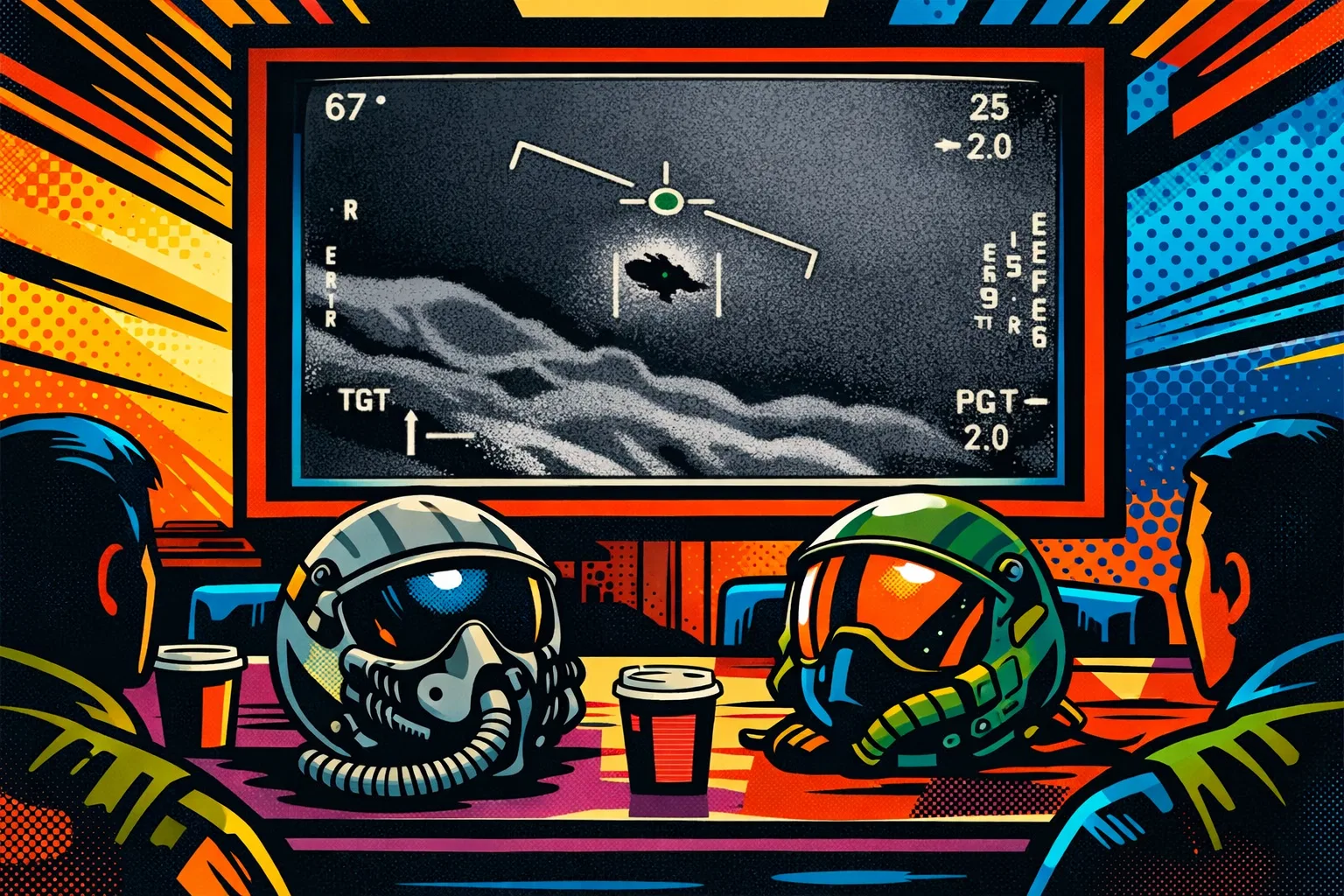
The Navy UAP videos made Luis Elizondo famous because they gave the public something more concrete than a story: military sensor footage, recorded by US Navy aircraft, later acknowledged and released by the Department of Defense. But the videos do not prove alien technology. They prove a narrower, still important point: some military encounters were real enough to be captured by Navy systems, discussed by pilots, reviewed by officials and, in several cases, still described as unidentified at the time of release. The credibility question is therefore not whether the clips were “fake”; the Pentagon said they were genuine Navy videos. The question is what they actually show, what the available data can and cannot support, and how far Elizondo’s interpretation goes beyond the public evidence.[U.S. Department of War]war.govStatement by the Department of Defense on the Release of Historical Navy Videos > U.S. Department of War > Release | U.S. Department of War…(https://www.war.gov/News/Releases/Release/Article/2165713/statement-by-the-department-of-defense-on-the-release-of-historical-navy-videos/)
How FLIR, Gimbal and GoFast entered public debate
The three best-known videos are usually called FLIR, Gimbal and GoFast. FLIR is associated with the 2004 USS Nimitz encounter off the coast of California; Gimbal and GoFast are associated with 2015 Navy incidents involving F/A-18 aircraft. They became publicly important in late 2017, when major US reporting linked them to a Pentagon UFO-related effort and to Luis Elizondo’s claim that he had worked on the Advanced Aerospace Threat Identification Program, or AATIP. The New Yorker later described the December 2017 New York Times story as a front-page moment that brought together AATIP, Harry Reid, Elizondo and the Navy footage in a way that changed the cultural and political status of the subject.[The New Yorker]newyorker.comThe New Yorker How the Pentagon Started Taking U.F.O.s SeriouslyThe New Yorker How the Pentagon Started Taking U.F.O.s Seriously
Elizondo’s role in this breakthrough was not that he personally filmed the objects. He was not one of the pilots in the famous encounters. His importance was as an insider-advocate who helped frame the footage as evidence of a serious national-security problem rather than a fringe curiosity. In that sense, the videos served as his strongest public evidence trail: not proof of his later, more extraordinary claims, but a visible bridge between his Pentagon-linked narrative and something ordinary readers, journalists and lawmakers could inspect for themselves.
The path into public debate also mattered because the footage did not arrive through a normal official press conference. The clips circulated in the public domain before formal Department of Defense release. In 2020, the department said the three videos had been circulating after “unauthorised releases” in 2007 and 2017, and that the Navy had previously acknowledged them as genuine Navy videos. That sequence created a lasting tension: supporters saw the videos as evidence that insiders had forced reluctant transparency; sceptics saw a media campaign built around ambiguous clips that were treated as more conclusive than they really were.[U.S. Department of War]war.govStatement by the Department of Defense on the Release of Historical Navy Videos > U.S. Department of War > Release | U.S. Department of War…(https://www.war.gov/News/Transcripts/Transcript/Article/3965734/dr-jon-kosloski-director-aaro-media-roundtable-on-the-fy24-consolidated-annual/)
What the Pentagon confirmed in 2020
The 2020 Pentagon statement is the most important anchor for this subtopic because it draws the line between authentication and interpretation. The Department of Defense authorised the release of three unclassified Navy videos: one from November 2004 and two from January 2015. It said the release would clear up public misconceptions about whether the footage was real and whether there was more to the videos. It also said the aerial phenomena in the videos remained characterised as “unidentified”.[U.S. Department of War]war.govStatement by the Department of Defense on the Release of Historical Navy Videos > U.S. Department of War > Release | U.S. Department of War…(https://www.war.gov/News/Releases/Release/Article/2165713/statement-by-the-department-of-defense-on-the-release-of-historical-navy-videos/)
That confirmation strengthened Elizondo’s public credibility in one specific way. It showed that a central piece of the story he had helped bring into public view was not fabricated by UFO hobbyists. The videos were indeed Navy material, and the government did not dismiss them as hoaxes. For a public figure whose appeal rests partly on claimed official access, this mattered. It gave his advocacy a documented institutional base.
But the same statement also limited what the videos could responsibly be used to claim. The Department of Defense did not say the objects were extraterrestrial. It did not say they represented non-human technology. It did not say they demonstrated impossible performance. It said they were unidentified, and that releasing the videos would not reveal sensitive capabilities or interfere with investigations of incursions into military airspace. That is a meaningful statement, but it is not a disclosure of alien craft.[U.S. Department of War]war.govStatement by the Department of Defense on the Release of Historical Navy Videos > U.S. Department of War > Release | U.S. Department of War…(https://www.war.gov/News/Transcripts/Transcript/Article/3965734/dr-jon-kosloski-director-aaro-media-roundtable-on-the-fy24-consolidated-annual/)
This distinction is often lost in public discussion. “Real video” becomes “real UFO”; “UFO” becomes “alien craft”; and “unidentified” becomes “unexplainable”. Each step adds more than the official evidence can bear. The Navy videos are powerful because they are official and unresolved in context, not because the clips alone establish the origin, technology or intent of whatever was recorded.
What the clips actually show, and why the images are not enough
The videos are not ordinary smartphone recordings. They include infrared imagery, targeting-pod displays, cockpit data and pilot audio. That gives them more evidential value than a casual sky video. Yet they are also short, compressed, context-poor clips from systems designed for military use, not for later public scientific analysis. Without full-resolution source data, full metadata, aircraft positions, wind conditions, radar tracks and complete event timelines, the public cannot confidently reconstruct what happened from the clips alone.
This is one reason the 2021 ODNI preliminary assessment is relevant. It found that the limited amount of high-quality UAP reporting hampered firm conclusions, while noting that many reported UAP were registered across multiple sensors, including radar, infrared, electro-optical systems, weapon seekers and visual observation. The report’s careful language cuts both ways: it supports taking some incidents seriously, but it also warns against treating incomplete data as proof of exotic technology.[Director of National Intelligence]dni.govDirector of National Intelligence
NASA’s 2023 UAP independent study reached a similar methodological point. It argued that UAP study needs rigorous data acquisition, better sensor calibration, multiple measurements, structured reporting and reduced stigma. It also noted that many existing observations were collected for other purposes and often lack the metadata needed for strong analysis. This is directly relevant to FLIR, Gimbal and GoFast: they are compelling public artefacts, but they are not the same thing as a purpose-built scientific dataset.[NASA Science]science.nasa.govSource details in endnotes.
For Elizondo, this creates a credibility split. He was right that the videos helped expose a real reporting and analysis gap inside national-security institutions. He is on weaker ground when the public clips are used rhetorically to imply conclusions that require far more data than viewers have.
GoFast shows the danger of trusting first impressions
GoFast is the clearest example of why “what it looks like” is not the same as “what it is doing”. The clip appears, to many viewers, to show a small object racing just above the ocean. The name itself encourages that reading. Pilot excitement on the audio adds to the impression. As public evidence, it is memorable because the object seems fast, low and strange.
AARO’s later case-resolution analysis sharply narrowed that interpretation. In its February 2025 GoFast report, AARO assessed that the object was about 13,000 feet above the Atlantic Ocean, not near the surface, and that its apparent movement was consistent with an object travelling between roughly 5 and 92 mph after wind effects were considered. AARO said it could not definitively identify the object, but assessed with high confidence that it did not show anomalous performance characteristics.[AARO]aaro.milGo Fast Case ResolutionGo Fast Case Resolution
This does not make GoFast worthless. It remains a useful case because it shows how trained pilots, advanced sensors and public viewers can still be misled by perspective, range, motion, wind and display geometry. It also shows why official authentication is not the same as exotic explanation. The footage can be real, the event can be worth reporting, and the most dramatic interpretation can still be wrong or overstated.
For Elizondo’s credibility, GoFast is a cautionary case. It does not discredit everything he says about UAP, but it weakens any broad argument that the famous Navy videos, by themselves, demonstrate extraordinary propulsion or non-human technology. If one of the marquee clips can be substantially reduced by later geometric and atmospheric analysis, then the whole video set has to be treated with care rather than awe.
Gimbal and FLIR remain more contested, but not conclusive
Gimbal is famous for the apparent rotating object and the pilots’ comments about a “fleet” on the sensors. Supporters often present it as one of the most striking Navy UAP clips because it seems to show a craft without obvious wings or exhaust rotating in flight. Sceptical analysts have argued that at least part of the apparent rotation may come from infrared glare and the gimbal-mounted camera system rather than the object itself; the public evidence has not settled the case to everyone’s satisfaction.[Leonard David's Inside Outer Space]leonarddavid.comdebunking navy ufo videosdebunking navy ufo videos
FLIR, linked to the broader Nimitz “Tic Tac” story, is different because the video is only one part of a larger witness-and-sensor narrative. Commander David Fravor and other personnel have described a 2004 encounter involving a white, oblong object with unusual movement. That testimony is more dramatic than the short FLIR clip alone. But the same evidential problem remains: the public video is not a complete reconstruction of the event, and the strongest claims depend on witness accounts, radar context and additional data not fully available to independent public review.[Time]time.comOpen source on time.com.
This matters because Elizondo’s public reputation often benefits from the emotional force of the Navy pilots’ accounts. Those witnesses are serious people and should not be dismissed casually. At the same time, their experiences do not automatically validate every claim Elizondo later made about secret programmes, recovered craft or non-human technology. The videos and witnesses support the narrower proposition that some military personnel encountered puzzling aerial events. They do not publicly establish the larger architecture of hidden alien technology.
Why the videos changed mainstream treatment of UAP
Before 2017, UFO coverage in mainstream outlets was usually framed as eccentric, comic or conspiratorial. The Navy videos helped change that tone because they involved military pilots, defence officials, sensor systems and national-security language. The shift from “UFO” to “UAP” was not just cosmetic. It allowed officials and journalists to discuss airspace incursions, pilot safety and intelligence gaps without appearing to endorse alien visitation.
The Navy’s later move towards formal reporting guidelines reinforced this change. Reporting in 2019 described the Navy as creating or updating procedures to make it easier for pilots and personnel to report unexplained aerial phenomena, partly to reduce stigma and allow more systematic analysis. Elizondo publicly praised that shift, calling it a major step for formalising reports and improving data-driven analysis.[The Washington Post]washingtonpost.comSource details in endnotes.
The mainstream breakthrough therefore had two layers. The public layer was the spectacle of the videos: strange shapes, infrared displays and pilots reacting in real time. The institutional layer was more important: Congress, the Navy, ODNI, NASA and AARO began treating UAP as a reporting and analysis problem. That is the strongest lasting consequence of the videos, regardless of what any individual clip ultimately turns out to show.
Elizondo deserves some credit for helping push that change into public view. His media appearances, links to To The Stars Academy, and association with the 2017 reporting helped make the issue legible to non-specialist audiences. But the breakthrough also depended on others: Navy aviators, Christopher Mellon, journalists, lawmakers, defence spokespeople and later formal offices. The videos made Elizondo more visible, but they were not his evidence alone.
Why unidentified does not mean extraterrestrial
The most common misunderstanding is simple: if the Pentagon says a video is real and unidentified, many people hear “confirmed alien craft”. That is not what the official record says. In the 2021 ODNI assessment, UAP were grouped into possible explanatory categories including airborne clutter, natural atmospheric phenomena, US government or industry developmental programmes, foreign adversary systems and a residual “other” category. That framework leaves room for unresolved cases, but it does not privilege extraterrestrial explanations.[Director of National Intelligence]dni.govDirector of National Intelligence
Later official work has continued in the same direction. AARO’s public imagery page includes cases that are unresolved, undergoing analysis, or resolved as balloons, birds, aircraft or other ordinary objects. Several unresolved entries are described as physical objects with unremarkable performance characteristics, or as cases where the available data is insufficient for more precise attribution. This pattern is important: “unresolved” often means “not enough information”, not “physics-defying craft”.[AARO]aaro.milOfficial UAP ImageryAARO UAP Imagery…
AARO’s 2024 public comments also emphasised that the office had received more than 1,600 UAP reports and had resolved hundreds as commonplace objects such as balloons, birds, drones, satellites and aircraft. That does not mean every case is solved. It means the overall evidence environment is mixed, messy and highly dependent on data quality.[U.S. Department of War]war.govStatement by the Department of Defense on the Release of Historical Navy Videos > U.S. Department of War > Release | U.S. Department of War…(https://www.war.gov/News/Transcripts/Transcript/Article/3965734/dr-jon-kosloski-director-aaro-media-roundtable-on-the-fy24-consolidated-annual/)
For readers assessing Elizondo, this is the crucial point. The Navy videos support his argument that UAP reporting deserved more serious treatment. They do not, on their own, support the strongest version of his later public narrative. A balanced judgement gives him credit for helping mainstream a legitimate defence and aviation-safety issue, while refusing to treat ambiguous video evidence as confirmation of extraterrestrial technology.

What the Navy videos really add to Elizondo’s credibility
The videos remain the most durable part of Elizondo’s public case because they are independently acknowledged, institutionally relevant and culturally consequential. They show that he was not merely promoting an imaginary controversy. There were real Navy recordings, real pilot concerns, real government statements and real follow-on processes. In a field full of hearsay, that matters.
Their limitation is just as important. They are not a clean proof package. They do not show a complete event chain. They do not publicly identify the objects. At least one famous clip, GoFast, has been officially assessed as non-anomalous in performance even though the object itself was not definitively identified. The broader lesson is that UAP evidence can be genuine and still be ambiguous, interesting and still prosaic, unresolved and still not alien.[AARO]aaro.milAARO Historical Record Report VolAARO Historical Record Report Vol
That is why the Navy videos should be treated as a mainstream breakthrough, not a final answer. They changed who was willing to talk about UAP, how pilots reported them, how Congress asked questions, and how agencies described the problem. They strengthened Luis Elizondo’s credibility as a catalyst for public attention. They did not settle the deeper claims that now define the most controversial parts of his reputation.
Amazon book picks
Further Reading
Books and field guides related to What Did the Navy Videos Actually Show?. Use these as the next step if you want deeper reading beyond the article.
UFO Files and UAP Disclosure
The truth is no longer hiding in the shadows. It is buried in declassified documents, locked in congressional hearing rooms, and streamin...
L' UAP et l'histoire de l'assurance
First published 1990. Subjects: Union des assurances de Paris, Histoire, Assurance, Insurance, History.
UAP i Norden
First published 1982. Subjects: Cooperative acquisition of library materials, Interlibrary loans, Library cooperation.
Aliança UAP
First published 1995. Subjects: Insurance companies, Aliança UAP (Firm), History.
eBay marketplace picks
Marketplace Samples
Example marketplace items related to this page. Use the search link to explore similar finds on eBay.




Endnotes
1.
Source: war.gov
Title: U.S. Department of War
Link:https://www.war.gov/News/Releases/Release/Article/2165713/statement-by-the-department-of-defense-on-the-release-of-historical-navy-videos/
Source snippet
Statement by the Department of Defense on the Release of Historical Navy Videos > U.S. Department of War > Release | U.S. Department of War...
2.
Source: time.com
Link:https://time.com/5680192/navy-confirms-ufo-videos-real/
3.
Source: dni.gov
Title: Director of National Intelligence
Link:https://www.dni.gov/files/ODNI/documents/assessments/Prelimary-Assessment-UAP-20210625.pdf
4.
Source: science.nasa.gov
Link:https://science.nasa.gov/wp-content/uploads/2023/09/uap-independent-study-team-final-report.pdf
5.
Source: aaro.mil
Title: [Go Fast]({{ ‘go-fast/’ | relative_url }}) Case Resolution
Link:https://www.aaro.mil/Portals/136/PDFs/case_resolution_reports/AARO_GoFast_Case_Resolution_Card_Methodology_Final.pdf
6.
Source: time.com
Title: Navy Pilot Says UFO He Saw Off California Was ‘Not of This World’
Link:https://time.com/5070962/navy-pilot-ufo-california-not-from-this-world/
7.
Source: time.com
Link:https://time.com/5577853/navy-ufo-reporting-guidelines/
8.
Source: aaro.mil
Title: Official UAP Imagery
Link:https://www.aaro.mil/UAP-Cases/Official-UAP-Imagery/
Source snippet
AARO UAP Imagery...
9.
Source: war.gov
Title: U.S. Department of War
Link:https://www.war.gov/News/Transcripts/Transcript/Article/3965734/dr-jon-kosloski-director-aaro-media-roundtable-on-the-fy24-consolidated-annual/
Source snippet
Dr. Jon Kosloski, Director, AARO, Media Roundtable on the FY24 Consolidated Annual Report on UAP > U.S. Department of War > Transcript |...
10.
Source: aaro.mil
Title: AARO Historical Record Report Vol 1 2024
Link:https://www.aaro.mil/Portals/136/PDFs/AARO_Historical_Record_Report_Vol_1_2024.pdf
11.
Source: aaro.mil
Link:https://www.aaro.mil/
12.
Source: science.nasa.gov
Link:https://science.nasa.gov/uap/
13.
Source: media.defense.gov
Title: DOPSR 2024 0263 AARO HISTORICAL RECORD REPORT VOLUME 1 2024
Link:https://media.defense.gov/2024/Mar/08/2003409233/-1/-1/0/DOPSR-2024-0263-AARO-HISTORICAL-RECORD-REPORT-VOLUME-1-2024.PDF
14.
Source: secnav.navy.mil
Title: mil UF O_Redacted
Link:https://www.secnav.navy.mil/foia/readingroom/CaseFiles/UAP%20INFO/UAP%20DOCUMENTS/UFO_Redacted.pdf
15.
Source: military.com
Title: us navy drafting new guidelines reporting ufos
Link:https://www.military.com/daily-news/2019/04/24/us-navy-drafting-new-guidelines-reporting-ufos.html
16.
Source: military.com
Title: ufo videos are footage real unidentified objects us navy acknowledges
Link:https://www.military.com/daily-news/2019/09/18/ufo-videos-are-footage-real-unidentified-objects-us-navy-acknowledges.html
17.
Source: youtube.com
Title: Luis Elizondo
Link:https://www.youtube.com/watch?v=9gLPtRwXgCM
Source snippet
"UFO" videos captured by US Navy Jets Declassified...
18.
Source: newyorker.com
Title: The New Yorker How the Pentagon Started Taking U.F.O.s Seriously
Link:https://www.newyorker.com/magazine/2021/05/10/how-the-pentagon-started-taking-ufos-seriously
19.
Source: washingtonpost.com
Link:https://www.washingtonpost.com/world/national-security/head-of-pentagons-secret-ufo-office-sought-to-make-evidence-public/2017/12/16/90bcb7cc-e2b2-11e7-8679-a9728984779c_story.html
20.
Source: leonarddavid.com
Title: debunking navy ufo videos
Link:https://www.leonarddavid.com/debunking-navy-ufo-videos/
21.
Source: washingtonpost.com
Title: The Washington Post UFO sightings: U.S. Navy drafts guidelines to report
Link:https://www.washingtonpost.com/national-security/2019/04/24/how-angry-pilots-got-navy-stop-dismissing-ufo-sightings/
22.
Source: animated-character-database.fandom.com
Title: Luis Elizondo
Link:https://animated-character-database.fandom.com/wiki/Luis_Elizondo
Additional References
23.
Source: youtube.com
Title: “UFO” videos captured by US Navy Jets Declassified
Link:https://www.youtube.com/watch?v=cdJLaqNEFMM
Source snippet
Luis Elizondo on unidentified aerial phenomena, extraterrestrials and the Pentagon's UFO programme...
24.
Source: youtube.com
Link:https://www.youtube.com/watch?v=4yX6ETCKyPo
Source snippet
Investigating The Pentagon UFO Videos...
25.
Source: youtube.com
Title: Investigating The Pentagon UFO Videos
Link:https://www.youtube.com/watch?v=NUebtejcoCk
Source snippet
'Underwhelming' first UFO file dump: Ross Coulthart, Luis Elizondo | CUOMO...
26.
Source: facebook.com
Link:https://www.facebook.com/NewsNationNow/posts/a-us-military-pilot-reportedly-had-a-close-encounter-with-an-unidentified-flying/650068174066870/
27.
Source: facebook.com
Link:https://www.facebook.com/NPR/posts/a-database-of-ufo-reports-now-includes-about-400-incidents-up-from-143-in-a-repo/10161475927071756/
28.
Source: reddit.com
Link:https://www.reddit.com/r/UFOs/comments/166dk0u/according_to_aaros_new_website_the_flir_gimbal/
29.
Source: facebook.com
Link:https://www.facebook.com/nbcwashington/posts/experts-have-urged-caution-around-the-release-of-the-new-files-warning-that-uap-/1421614630008887/
30.
Source: facebook.com
Link:https://www.facebook.com/thevoiceofsikkim/posts/-file-1-declassified-what-did-us-navy-pilots-actually-seeimagine-youre-a-highly-/1413950667441659/
31.
Source: reddit.com
Link:https://www.reddit.com/r/UFOs/comments/1bfmuzz/for_those_who_dont_know_the_gimbal_and_gofast/
32.
Source: ralphbuncheinstitute.org
Link:https://ralphbuncheinstitute.org/nasa-unidentified-anomalous-phenomena-independent-study-team-report/
Topic Tree
Follow this branch
Parent topic
ElizondoRelated pages 7
- AARO How Strong Is AARO's Rebuttal?
- AATIP Role Did Elizondo Really Run AATIP?
- Biological Claims Why the Biological Claims Need Caution
- Congress What Did Elizondo Tell Congress?
- Craft Claims Where Is the Evidence for Recovered Craft?
- Influence How Elizondo Changed the UAP Debate
- Source Trail What Did Elizondo Know First Hand?