Within Wilson Memo
Could contractors really block oversight?
The memo's most consequential claim is that contractor access controls could exclude senior officials from a hidden retrieval programme.
On this page
- How the memo describes contractor control
- What special access language makes plausible
- Where bureaucratic realism stops short of proof
Page outline Jump by section
Introduction
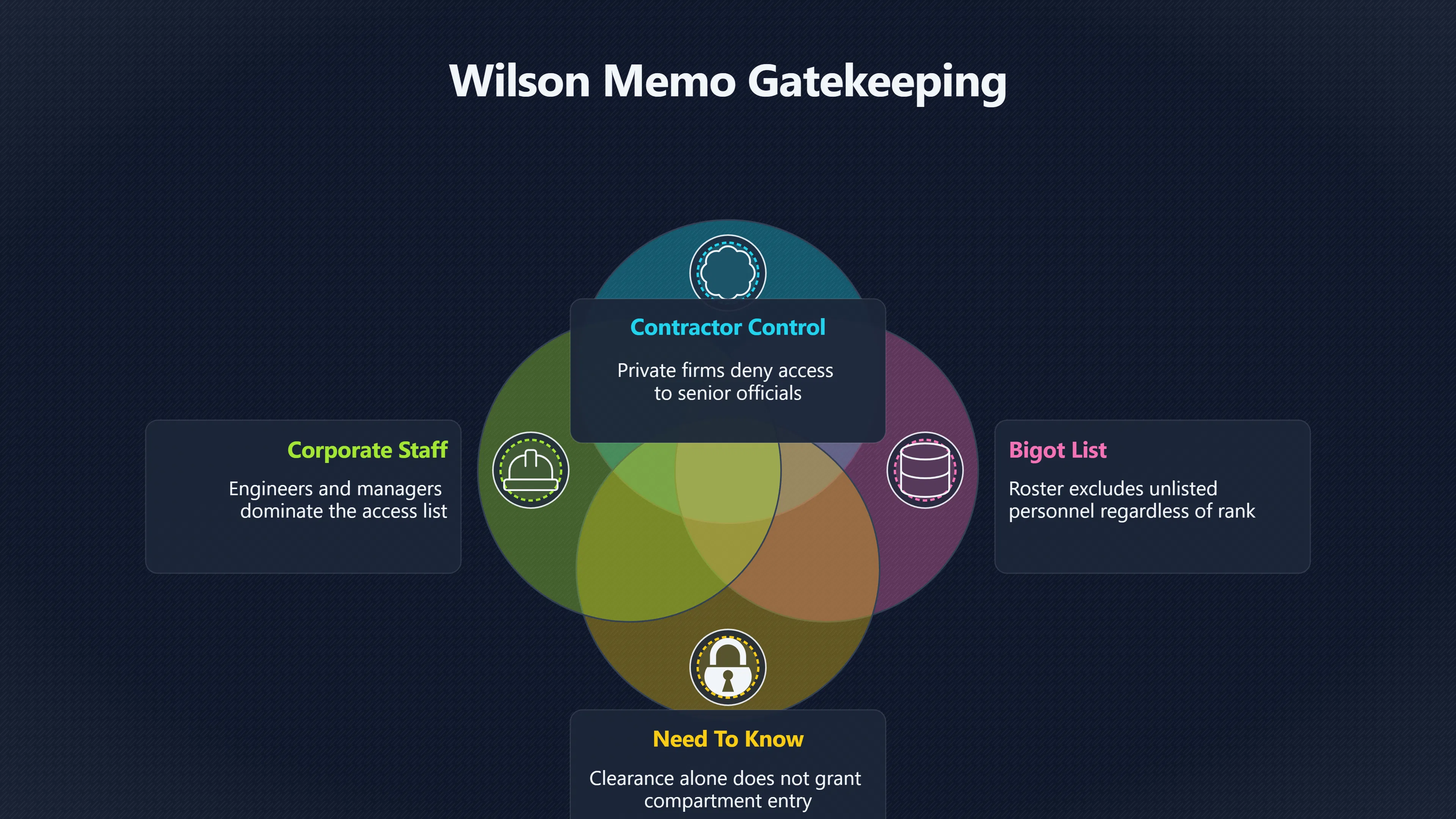
One reason the Wilson-Davis memo has remained influential is that its most dramatic claim does not initially sound like science fiction. The document describes a familiar feature of the US national-security system: highly restricted programmes, compartmented access, private contractors, and “need-to-know” rules. Its central governance claim is that a defence contractor running an alleged crash-retrieval programme could deny access even to a senior intelligence official because he was not on the programme’s “bigot list” — the roster of people formally read into the compartment. If true, that would imply an extraordinary level of contractor gatekeeping over information that should arguably sit within government oversight. If false, it is still a sophisticated claim because it borrows heavily from real special-access procedures. The key credibility question is therefore not whether concepts like bigot lists exist. They do. The question is whether those real mechanisms could function in the way the memo describes.[Wikipedia]WikipediaBIGOT listBIGOT list
How the memo describes contractor control
| According to the memo attributed to Eric Davis, Thomas Wilson said he traced rumours of a deeply hidden programme to an aerospace contractor operating under a Special Access Program (SAP). When he attempted to gain access, the contractor’s representatives allegedly argued that his rank and existing clearances were irrelevant because he lacked a specific need to know and was not listed among the programme’s authorised personnel.[Enigma Labs]enigmalabs.ioEnigma Labs | Report a UFO sightingThe Wilson MemoA “bigot list” is a list of people with access to a particular operation,²⁵… Wilson… | Report a UFO sighting |
The document presents the dispute as a clash between two different concepts of authority:
- Wilson allegedly believed his position gave him legitimate oversight rights.
- The programme managers allegedly argued that access depended solely on inclusion within the compartment.
- The contractor supposedly maintained a tightly controlled access roster and treated that roster as decisive.
-
Wilson allegedly discovered that many names on the list were corporate scientists, engineers and managers rather than senior elected officials.[Enigma Labs]enigmalabs.ioEnigma Labs | Report a UFO sightingThe Wilson MemoA “bigot list” is a list of people with access to a particular operation,²⁵… Wilson… Report a UFO sighting
This is one of the memo’s most consequential passages because it shifts the story away from extraterrestrial claims and towards institutional control. The underlying allegation is not merely that secret technology existed, but that private-sector gatekeepers had become the practical custodians of the secret.
Supporters of the memo often point to this bureaucratic framing as evidence that the document was written by someone familiar with classified-programme culture. Critics respond that detailed jargon can make a narrative feel authentic without proving that the underlying events happened.
What a “bigot list” actually is
The term “bigot list” is not a UFO invention. It has a long history in military and intelligence security systems. A BIGOT list is essentially a roster of personnel authorised to receive information about a particular operation or compartment. The concept emerged during highly secret Allied operations in the Second World War and later became part of broader classified-access practice.[Wikipedia]WikipediaSpecial access programSpecial access program
In modern security systems, access generally depends on more than holding a high clearance. Personnel normally require:
- The appropriate clearance level.
- A demonstrated need to know.
- Formal approval for that specific compartment or programme. [Wikipedia]
This distinction matters because many readers incorrectly assume that a Top Secret clearance grants universal access. In reality, highly compartmented programmes routinely exclude officials who possess equivalent or even higher clearances if they have not been formally read into the compartment. Special Access Programs are specifically designed to impose restrictions beyond normal classified handling procedures.[Wikipedia]WikipediaBIGOT listBIGOT list
As a result, the memo’s use of terms such as “bigot list”, “need to know”, and compartmented access sounds plausible to people familiar with US security structures. Those concepts are real and documented independently of the UFO debate.[Wikipedia]WikipediaSpecial access programSpecial access program
Why the contractor-gatekeeper scenario sounds believable
The memo’s strongest point is not evidence of non-human technology. It is its depiction of how secrecy can operate inside the defence contracting world.
Large defence companies routinely perform classified work under government contracts. In many cases, contractor facilities, contractor employees, and contractor-run security systems become part of the operational architecture of a classified programme. Special Access Programs can involve dedicated security officers, restricted personnel rosters, specialised non-disclosure agreements and tightly managed information channels.[Wikipedia]WikipediaSpecial access programSpecial access program
Because of this, several aspects of the memo do not immediately trigger obvious technical objections:
- Contractors often hold and protect classified information.
- Access is routinely compartmented.
- Need-to-know restrictions can override assumptions based on rank.
- Highly sensitive programmes may have relatively small populations of authorised personnel.
- Some SAPs operate with reporting structures unfamiliar even to senior officials outside the compartment.[The War Zone]twz.comspecial access programs and the pentagons ecosystem of secrecyThe War ZoneSpecial Access Programs And The Pentagon's Ecosystem…1 Dec 2019 — SAPs are merely a set of security protocols limiting acc…
This bureaucratic realism is a major reason the memo acquired credibility among many UAP researchers. The story does not portray secrecy as magical. Instead, it relies on recognisable security practices and organisational behaviour.
Where bureaucratic realism stops short of proof
The existence of bigot lists and compartmented programmes does not automatically validate the memo’s larger claims.
The crucial leap occurs when the narrative moves from “restricted access exists” to “a contractor successfully blocked legitimate government oversight of a programme involving recovered non-human technology”. Evidence for the first proposition is abundant. Evidence for the second remains disputed and largely dependent on the memo itself.[Wikipedia]WikipediaSpecial access programSpecial access program
Several questions remain unresolved:
Could a contractor legally ignore senior oversight?
The memo portrays contractor officials effectively overruling a senior intelligence officer. While Special Access Programs can be extraordinarily restrictive, they still exist within government authority structures. Critics argue that the story sometimes blurs the difference between denying operational access and escaping oversight altogether. A contractor cannot simply create sovereign authority independent of the government that funds and authorises the programme.[Wikipedia]WikipediaSpecial access programSpecial access program
Is the roster described in the memo realistic?
| The memo reportedly describes a bigot list containing hundreds of names accumulated over time, largely composed of technical personnel and corporate staff. Supporters see this as consistent with a long-running engineering effort. Critics note that readers have no independent access to the alleged list, making the claim impossible to verify. The memo is effectively its own source for this detail.[Enigma Labs]enigmalabs.ioEnigma Labs | Report a UFO sightingThe Wilson MemoA “bigot list” is a list of people with access to a particular operation,²⁵… Wilson… | Report a UFO sighting |
Does realistic jargon prove insider access?
Not necessarily. Security terminology is not entirely obscure. Researchers, journalists, military personnel and defence contractors can become familiar with concepts such as SAPs, carve-outs, compartments and bigot lists. A document can therefore employ authentic language without documenting authentic events. The realism of the vocabulary increases plausibility but does not establish truth.[Wikipedia]WikipediaSpecial access programSpecial access program
The oversight question at the centre of the memo
The contractor-gatekeeping claim matters because it addresses a broader issue that extends beyond UFOs: who ultimately controls highly classified information?
| The memo’s narrative suggests a scenario in which secrecy becomes self-protecting. Access is limited by a closed circle of programme managers, lawyers and security officials; the authorised personnel list becomes the practical source of authority; and officials outside the compartment struggle to determine what exists behind the barrier.[Enigma Labs]enigmalabs.ioEnigma Labs | Report a UFO sightingThe Wilson MemoA “bigot list” is a list of people with access to a particular operation,²⁵… Wilson… | Report a UFO sighting |
That concern is not unique to the Wilson-Davis story. Debates over Special Access Programs have long involved tensions between secrecy, contractor involvement, congressional oversight and executive accountability. Official policy recognises the existence of unacknowledged and even waived SAPs that operate under exceptional reporting restrictions, although those programmes are still supposed to remain within legal oversight frameworks.[Wikipedia]WikipediaSpecial access programSpecial access program
This is where the memo achieves its greatest persuasive power. It embeds an extraordinary UFO allegation inside a governance problem that many readers already believe is possible: the risk that compartmentalisation and contractor control can make meaningful oversight difficult.
Why this remains a credibility test for Eric Davis
For Eric Davis’s credibility, the gatekeeping section of the memo occupies an unusual position. It is neither the most sensational part of the story nor the easiest to dismiss.
The underlying security concepts are genuine. Bigot lists exist. Special Access Programs exist. Contractors can hold highly classified responsibilities. Need-to-know restrictions can exclude senior personnel. Those realities make the memo sound more sophisticated than many UFO narratives.[Wikipedia]WikipediaSpecial access programSpecial access program[Wikipedia]WikipediaSpecial access programSpecial access program
Yet the key allegation remains unverified. No public documentation independently confirms that the specific contractor meeting occurred as described, that the alleged access denial happened, or that a non-human technology programme existed behind the compartment. The memo therefore gains credibility from its realistic depiction of classified bureaucracy while still depending on a disputed chain of custody and an uncorroborated account. That tension explains why the contractor gatekeeping claim remains one of the most debated elements of the Wilson-Davis narrative and one of the most important tests of how readers assess Eric Davis’s role within it.
Amazon book picks
Further Reading
Books and field guides related to Could contractors really block oversight?. Use these as the next step if you want deeper reading beyond the article.
Skunk Works
Explains contractor secrecy, compartmentalization, and classified aerospace culture.
Area 51
Directly relevant to questions about hidden programs and government-contractor relationships.
The Pentagon's Brain
Provides context on classified research ecosystems and oversight limits.
eBay marketplace picks
Marketplace Samples
Example marketplace items related to this page. Use the search link to explore similar finds on eBay.




Endnotes
1.
Source: Wikipedia
Title: BIGOT list
Link:https://en.wikipedia.org/wiki/BIGOT_list
2.
Source: Wikipedia
Title: Special access program
Link:https://en.wikipedia.org/wiki/Special_access_program
3.
Source: enigmalabs.io
Link:https://enigmalabs.io/library/b80b4058-3f47-4b2a-8d61-b735c4c4bf69
Source snippet
Enigma Labs | Report a UFO sightingThe Wilson MemoA “bigot list” is a list of people with access to a particular operation,²⁵... Wilson...
4.
Source: twz.com
Title: special access programs and the pentagons ecosystem of secrecy
Link:https://www.twz.com/29092/special-access-programs-and-the-pentagons-ecosystem-of-secrecy
Source snippet
The War ZoneSpecial Access Programs And The Pentagon's Ecosystem...1 Dec 2019 — SAPs are merely a set of security protocols limiting acc...
Additional References
5.
Source: sgp.fas.org
Link:https://sgp.fas.org/library/jsc/chap2.html
Source snippet
FAS Project on Government SecrecyRedefining Security: Chapter 2A single specially protected information control officer and channel would...
6.
Source: x.com
Link:https://x.com/grok/status/1993727752273584490?lang=en
Source snippet
USAP (Unacknowledged Special Access Program)- Bigoted: Refers to a "bigot list"—a roster of authorized personnel with need-to-know access...
7.
Source: spreaker.com
Link:https://www.spreaker.com/episode/unacknowledged-special-access-programs-reverse-engineering-ufo-s-the-wilson-davis-memo-ep-8–57185966
Source snippet
The Wilson-Davis MEMO- [EP:8]30 Sept 2022 — Unacknowledged Special Access Programs & Reverse Engineering UFO's- The Wilson-Davis memo and...
8.
Source: metallicman.com
Link:https://metallicman.com/laoban4site/the-admiral-wilson-leak-evidence-of-saps-special-access-programs-reverse-engineering/
Source snippet
The Admiral Wilson Leak: Evidence of USAPs...23 Dec 2019 — The Admiral Wilson leak refers to notes where Wilson, a senior official, admi...
9.
Source: quizlet.com
Link:https://quizlet.com/700649131/special-access-program-sap-overview-flash-cards/
Source snippet
Special Access Program (SAP) Overview FlashcardsA program established for a specific class of classified information that imposes safegua...
10.
Source: s3images.coroflot.com
Title: original pdf 221275 nvgq2smj2hkjowxdvimchyosb
Link:https://s3images.coroflot.com/user_files/individual_files/original_pdf_221275_nvgq2smj2hkjowxdvimchyosb.pdf
Source snippet
called Miller ca. late June '97 and told that he/...Every SAP must have a bigot list that details who exactly has access to their progra...
11.
Source: s3images.coroflot.com
Title: original pdf 221275 wnexkpzl0axlmmqn4fujlxkve
Link:https://s3images.coroflot.com/user_files/individual_files/original_pdf_221275_wnexkpzl0axlmmqn4fujlxkve.pdf
Source snippet
Air Force UFO Reverse Engineering Programs30 Jan 2026 — wave bigoted Unacknowledged SAP is created and that's public law.”... bigot list...
12.
Source: bibliotecapleyades.net
Title: ciencia extraterrestrialtech22
Link:https://www.bibliotecapleyades.net/ciencia3/ciencia_extraterrestrialtech22.htm
Source snippet
The Admiral Wilson Leak Documents6 Sept 2019 — The bigot list is, according to Wikipedia. "is a list of personnel possessing appropriate...
13.
Source: thedebrief.org
Title: The Debrief It’s Classified!
Link:https://thedebrief.org/its-classified-a-deep-dive-into-the-dark-world-of-keeping-secrets/
Source snippet
A Deep Dive Into the Dark World of Keeping...21 Sept 2022 — Personnel who have approved access to a specific SAP are maintained in a dir...
14.
Source: electrospaces.net
Title: the us classification system
Link:https://www.electrospaces.net/2013/09/the-us-classification-system.html
Source snippet
13 Sept 2013 — The United States government classifies information according to the degree which the unauthorized disclosure would damage...
Topic Tree