Within Kirkpatrick
Grusch Claims Versus Kirkpatrick's Denial
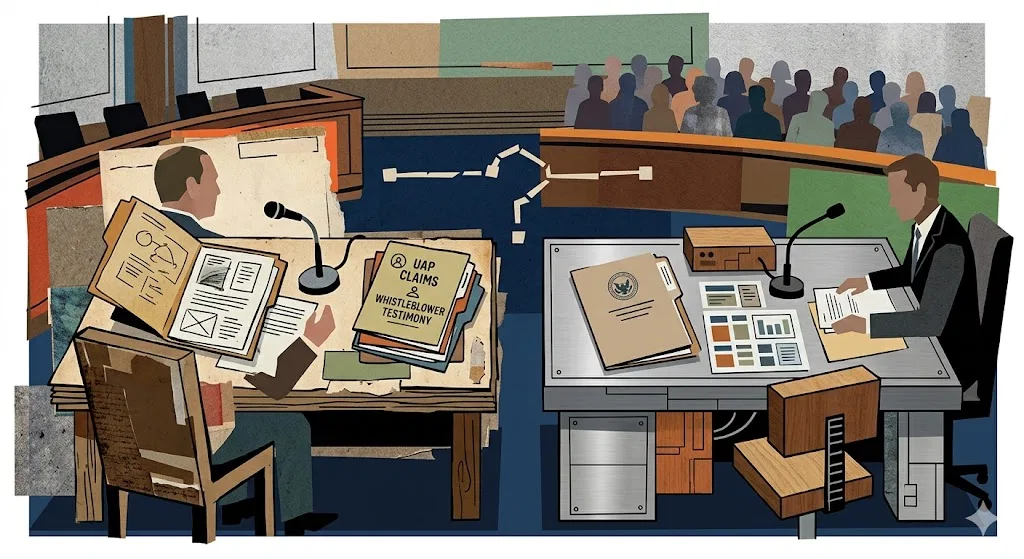
The Grusch contrast shows the clash between whistleblower-linked claims and Kirkpatrick's demand for verifiable evidence.
On this page
- What Grusch alleged in public
- What AARO said it could verify
- Second hand claims and classified limits
Page outline Jump by section
Introduction
David Grusch became the clearest public counterpoint to Sean Kirkpatrick’s AARO-era scepticism. Grusch alleged that the US government has concealed a long-running UAP crash-retrieval and reverse-engineering programme involving craft of “non-human” origin, while AARO under Kirkpatrick said it had found no verifiable evidence that such programmes had ever existed. The clash matters because it is not simply “believer versus sceptic”: it is a conflict between whistleblower-linked claims said to be constrained by classification, and an official review process that demanded documents, programmes, materials, names and testable leads.[oversight.house.gov]oversight.house.govOpening StatementJuly 23, 2023 — 25 Jul 2023 — My name is David Charles Grusch. I was an intelligence officer for 14 years, both in the US Air. Force (USA…
The strongest public reading is cautious. Grusch’s credentials and use of formal complaint channels make his allegations more serious than ordinary UFO rumour, but his most dramatic claims remain publicly unproven and largely second-hand. AARO’s denial is more concrete on what it says it checked, but public confidence is limited by the fact that many underlying records, access determinations and interviews remain classified or anonymised. The dispute therefore sits at the centre of Kirkpatrick’s credibility problem: whether he represents disciplined evidential restraint, institutional minimisation, or both in different ways.
What Grusch alleged in public
Grusch’s public case emerged in June 2023 and then moved into a formal congressional setting in July 2023. In his written opening statement to the House Oversight hearing, he described himself as a former US Air Force intelligence officer and National Geospatial-Intelligence Agency official who had worked on UAP issues and who had referred information to oversight channels. His central claim was that, during his official duties, he was informed of a “multi-decade” UAP crash-retrieval and reverse-engineering programme to which he had been denied access.[oversight.house.gov]oversight.house.govExecutive Director Read moreImplications on National Security, Public Safety, and…26 Jul 2023 — Unidentified Anomalous Phenomena: Implications on National Securit…
The core allegations can be separated into three levels of strength:
First, the institutional allegation. Grusch claimed that information about UAP-related programmes had been improperly withheld from Congress and that elements of the US government had hidden programmes involving recovered craft. This is the part of his case most directly tied to oversight, whistleblower law and classified access, rather than to public proof of aliens.
Second, the technology allegation. He alleged that the US government, sometimes in connection with private aerospace contractors, had recovered intact or partially intact craft of “non-human” origin and had attempted to reverse-engineer them. This is the claim that most directly contradicted AARO’s public findings.[Vanity Fair]vanityfair.comVanity FairWhy 'The New York Times,' 'The Washington Post,' and…June 8, 2023 — 8 Jun 2023 — In the story, a former intelligence offici…
Third, the biological and intimidation allegations. At the hearing, Grusch said he had been told that “non-human biologics” had been recovered from alleged craft and suggested that people had been harmed or threatened in connection with concealment. These were among the most striking claims, but also among the least publicly evidenced, because he repeatedly indicated that details would have to be provided in a classified setting.[Time]time.comSource details in endnotes.
For a credibility assessment, the crucial point is that Grusch did not publicly present a recovered object, a photograph with clear chain of custody, a programme budget line, a named contractor record, or a declassified document proving non-human technology. His testimony relied heavily on what he said he had been told by people with access, plus information he said he had provided through protected channels.

What AARO said it could verify
AARO’s answer, under and after Kirkpatrick’s leadership, was not merely that it had not seen aliens. It said it had pursued specific claims and found that they did not verify. In its 2024 historical report, AARO stated that it found no empirical evidence that the US government or private companies had reverse-engineered extraterrestrial technology, and no evidence that any US government investigation, academic research effort or official review panel had confirmed a UAP sighting as extraterrestrial technology.[AARO]aaro.milAARO Historical Record Report VolAARO_Historical_Record_Repor…6 Mar 2024 — AARO found no empirical evidence for claims that the USG and private companies have been…
The report is important because it addressed the class of allegations Grusch made, even where it did not publicly frame every finding as a direct response to him by name. AARO said it had investigated named people, known locations, alleged documents, companies, technological tests and claimed programmes. Its conclusion was that the relevant claims were either unsupported, misidentified, connected to authentic but non-UAP classified programmes, or associated with proposed efforts that never became successful alien-technology programmes.[AARO]aaro.milEFOIA Reading RoomEFOIA Reading Room
Several AARO findings are especially relevant to the Grusch clash:
- AARO said it had found no authentic UAP-related non-disclosure agreement threatening death or violence for disclosure.
- It said executives, scientists and chief technology officers at named companies denied, on the record, possessing or reverse-engineering extraterrestrial technology.
- It said a material sample alleged to be from an off-world craft was a manufactured terrestrial alloy with no exceptional qualities.
- It said one proposed programme, KONA BLUE, was a prospective special access programme supported by people who believed the government was hiding off-world technology, but it was not approved and produced no empirical evidence.
- It said an intelligence-community controlled access programme had briefly been expanded in 2021 to protect UAP reverse-engineering language, but that it never recovered or reverse-engineered UAP or extraterrestrial craft and was later disestablished for lack of merit.[AARO]aaro.milAARO Historical Record Report VolAARO_Historical_Record_Repor…6 Mar 2024 — AARO found no empirical evidence for claims that the USG and private companies have been…
This is where Kirkpatrick’s credibility is strongest: AARO gave a falsifiable style of denial. It did not simply say “trust us”. It said it looked for named programmes, checked named companies, reviewed alleged documents and tested alleged material. That is more evidentially useful than a broad press-office dismissal.
Yet the denial still has limits. The public cannot independently inspect all classified programme searches, interview memoranda or access records. AARO’s report anonymised many people and organisations. For sceptical readers, that is normal national-security practice. For Grusch’s supporters, it leaves room to argue that AARO could have missed, been blocked from, or been institutionally steered away from the most sensitive compartments.
Why the dispute became personal for Kirkpatrick
Kirkpatrick’s role made him the public face of a negative finding. Grusch’s supporters saw him as denying claims that they believed had already been validated through inspector-general or congressional channels. Kirkpatrick, by contrast, argued after leaving government that AARO had encountered repeated allegations circulating among a small network of UAP advocates rather than evidence of alien technology. In a January 2024 Scientific American essay, he said the forthcoming investigative record found no evidence of aliens, but did find repeated claims passed around by UFO advocates.[Scientific American]scientificamerican.comScientific American Here's What I Learned as the U.S. Government's UFO HunterScientific American Here's What I Learned as the U.S. Government's UFO Hunter
This matters because the argument is partly about epistemology: what counts as evidence? Grusch’s side places weight on high-clearance witnesses, protected disclosures, alleged classified testimony and the idea that public proof is impossible until Congress forces declassification. Kirkpatrick’s side places weight on empirical traceability: records, materials, programme access, data, budgets, names and testable claims. Neither approach is neutral. Whistleblower systems often begin with testimony, but extraordinary technology claims require stronger public substantiation than testimony alone.
The dispute also exposed a public-relations asymmetry. Grusch could say that the strongest details were classified. AARO could say it had checked those details, but could not show the full classified audit trail. That left the public watching two authority claims collide: an intelligence whistleblower saying “I gave the evidence to the right people”, and the official investigator saying “we checked and it did not hold up”.
Second-hand claims and classified limits
The most important credibility distinction is first-hand versus second-hand knowledge. Grusch did not publicly claim that he personally worked on an alien craft, handled non-human biological material, or saw a reverse-engineering laboratory. His public claim was that he interviewed or received information from people he considered credible, including people he said had direct knowledge. That makes his testimony potentially important as a lead-generation mechanism, but weaker as public proof.[oversight.house.gov]oversight.house.govRyan HOC TestimonyRyan HOC Testimony
AARO leaned heavily on this weakness. Its historical report said none of the interviewees who described hidden reverse-engineering programmes had first-hand knowledge of those programmes: they had not been approved for access and had not worked on the alleged efforts. AARO assessed that this probably led to misinterpretation of authentic, sensitive national-security programmes as alien or UAP-related programmes.[AARO]aaro.milEFOIA Reading RoomEFOIA Reading Room
That finding does not automatically prove every whistleblower-linked concern false. Classified systems can create real oversight failures, and people outside a compartment may still learn true information indirectly. But it does change the burden. If the claim is that the US government possesses non-human craft and biologics, then second-hand reports are not enough for public verification. They are leads, not settled evidence.
The classified setting also cuts both ways. It may explain why Grusch could not publicly provide names, locations and documents. But classification can also protect weak claims from scrutiny, because outsiders cannot see whether the hidden details are specific and corroborated or vague and circular. A serious assessment has to hold both possibilities at once.
The strongest argument for taking Grusch seriously
The strongest pro-Grusch argument is not that he publicly proved alien technology. He did not. The stronger argument is that a former intelligence official with relevant UAP task-force exposure used formal channels, testified under oath, and made claims that some members of Congress considered serious enough to pursue through hearings, proposed legislation and requests for access. The House Oversight Committee’s July 2023 hearing treated UAP transparency as a matter of national security, public safety and government accountability, not merely popular entertainment.[oversight.house.gov]oversight.house.govTestimony Dr. Tim GallaudetTestimony Dr. Tim Gallaudet
Supporters also argue that AARO’s failure to verify a programme does not necessarily disprove an illegally hidden or misreported compartment. If a programme were concealed from ordinary oversight, they say, then a conventional search through declared channels might miss it. This is why Grusch’s allegations were politically potent: they were framed not just as “aliens exist”, but as “Congress may have been denied lawful knowledge of hidden programmes”.
A fair version of this argument does not require accepting every dramatic claim. It says that Grusch’s testimony justified further oversight because the alleged misconduct, if true, would be serious even before the non-human claim is resolved. On that view, the main issue is not whether the public has already seen proof of alien craft, but whether Congress has had full access to the records, people and programmes needed to test the allegation.
The strongest argument for AARO’s denial
The strongest pro-AARO argument is that extraordinary claims became weaker, not stronger, when pushed towards verification. AARO said it looked for the specific programmes, companies, people, materials and documents identified by interviewees and found no empirical support for the hidden alien-technology narrative. It also offered mundane or institutional explanations for several claim pathways: misidentified classified programmes, circular reporting among believers, failed or proposed UAP-related efforts, and ordinary materials mistaken for exotic debris.[AARO]aaro.milEFOIA Reading RoomEFOIA Reading Room
AARO’s position is reinforced by NASA’s independent UAP study, which did not find conclusive evidence in the peer-reviewed scientific literature for an extraterrestrial origin of UAP and emphasised the need for better data, standardised reporting and scientific analysis. NASA’s stance does not adjudicate Grusch’s classified programme claims, but it supports Kirkpatrick’s broader evidential caution: unexplained does not mean extraterrestrial, and weak data cannot carry an extraordinary conclusion.[NASA Science]science.nasa.govScience Independent Study Team ReportScience Independent Study Team Report
The best sceptical reading is therefore not that all UAP witnesses are lying or that all unexplained cases are trivial. It is that Grusch’s most dramatic allegations have not crossed the evidential threshold required to establish recovered non-human technology. AARO’s denial is credible insofar as it engaged with specific leads and found no verifiable trail.
What remains unresolved
The unresolved zone is narrower than the public debate often suggests. It is not unresolved whether Grusch has publicly proven alien crash retrievals; he has not. It is not unresolved whether AARO publicly claims to have found no evidence; it clearly does. What remains unresolved is whether classified evidence exists outside the public record that would significantly change the assessment.
Three questions still matter:
Did Congress receive enough classified detail to test Grusch’s claims independently? Public hearings showed interest, but the public record does not establish that all alleged witnesses, documents and programme names were fully examined in a way outsiders can audit.
Was AARO’s access genuinely complete? AARO said it was granted full, unrestricted access by relevant organisations. Critics question whether any office inside the defence establishment can reliably audit the most sensitive alleged wrongdoing by that same establishment. That concern is plausible as a governance worry, but it is not itself evidence of alien technology.[AARO]aaro.milEFOIA Reading RoomEFOIA Reading Room
Are the same claims being independently corroborated, or merely repeated? AARO’s “circular reporting” claim is central. If multiple witnesses independently identify the same recoverable records, materials or budget structures, Grusch’s case strengthens. If witnesses are repeating stories from the same small network without direct access, AARO’s scepticism strengthens.
Credibility takeaway for Sean Kirkpatrick
The Grusch clash is the key stress test for Sean Kirkpatrick’s public credibility. If a reader values public, verifiable evidence, Kirkpatrick comes out stronger: AARO articulated a clear standard, pursued specific categories of leads, and found no empirical support for recovered extraterrestrial technology. If a reader distrusts classified institutions, Kirkpatrick’s position remains less satisfying, because the public cannot fully inspect the classified basis for AARO’s denial.
The fairest conclusion is that Kirkpatrick’s denial is stronger than Grusch’s public proof, but not as emotionally or politically final as believers and sceptics often pretend. Grusch raised serious oversight allegations and did so through channels that deserve examination. But the non-human craft and biologics claims remain unverified in public. AARO’s denial directly challenges them with a more evidence-based record, while still asking the public to accept that classified searches were complete and competent.
For assessing Kirkpatrick, this episode shows both his value and his vulnerability. His value lies in insisting that extraordinary UAP claims be reduced to checkable evidence: names, programmes, materials, documents and data. His vulnerability lies in representing an institution whose secrecy makes even well-founded denials hard to prove publicly. The result is not a clean victory for either side, but a clear evidential hierarchy: Grusch’s allegations are important leads and politically consequential claims; AARO’s denials are the stronger public record unless and until classified corroboration becomes inspectable.
Amazon book picks
Further Reading
No matched book cards were available for Grusch Claims Versus Kirkpatrick's Denial, so this fallback keeps a direct Amazon reading path visible.
Topical books
UFO research books
Browse books, explainers and reference titles related to this topic.
Search AmazonRelated search
UFO sightings books
Browse books, explainers and reference titles related to this topic.
Search AmazonRelated search
UAP books
Browse books, explainers and reference titles related to this topic.
Search AmazoneBay marketplace picks
Marketplace Samples
Example marketplace items related to this page. Use the search link to explore similar finds on eBay.



Endnotes
1.
Source: oversight.house.gov
Title: Opening Statement
Link:https://oversight.house.gov/wp-content/uploads/2023/07/Dave_G_HOC_Speech_FINAL_For_Trans.pdf
Source snippet
July 23, 2023 — 25 Jul 2023 — My name is David Charles Grusch. I was an intelligence officer for 14 years, both in the US Air. Force (USA...
Published: July 23, 2023
2.
Source: aaro.mil
Title: AARO Historical Record Report Vol 1 2024
Link:https://www.aaro.mil/Portals/136/PDFs/AARO_Historical_Record_Report_Vol_1_2024.pdf
Source snippet
AARO_Historical_Record_Repor...6 Mar 2024 — AARO found no empirical evidence for claims that the USG and private companies have been...
3.
Source: oversight.house.gov
Title: Executive Director Read more
Link:https://oversight.house.gov/hearing/unidentified-anomalous-phenomena-implications-on-national-security-public-safety-and-government-transparency/
Source snippet
Implications on National Security, Public Safety, and...26 Jul 2023 — Unidentified Anomalous Phenomena: Implications on National Securit...
4.
Source: time.com
Link:https://time.com/6298287/congress-ufo-hearing/
5.
Source: science.nasa.gov
Title: Science Independent Study Team Report
Link:https://science.nasa.gov/wp-content/uploads/2023/09/uap-independent-study-team-final-report.pdf
6.
Source: docs.house.gov
Title: HHRG 118 GO12 Wstate ShellenbergerM 20241113
Link:https://docs.house.gov/meetings/GO/GO12/20241113/117721/HHRG-118-GO12-Wstate-ShellenbergerM-20241113.pdf
7.
Source: oversight.house.gov
Title: Ryan HOC Testimony
Link:https://oversight.house.gov/wp-content/uploads/2023/07/Ryan-HOC-Testimony.pdf
8.
Source: oversight.house.gov
Title: Testimony Dr. Tim Gallaudet
Link:https://oversight.house.gov/wp-content/uploads/2024/11/Testimony-Dr.-Tim-Gallaudet.pdf
9.
Source: oversight.house.gov
Title: Written Testimony Shellenberger
Link:https://oversight.house.gov/wp-content/uploads/2024/11/Written-Testimony-Shellenberger.pdf
10.
Source: science.nasa.gov
Link:https://science.nasa.gov/uap/faqs/
11.
Source: science.nasa.gov
Link:https://science.nasa.gov/uap/
12.
Source: aaro.mil
Title: EFOIA Reading Room
Link:https://www.aaro.mil/EFOIA-Reading-Room/
13.
Source: vanityfair.com
Link:https://www.vanityfair.com/news/2023/06/ufo-report-media?srsltid=AfmBOoohABKM18O3tKeX7LViCk6uYec9DlYJ-2Mx3uqhq1DMb7LfbHlm
Source snippet
Vanity FairWhy 'The New York Times,' 'The Washington Post,' and...June 8, 2023 — 8 Jun 2023 — In the story, a former intelligence offici...
Published: June 8, 2023
14.
Source: scientificamerican.com
Title: Scientific American Here’s What I Learned as the U.S. Government’s UFO Hunter
Link:https://www.scientificamerican.com/article/heres-what-i-learned-as-the-u-s-governments-ufo-hunter/
15.
Source: scientificamerican.com
Title: the governments former ufo hunter has a lot to say
Link:https://www.scientificamerican.com/podcast/episode/the-governments-former-ufo-hunter-has-a-lot-to-say/
16.
Source: scientificamerican.com
Link:https://www.scientificamerican.com/author/sean-kirkpatrick/
Additional References
17.
Source: youtube.com
Link:https://www.youtube.com/watch?v=ifpLXP0poug
Source snippet
5 UFO whistleblowers: Lue Elizondo calls David Grusch a 'hero' | Reality Check with Ross Coulthart...
18.
Source: youtube.com
Link:https://www.youtube.com/watch?v=OV-SQkEGIDw
Source snippet
3 UFO whistleblower: 'Non-human biologics' found on crashed craft...
19.
Source: youtube.com
Title: UFO whistleblower: ‘Non-human biologics’ found on crashed craft
Link:https://www.youtube.com/watch?v=9wHyoEOyT6Q
Source snippet
4 Pentagon UFO investigator: Extraterrestrial 'technical surprise' is top concern | ABCNL...
20.
Source: war.gov
Title: department of defense releases the annual report on unidentified anomalous phen
Link:https://www.war.gov/News/Releases/Release/Article/3964824/department-of-defense-releases-the-annual-report-on-unidentified-anomalous-phen/
21.
Source: dni.gov
Title: 3733 2023 consolidated annual report on unidentified anomalous phenomena
Link:https://www.dni.gov/index.php/newsroom/reports-publications/reports-publications-2023/3733-2023-consolidated-annual-report-on-unidentified-anomalous-phenomena
22.
Source: facebook.com
Link:https://www.facebook.com/itvnews/posts/a-nasa-report-into-unidentified-flying-objects-ufos-has-found-no-evidence-that-t/686500760179269/
23.
Source: facebook.com
Link:https://www.facebook.com/NBCNews/posts/a-ufo-whistleblower-claims-that-the-us-government-has-evidence-of-non-human-biol/677702834221585/
24.
Source: facebook.com
Link:https://www.facebook.com/NewsNationNow/posts/a-former-navy-pilot-says-claims-that-the-government-is-withholding-information-a/3632150787008480/
25.
Source: facebook.com
Link:https://www.facebook.com/deepuniversee/posts/a-former-us-intelligence-officer-david-grusch-gave-sworn-testimony-before-congre/965963276201561/
26.
Source: facebook.com
Link:https://www.facebook.com/BusinessToday/posts/a-former-us-intelligence-officer-david-grusch-said-the-us-government-is-in-posse/690378133136568/
Topic Tree
Follow this branch
Parent topic
KirkpatrickRelated pages 7
- AARO Report Did AARO Close The Crash Retrieval Story?
- AARO Role How Much Authority Did AARO Give Him?
- Core Claims What Did Kirkpatrick Actually Claim?
- Senate Hearing Why Did 650 UAP Cases Matter?
- Sensor Data Why Better Sensors Change UAP Claims
- Supporters Why Sceptics Think Kirkpatrick Was Needed
- Transparency Can The Public Trust A Classified Review?