Within Transparency
What did AARO actually check?
Critics argued that AARO's claimed access to restricted programmes mattered less because the public could not inspect the search trail.
On this page
- Why compartmented programmes became the central objection
- What AARO said about its access
- What a public audit trail would need to show
Page outline Jump by section
Introduction
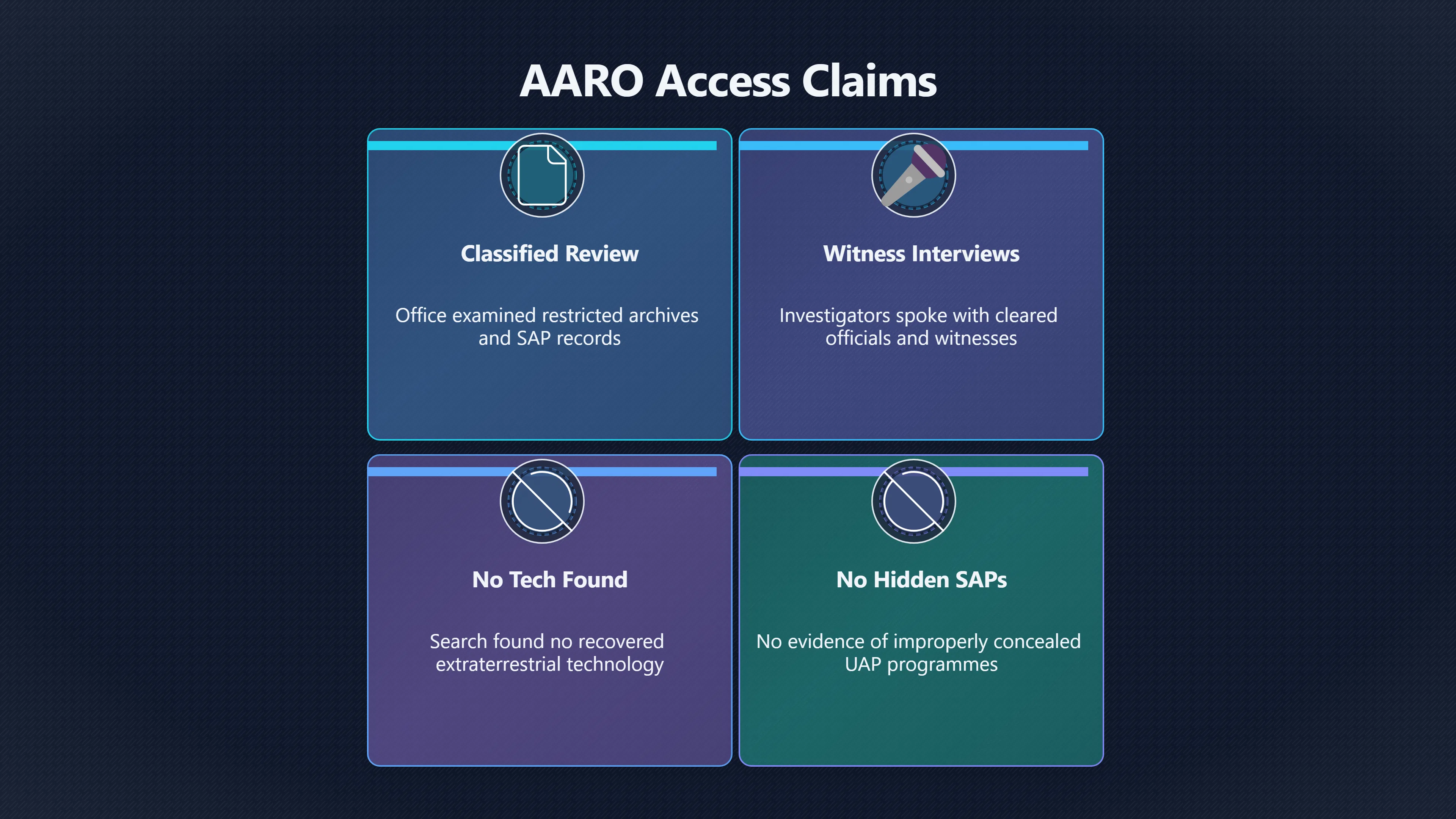
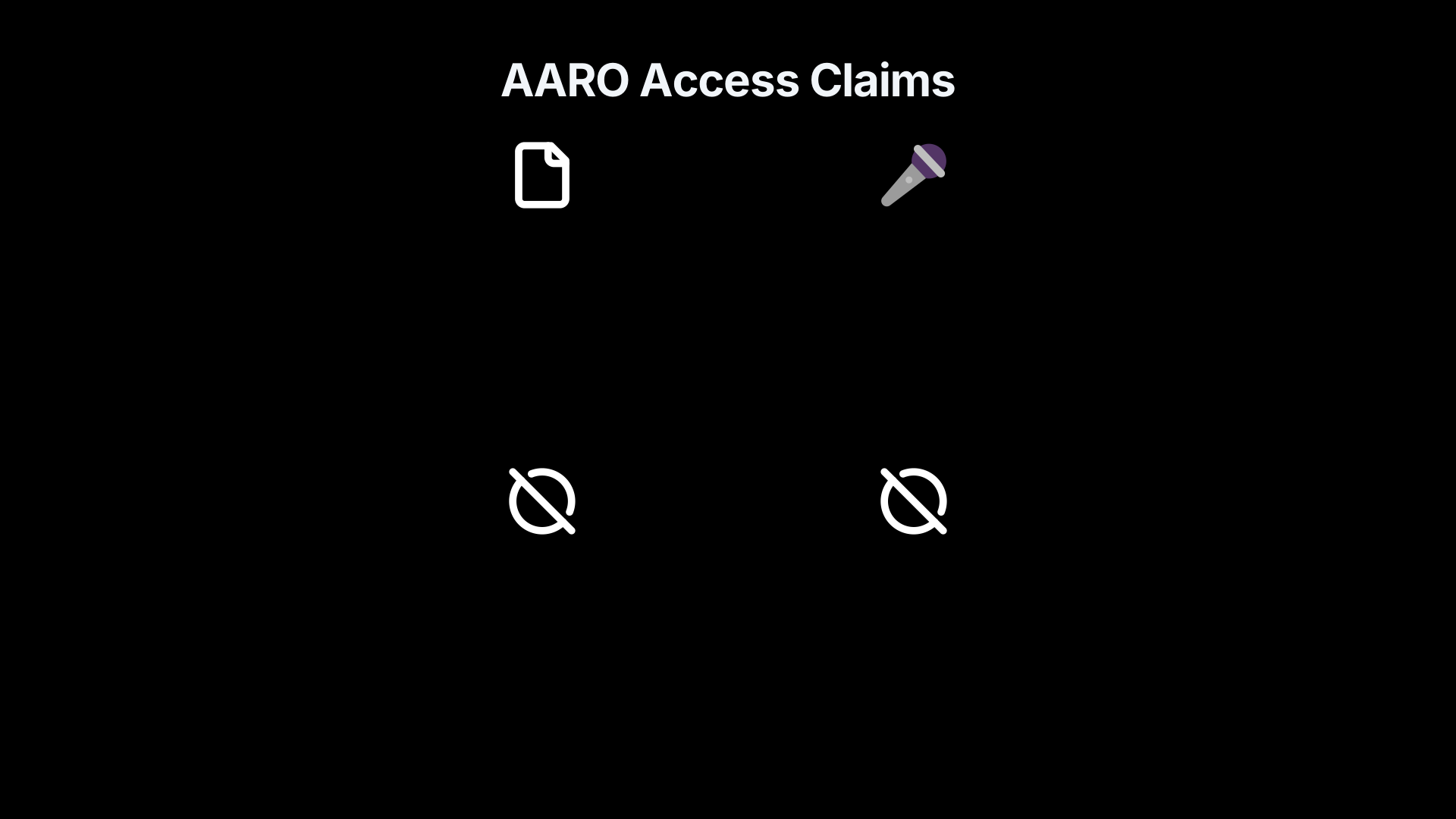
One of the most specific transparency criticisms directed at Sean Kirkpatrick’s tenure at the All-domain Anomaly Resolution Office (AARO) concerns neither his scientific qualifications nor the office’s formal authority. It concerns the audit trail. AARO stated that it examined classified and unclassified records, interviewed witnesses, and worked with officials responsible for overseeing highly restricted programmes, including Special Access Programmes (SAPs). It then concluded that it found no evidence of a hidden UAP reverse-engineering effort, no verified extraterrestrial technology, and no indication that relevant UAP programmes had been improperly concealed from Congress.[aaro.mil]aaro.milAARO Historical Record Report VolAARO_Historical_Record_Repor…6 Mar 2024 — Nexus of Proponents of the USG UAP Reverse-Engineering Allegation. AARO found no empirical ev…
 For critics, however, the central problem is that the public cannot independently verify what was searched, which programmes were examined, which leads were rejected, or how deeply investigators penetrated compartmented systems. The dispute is therefore less about whether AARO claimed to have looked and more about whether outsiders can reconstruct what it actually checked.
Why compartmented programmes became the central objection
Special Access Programmes occupy a unique place in the UAP debate because they are designed to restrict information beyond ordinary classification channels. Access is granted only to specifically authorised individuals, and programme details are often compartmented so that even cleared personnel may not know the full scope of an activity.
This matters because some prominent UAP allegations, including those made by former intelligence officer David Grusch, centred on claims that information about recovered technology or reverse-engineering efforts existed within deeply restricted government and contractor environments. If such allegations were true, critics argue, the relevant evidence would be expected to reside in exactly the kinds of compartments that are difficult for outsiders to inspect.[Time]time.comintelligence official, testified before Congress, alleging that the U.S. government has been concealing a longstanding program focused on…
The resulting argument is straightforward:
- AARO’s conclusions carry weight because the office was granted access unavailable to the public.
- Yet the same secrecy that enables access prevents independent verification.
- Therefore, outsiders must largely rely on institutional assurances rather than an inspectable evidential trail.
This is not necessarily an accusation that AARO failed to investigate. Rather, it is a challenge to the public’s ability to verify that the investigation reached every relevant compartment.
What AARO said about its access
AARO repeatedly stated that its historical review involved classified and unclassified archives, interviews, and cooperation with officials responsible for controlled-access and special-access programme oversight. The office characterised its review as broad and designed to examine allegations that hidden UAP-related programmes existed inside government or contractor structures.[aaro.mil]aaro.milUAP Records/Information Papers13 Feb 2026 — The All-domain Anomaly Resolution Office (AARO) first learned of the KONA BLUE program from interviews c…
The March 2024 Historical Record Report went further. It stated that AARO found no empirical evidence that any government, private-sector, academic, or military effort had recovered extraterrestrial technology. It also reported no evidence that UAP-related Special Access Programmes existed outside proper congressional reporting channels.[2U.S. Department of War]media.defense.govDOPSR 2024 0263 AARO HISTORICAL RECORD REPORT VOLUMEU.S. Department of WarAARO Historical Record Report Volume 18 Mar 2024 — Although AARO continues to conduct interviews, research programs…
AARO additionally concluded that many allegations traced back to misunderstandings, misidentified classified programmes, folklore that developed around genuine secret projects, or what it described as circular reporting among individuals who believed hidden reverse-engineering programmes existed.[aaro.mil]aaro.milAARO Historical Record Report VolAARO_Historical_Record_Repor…6 Mar 2024 — Nexus of Proponents of the USG UAP Reverse-Engineering Allegation. AARO found no empirical ev…
From Kirkpatrick’s perspective, this access was precisely why AARO’s findings should be taken seriously. The office was created by Congress partly to examine claims that ordinary investigators could not easily reach because they involved classified systems and compartmented records.[Wikipedia]WikipediaAll-domain Anomaly Resolution OfficeAll-domain Anomaly Resolution Office
The missing audit trail problem
The transparency objection arises because AARO’s public reports describe outcomes rather than providing a detailed chain of verification.
A conventional public audit often leaves behind a visible trail: documents reviewed, databases searched, witnesses interviewed, methodologies used, rejected hypotheses, and decision records. In the UAP case, much of that information remains inaccessible because revealing it could itself expose classified programme structures.
Critics therefore ask questions that the public report cannot fully answer:
- Which specific SAPs were examined?
- Which programme names were checked?
- How were contractor-held records searched?
- Were any compartments inaccessible even to AARO investigators?
- How were negative findings documented?
- Which whistleblower claims were fully investigated versus preliminarily assessed?
The public cannot independently inspect those steps. As a result, AARO’s findings function largely as institutional testimony about what happened inside classified spaces rather than as a publicly reproducible investigation.
Importantly, this criticism does not automatically invalidate AARO’s conclusions. A classified review can be rigorous and still leave little public evidence behind. The criticism instead concerns verifiability. Outsiders cannot easily distinguish between a comprehensive search and an incomplete one because the underlying search process is mostly hidden.
Kona Blue as a revealing example
One reason the audit-trail issue became so prominent is the disclosure of the proposed “Kona Blue” programme.
AARO reported that it uncovered records showing that advocates had attempted to establish a Department of Homeland Security Special Access Programme focused on alleged recovered non-human technology. According to AARO, the proposal was ultimately rejected because supporters failed to provide empirical evidence for their claims. The office presented Kona Blue as an example of how stories about hidden UAP programmes could develop from real but unsuccessful bureaucratic efforts.[Wikipedia]WikipediaAll-domain Anomaly Resolution OfficeAll-domain Anomaly Resolution Office[The Guardian]theguardian.comConducted by the All-Domain Anomaly Resolution Office (AARO), the investigation reviewed historical data and conducted interviews with of…
For supporters of AARO, Kona Blue demonstrated that investigators were genuinely reaching into restricted programme channels and uncovering obscure historical material.
For critics, the episode demonstrated something different: AARO could disclose details when it chose to do so, yet most programme-review activity remained opaque. The public learned about one programme proposal but not the full universe of searches that supposedly led to broader negative conclusions.
Thus, Kona Blue became evidence for both sides of the debate. It showed access, but it also highlighted how little of the underlying review process remained visible.
What a public audit trail would need to show
The strongest transparency critics generally do not argue that every classified record should be released. Instead, they argue that confidence would increase if more of the investigative pathway were visible.
A stronger public audit trail might include:
- A clearer description of how programme searches were conducted.
- Independent verification by inspectors general, congressional committees, or cleared external reviewers.
- Documentation showing how specific allegations were traced and resolved.
- Aggregate information about how many compartments, programmes, archives, or contractors were examined.
- Greater disclosure of how investigators determined that named allegations referred to ordinary classified activities rather than hidden UAP efforts.
Such measures would not necessarily settle the debate. People who believe evidence remains hidden could still argue that critical compartments were missed. However, they would narrow the gap between “trust us, we checked” and “here is a visible record of what was checked.”
What this means for assessing Kirkpatrick’s credibility
The audit-trail dispute is ultimately a credibility question rather than a technical question about extraterrestrial life.
Kirkpatrick’s defenders argue that his conclusions deserve weight precisely because he occupied a position with access to classified systems, special-access oversight channels, and government records unavailable to most commentators. AARO’s findings were not casual opinions but the result of an authorised investigation.[2U.S. Department of War]media.defense.govDOPSR 2024 0263 AARO HISTORICAL RECORD REPORT VOLUMEU.S. Department of WarAARO Historical Record Report Volume 18 Mar 2024 — Although AARO continues to conduct interviews, research programs…
Critics respond that access alone does not eliminate the need for transparency. If the public cannot inspect the search path, they cannot independently judge whether the investigation was exhaustive, whether institutional blind spots existed, or whether sensitive compartments were reviewed adequately.
As a result, the disagreement over Special Access Programmes is not simply a disagreement about UFOs. It is a disagreement about evidential standards. AARO asked the public to accept conclusions drawn from restricted systems. Critics accepted that those systems were restricted but questioned whether the resulting investigation left enough of an audit trail to justify confidence in its final verdict.
Amazon book picks
Further Reading
No matched book cards were available for What did AARO actually check?, so this fallback keeps a direct Amazon reading path visible.
Topical books
UFO research books
Browse books, explainers and reference titles related to this topic.
Search AmazonRelated search
UFO sightings books
Browse books, explainers and reference titles related to this topic.
Search AmazonRelated search
UAP books
Browse books, explainers and reference titles related to this topic.
Search AmazoneBay marketplace picks
Marketplace Samples
Example marketplace items related to this page. Use the search link to explore similar finds on eBay.


![Listing image for Dorothea Lange/W. Miller WWII National Archives Prints [3] Japanese Civiilians](https://i.ebayimg.com/images/g/ygUAAeSwJ~dpY~Zo/s-l225.jpg)
Endnotes
1.
Source: aaro.mil
Title: AARO Historical Record Report Vol 1 2024
Link:https://www.aaro.mil/Portals/136/PDFs/AARO_Historical_Record_Report_Vol_1_2024.pdf
Source snippet
AARO_Historical_Record_Repor...6 Mar 2024 — Nexus of Proponents of the USG UAP Reverse-Engineering Allegation. AARO found no empirical ev...
2.
Source: war.gov
Title: dod report discounts sightings of extraterrestrial technology
Link:https://www.war.gov/News/News-Stories/Article/Article/3701297/dod-report-discounts-sightings-of-extraterrestrial-technology/
Source snippet
Department of WarDOD Report Discounts Sightings of Extraterrestrial...8 Mar 2024 — AARO has found no indications that any information wa...
3.
Source: time.com
Link:https://time.com/6298287/congress-ufo-hearing/
Source snippet
intelligence official, testified before Congress, alleging that the U.S. government has been concealing a longstanding program focused on...
4.
Source: war.gov
Title: usdis ronald moultrie and dr sean kirkpatrick media roundtable on the all domai
Link:https://www.war.gov/News/Transcripts/Transcript/Article/3249303/usdis-ronald-moultrie-and-dr-sean-kirkpatrick-media-roundtable-on-the-all-domai/
Source snippet
Department of WarUSD(I&S) Ronald Moultrie and Dr. Sean Kirkpatrick Media...16 Dec 2022 — In July, we established the All-domain Anomaly...
5.
Source: Wikipedia
Title: All-domain Anomaly Resolution Office
Link:https://en.wikipedia.org/wiki/All-domain_Anomaly_Resolution_Office
6.
Source: aaro.mil
Title: UAP Records
Link:https://www.aaro.mil/UAP-Records/
Source snippet
/Information Papers13 Feb 2026 — The All-domain Anomaly Resolution Office (AARO) first learned of the KONA BLUE program from interviews c...
7.
Source: media.defense.gov
Title: DOPSR 2024 0263 AARO HISTORICAL RECORD REPORT VOLUME 1 2024
Link:https://media.defense.gov/2024/Mar/08/2003409233/-1/-1/0/DOPSR-2024-0263-AARO-HISTORICAL-RECORD-REPORT-VOLUME-1-2024.PDF
Source snippet
U.S. Department of WarAARO Historical Record Report Volume 18 Mar 2024 — Although AARO continues to conduct interviews, research programs...
8.
Source: theguardian.com
Link:https://www.theguardian.com/world/2024/mar/08/pentagon-ufo-report-hiding-aliens
Source snippet
Conducted by the All-Domain Anomaly Resolution Office (AARO), the investigation reviewed historical data and conducted interviews with of...
Additional References
9.
Source: nypost.com
Link:https://nypost.com/2024/10/09/us-news/pentagon-denies-report-claiming-to-reveal-name-of-top-secret-ufo-program-for-the-first-time/
Source snippet
The allegations were made public by journalist Michael Shellenberger. Pentagon spokesperson Sue Gough stated that there is no record of s...
10.
Source: youtube.com
Link:https://www.youtube.com/watch?v=ZoSZA7Meneg
Source snippet
Live: Congress holds hearing on UFOs after whistleblowers claim government kept information secret...
11.
Source: youtube.com
Link:https://www.youtube.com/watch?v=lNiPCV6cAP4
Source snippet
Whistleblower opening statement in House hearing on alleged covert government UAP program...
12.
Source: youtube.com
Link:https://www.youtube.com/watch?v=bi0H_mkwTW0
Source snippet
What a Pentagon Scientist Found Out About UFOs with Dr. Sean Kirkpatrick...
13.
Source: youtube.com
Title: What a Pentagon Scientist Found Out About UFOs with Dr. Sean Kirkpatrick
Link:https://www.youtube.com/watch?v=VyK46wdMJkQ
Source snippet
Historic [Senate Hearing]({{ 'senate-hearing/' | relative_url }}) on #UAP & #AARO, Dr. Sean Kirkpatrick Testifies #EmergingThreats #Disclosure...
14.
Source: youtube.com
Link:https://www.youtube.com/watch?v=EXri0KF2oZY
Topic Tree