Within Grusch
What Did the Whistleblower Process Prove?
The inspector-general and congressional process shows seriousness, but it does not publicly validate alien-retrieval claims.
On this page
- Urgent concern and retaliation context
- Congressional briefings and frustration
- Serious channel versus confirmed facts
Page outline Jump by section
Introduction
David Grusch’s whistleblower process proved something narrower, but still important, than many headlines implied. It showed that his allegations were serious enough to enter protected intelligence-community reporting channels, reach inspectors general and Congress, and help force a governance debate about whether UAP-related information had been kept outside proper oversight. It did not publicly prove that the United States possesses recovered non-human craft, biological remains, or a hidden reverse-engineering programme.
That distinction is the key to judging Grusch fairly. His formal complaints moved his story out of ordinary UFO media and into the machinery of classified oversight. They also gave supporters a reason to say the case deserved investigation rather than dismissal. But the public record still separates the process from the truth of the most extraordinary claims. An inspector-general pathway can validate that a whistleblower has made a protected disclosure, or that an allegation warrants lawful handling; it does not, by itself, establish that every factual claim inside the allegation is true. Grusch himself framed the matter as a congressional oversight issue based largely on information he said others had given him.[house]oversight.house.govDavid Fravor Statement for House Oversight CommitteeDavid Fravor Statement for House Oversight Committee
What Grusch’s complaint actually put into the system
Grusch’s July 2023 House opening statement is the cleanest public statement of how he wanted readers and lawmakers to understand the whistleblower route. He said he became a whistleblower through a Presidential Policy Directive 19 “urgent concern” filing with the Intelligence Community Inspector General after receiving reports from current and former military and intelligence-community figures that the US government was operating with secrecy “above Congressional oversight” on UAPs. He also said his testimony was based on information given to him by others, including alleged photographs, official documents and classified oral testimony, and that he had tried to corroborate it over four years.[house]oversight.house.govDavid Fravor Statement for House Oversight CommitteeDavid Fravor Statement for House Oversight Committee
The governance claim was therefore central from the start. Grusch was not only saying “there are extraordinary objects”; he was saying that information, funding, access and classified programmes had allegedly been structured in a way that prevented Congress from exercising proper oversight. In his statement, he said he had been tasked in 2019 to identify Special Access Programmes and Controlled Access Programmes relevant to the UAP Task Force’s congressionally mandated mission, and that he was later informed of a multi-decade crash-retrieval and reverse-engineering programme to which he was denied access.[house]oversight.house.govDavid Fravor Statement for House Oversight CommitteeDavid Fravor Statement for House Oversight Committee
That matters because an oversight complaint is judged differently from a public proof claim. A whistleblower can be reporting suspected unlawful concealment, misuse of funds, reprisal or denial of access. The inspector-general process can then become a route for classified names, locations, programme titles or witness identities to be provided lawfully. It does not require those details to be made public, and it does not automatically turn the underlying allegations into verified public facts.
Why “urgent concern” sounds stronger than it proves
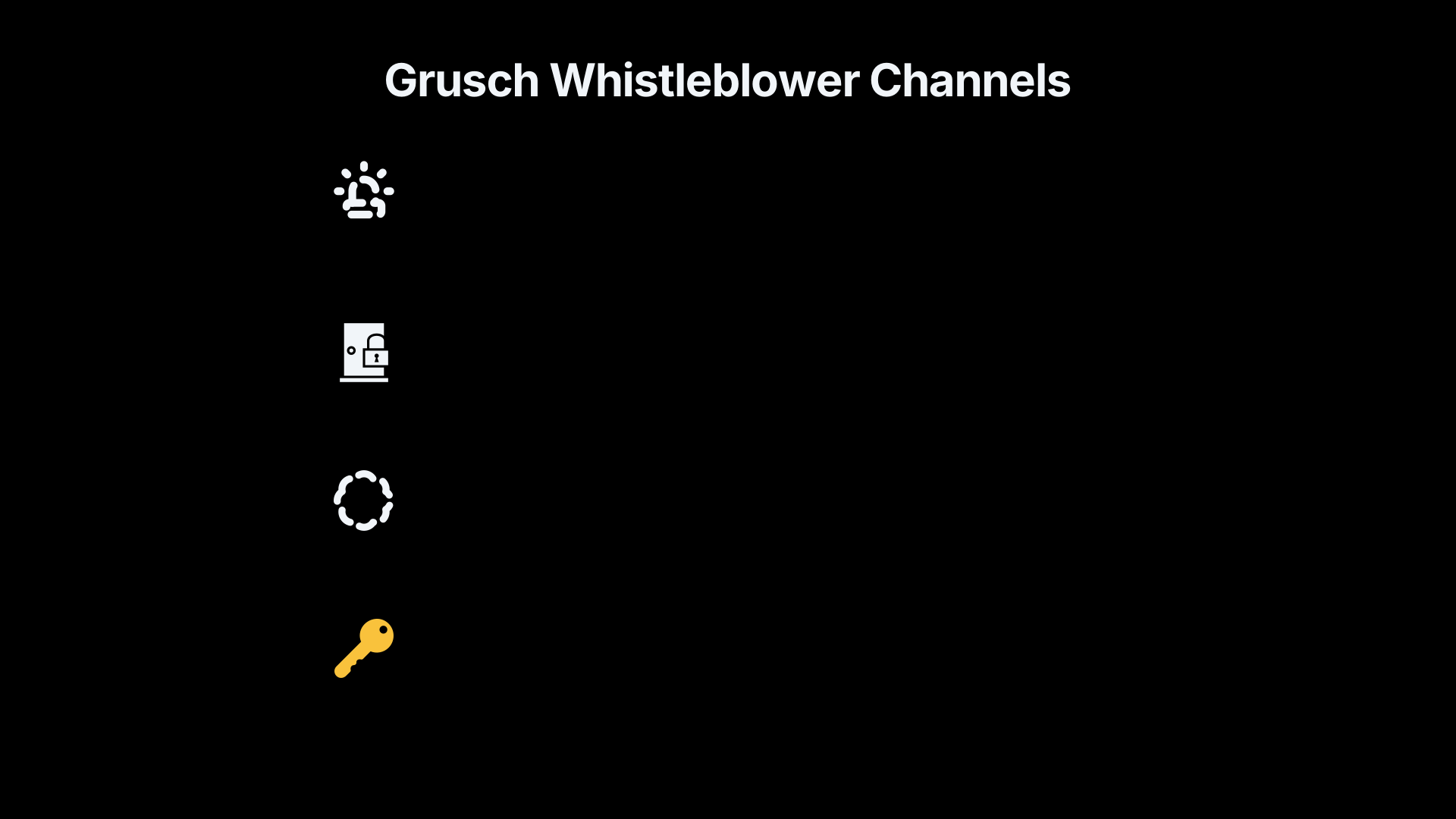
The phrase “urgent concern” has become one of the most misunderstood parts of the Grusch story. In intelligence-community rules, it is a legal and procedural category, not a stamp saying “the aliens are real”. ODNI guidance says an intelligence employee, assignee, detailee or contractor who wants to report an urgent concern to Congress may report it to the Intelligence Community Inspector General. The ICIG then has a statutory timeframe to decide whether the complaint or information appears credible and, if so, to transmit it to the Director of National Intelligence; the DNI then has a further timeframe to forward it to the congressional intelligence committees.[ODNI]odni.govSource details in endnotes.
ODNI’s own explanation defines an urgent concern broadly. It can include a serious or flagrant problem relating to the funding, administration or operation of an intelligence activity involving classified information; a false statement or wilful withholding from Congress on a material intelligence issue; or reprisal in response to an employee reporting such a concern.[Director of National Intelligence]dni.govSource details in endnotes.
That definition fits the governance aspect of Grusch’s claims much more directly than the alien-retrieval aspect. If officials were withholding classified UAP-related information from Congress, misusing appropriations, retaliating against a protected discloser, or blocking lawful access by oversight bodies, that could be an urgent concern even if the disputed programmes later turned out to involve misunderstood conventional technology. The category is about whether the complaint belongs in protected oversight channels, not whether the most spectacular interpretation is already established.
Retaliation claims changed the credibility question
Grusch’s public testimony included a second thread: he said he suffered retaliation after reporting what he had learned. That claim matters because retaliation is independently relevant to whistleblower credibility and institutional behaviour. If a complainant is punished for using lawful channels, that can be a serious problem even if investigators have not yet proved every underlying claim. ODNI guidance states that intelligence-community protections prohibit personnel actions and security-clearance determinations taken in reprisal for lawful disclosures, and that the ICIG may receive and investigate reprisal complaints from intelligence-community employees and contractors.[Director of National Intelligence]dni.govSource details in endnotes.
For readers assessing Grusch, this creates two separate questions:
- Was Grusch legally and procedurally entitled to report his concerns? The public record strongly supports that he used recognised channels rather than simply leaking classified material.
- Were his retaliation claims substantiated in a way the public can inspect? The public record is much thinner. Some filings and summaries have circulated, but the underlying classified material, witness identities and investigative conclusions are not available in a complete public form.
- Would retaliation prove the crash-retrieval claim? No. It could show institutional hostility, mishandling or fear around classified access, but it would not by itself prove the alleged non-human origin of any material.
This is why the complaint process raises Grusch’s seriousness without settling the case. It makes him harder to dismiss as merely a media personality, because he used a formal route designed for classified allegations. But it also leaves readers dependent on institutions whose outputs are partly secret and whose public statements do not yet converge.
Congressional briefings showed seriousness and frustration
The House Oversight Committee hearing on 26 July 2023 gave Grusch’s allegations a public congressional stage. The committee’s hearing page lists Grusch as a witness and identifies him as a former National Reconnaissance Office representative to the UAP Task Force, alongside Ryan Graves and retired Commander David Fravor.[house]oversight.house.govDavid Fravor Statement for House Oversight CommitteeDavid Fravor Statement for House Oversight Committee
At the hearing and in later reporting, the key governance issue was access. Grusch indicated that he could provide specific names and locations in a closed setting, not in open session. That answer satisfied supporters who saw it as proof that he was respecting classification rules. It frustrated sceptics who wanted public evidence rather than further classified claims. It also exposed a practical problem: if the case depends on special-access programme names, witness identities and contractor locations, most of the material needed to test it may sit behind the very classification barriers that Grusch says are part of the problem.
That tension continued after the hearing. In January 2024, House lawmakers received a classified briefing from Intelligence Community Inspector General Thomas Monheim about UAP reporting transparency. CBS News reported that members emerged still frustrated in their effort to obtain more information about Grusch’s claims; the briefing confirmed continuing official interest, but did not publicly disclose decisive new evidence validating the crash-retrieval allegations.[CBS News]cbsnews.comCBS News Lawmakers investigating UAPs, or UFOs, remain frustratedCBS News Lawmakers investigating UAPs, or UFOs, remain frustrated
This is the oversight process in miniature: it creates pressure, hearings, classified briefings and legislative attention, but the public often sees only the shadow of the evidence. For credibility, that cuts both ways. Supporters can say Grusch’s allegations are being taken seriously by the right institutions. Sceptics can reply that repeated briefings without public corroboration should not be treated as confirmation.

The official process did not equal official validation
The biggest mistake in many discussions of Grusch is treating “he filed a whistleblower complaint” as if it means “the government confirmed his claims”. Those are different propositions.
The process can support several more modest conclusions. It can show that Grusch had a lawful route to report classified concerns, that the subject reached inspectors general and lawmakers, and that Congress had enough concern to hold hearings and seek briefings. It can also show that UAP oversight had become a real institutional issue rather than only a fringe public debate. But it cannot, on the currently public evidence, show that the alleged recovered non-human craft exist.
The strongest official rebuttal is the Pentagon’s All-domain Anomaly Resolution Office historical report, released in March 2024. AARO said it found no evidence that any US government investigation, academic-sponsored research or official review panel had confirmed a UAP sighting as extraterrestrial technology. It also said it found no empirical evidence that the US government or private companies had reverse-engineered extraterrestrial technology, and that many claims involving specific people, places, tests and documents were inaccurate.[U.S. Department of War]media.defense.govU.S. Department of War AARO Historical Record Report Volume 1U.S. Department of War AARO Historical Record Report Volume 1(#endnote-5 “Endnote 5”)
AARO’s report went further than a generic denial. It said some authentic classified programmes had been mistakenly associated with alien or extraterrestrial activity, that named company executives denied possessing or reverse-engineering off-world technology, and that a sample alleged to come from an off-world craft was a manufactured terrestrial alloy. It also said the interviewees it reviewed did not have first-hand knowledge of the alleged programmes and were not approved for access to them.[U.S. Department of War]media.defense.govU.S. Department of War AARO Historical Record Report Volume 1U.S. Department of War AARO Historical Record Report Volume 1(#endnote-5 “Endnote 5”)
That does not end every dispute. Grusch’s supporters argue that AARO may not have had access to the right compartments, may have been misled, or may not have engaged properly with all relevant whistleblowers. But as public evidence, AARO’s report is a major counterweight: it is an official review explicitly addressing the same family of hidden reverse-engineering claims and finding no empirical support.
What changed in Congress after the complaints
Grusch’s whistleblower route helped shift the UAP debate from sightings and stigma towards records, access and accountability. One visible result was the Senate push for a UAP records disclosure framework. In July 2023, Senators Chuck Schumer and Mike Rounds introduced legislation modelled on the JFK assassination records process, directing the National Archives to create a UAP Records Collection and requiring government offices to identify relevant records.[senate]democrats.senate.govDemocratic Leadership Schumer, Rounds Introduce New Legislation To DeclassifyDemocratic Leadership Schumer, Rounds Introduce New Legislation To Declassify
The proposed UAP Disclosure Act language was striking because it assumed that government UAP records existed and that an enforceable disclosure process was needed. The amendment text argued that legislation was necessary to create an independent and accountable process for public disclosure and to restore proper oversight over UAP records by elected officials.[senate]democrats.senate.govDemocratic Leadership Schumer, Rounds Introduce New Legislation To DeclassifyDemocratic Leadership Schumer, Rounds Introduce New Legislation To Declassify
The final legislative outcome was narrower than many disclosure advocates wanted. The 2024 National Defense Authorization Act still included UAP record provisions, and the National Archives later described its UAP records collection as fulfilling the NDAA requirement. But the broader proposed machinery, including stronger independent review features, was reduced.[Inside Government Contracts]insidegovernmentcontracts.comInside Government Contracts Implications of the Unidentified Anomalous PhenomenaInside Government Contracts Implications of the Unidentified Anomalous Phenomena
For Grusch’s credibility, this matters in a limited way. The legislation does not prove his central claims, but it shows that his allegations landed during a period when senior lawmakers considered UAP record control and declassification serious enough to legislate around. It moved the question from “Do you believe one whistleblower?” to “Are existing secrecy and records systems adequate for this category of claims?”
A useful way to read the oversight evidence
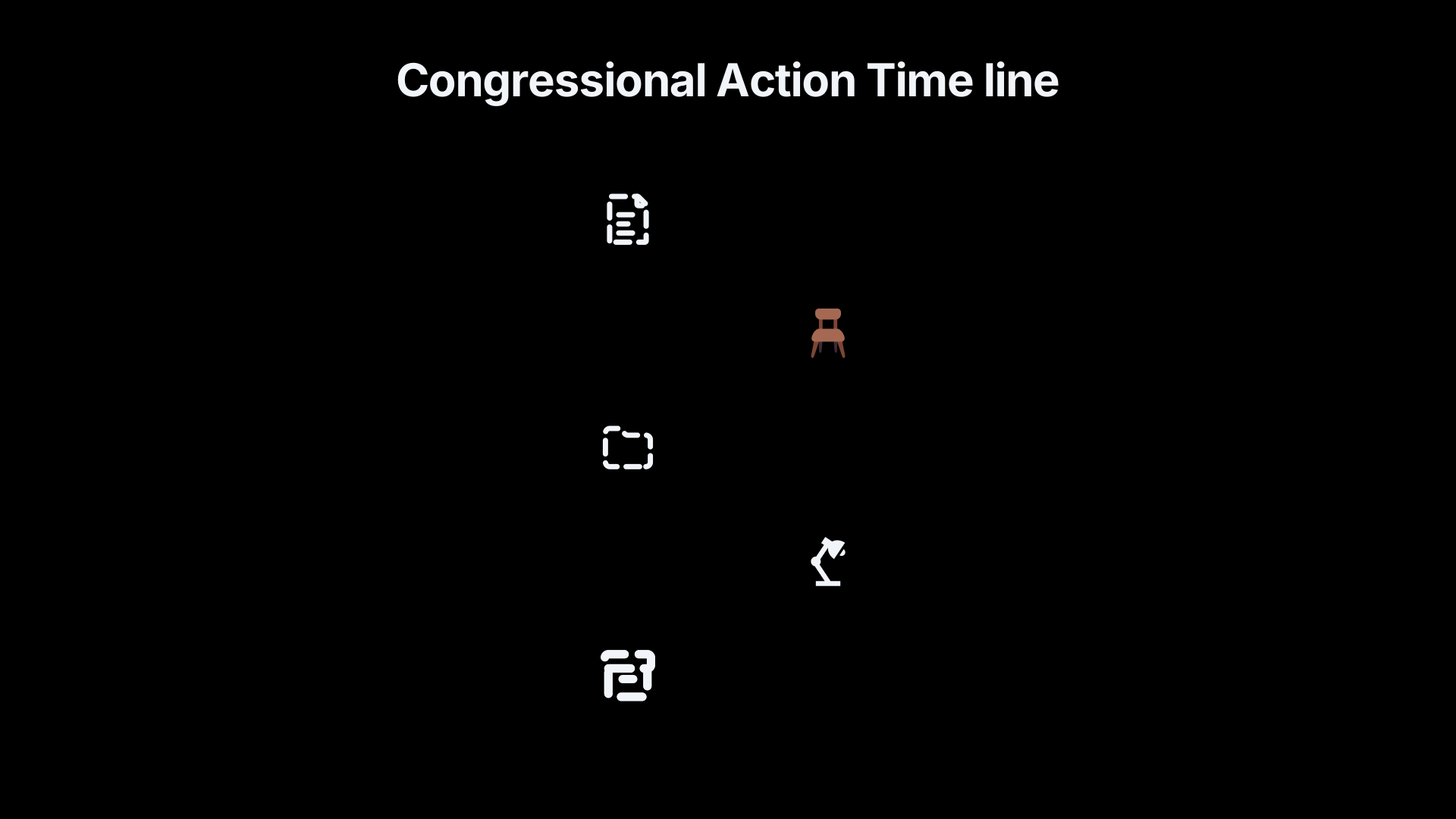
The oversight process is best read in layers.
First layer: verified institutional seriousness. Grusch had relevant intelligence roles, appeared before a House committee, and used protected channels for classified complaints. The House hearing record and his submitted statement support that basic seriousness.[house]oversight.house.govDavid Fravor Statement for House Oversight CommitteeDavid Fravor Statement for House Oversight Committee
Second layer: plausible oversight concern. His allegation that UAP-related information was withheld from Congress fits the kind of issue the urgent-concern framework is designed to route safely. That does not mean the underlying UAP interpretation is correct; it means the alleged withholding, reprisal or access problem is institutionally recognisable.[Director of National Intelligence]dni.govSource details in endnotes.
Third layer: unresolved evidential claim. The extraordinary part — recovered non-human craft, biologics and a long-running reverse-engineering programme — remains unproven in public. Grusch said he was reporting what he had been told by others, while AARO later said it found no empirical evidence for the reverse-engineering narrative and identified misinterpretations of real classified programmes as a likely source of some claims.[house]oversight.house.govDavid Fravor Statement for House Oversight CommitteeDavid Fravor Statement for House Oversight Committee
Fourth layer: contested institutional trust. Supporters distrust AARO and argue that Congress and inspectors general are better routes for hidden classified matters. Sceptics distrust the leap from protected complaint to extraordinary conclusion and point to the lack of public physical evidence, named first-hand custodians or declassified documents. Both reactions are understandable, because the process is partly public and partly sealed.
What the whistleblower process proved
The whistleblower process proved that Grusch was not merely making a casual public UFO claim. He used formal intelligence-community channels, framed his allegations around congressional oversight, and helped push the issue into hearings, classified briefings and legislation. That is a meaningful fact about governance and credibility.
It also proved less than many supporters claim. It did not publicly authenticate recovered craft, non-human biologics, hidden contractor possession, or a successful reverse-engineering programme. A protected disclosure can be sincere, procedurally serious and worth investigating while still containing claims that are mistaken, exaggerated, second-hand or impossible for the public to verify.
The most careful conclusion is therefore balanced: Grusch’s whistleblower complaints increased the legitimacy of asking oversight questions, but they did not settle the factual question at the heart of his story. They made “Who knew what, who had access, and what was withheld from Congress?” a serious public issue. They did not make “the US has recovered non-human technology” an established public fact.
Amazon book picks
Further Reading
Books and field guides related to What Did the Whistleblower Process Prove?. Use these as the next step if you want deeper reading beyond the article.
L' UAP et l'histoire de l'assurance
First published 1990. Subjects: Union des assurances de Paris, Histoire, Assurance, Insurance, History.
Aliança UAP
First published 1995. Subjects: Insurance companies, Aliança UAP (Firm), History.
UAP i Norden
First published 1982. Subjects: Cooperative acquisition of library materials, Interlibrary loans, Library cooperation.
2023 UFO/UAP Calendar
First published 2022. Subjects: Science, Curiosities and wonders.
eBay marketplace picks
Marketplace Samples
Example marketplace items related to this page. Use the search link to explore similar finds on eBay.


Endnotes
1.
Source: oversight.house.gov
Title: Oversight Committee Microsoft Word
Link:https://oversight.house.gov/wp-content/uploads/2023/07/Dave_G_HOC_Speech_FINAL_For_Trans.pdf
2.
Source: dni.gov
Link:https://www.dni.gov/index.php/who-we-are/organizations/icig/icig-related-menus/icig-related-links/making-lawful-disclosures
3.
Source: odni.gov
Link:https://www.odni.gov/index.php/ncsc-what-we-do/194-dni/about-this-site/366-summary-of-procedures-for-reporting-urgent-concerns-pursuant-to-the-icwpa
4.
Source: oversight.house.gov
Link:https://oversight.house.gov/hearing/unidentified-anomalous-phenomena-implications-on-national-security-public-safety-and-government-transparency/
5.
Source: media.defense.gov
Title: U.S. Department of War AARO Historical Record Report Volume 1
Link:https://media.defense.gov/2024/Mar/08/2003409233/-1/-1/0/DOPSR-2024-0263-AARO-HISTORICAL-RECORD-REPORT-VOLUME-1-2024.PDF
6.
Source: democrats.senate.gov
Title: Democratic Leadership Schumer, Rounds Introduce New Legislation To Declassify
Link:https://www.democrats.senate.gov/newsroom/press-releases/schumer-rounds-introduce-new-legislation-to-declassify-government-records-related-to-unidentified-anomalous-phenomena-and-ufos_modeled-after-jfk-assassination-records-collection-act–as-an-amendment-to-ndaa
7.
Source: democrats.senate.gov
Title: Democratic Leadershipuap_amendment.pdf
Link:https://www.democrats.senate.gov/imo/media/doc/uap_amendment.pdf
8.
Source: archives.gov
Title: rfk files uap records april 2025
Link:https://www.archives.gov/news/articles/rfk-files-uap-records-april-2025
Published: april 2025
9.
Source: oversight.house.gov
Title: David Fravor Statement for House Oversight Committee
Link:https://oversight.house.gov/wp-content/uploads/2023/07/David-Fravor-Statement-for-House-Oversight-Committee.pdf
10.
Source: oversight.house.gov
Title: George Knapp Written Testimony
Link:https://oversight.house.gov/wp-content/uploads/2025/09/George-Knapp-Written-Testimony.pdf
11.
Source: oversight.house.gov
Title: Borland Written Testimony
Link:https://oversight.house.gov/wp-content/uploads/2025/09/Borland-Written-Testimony.pdf
12.
Source: oversight.house.gov
Title: Written Testimony Shellenberger
Link:https://oversight.house.gov/wp-content/uploads/2024/11/Written-Testimony-Shellenberger.pdf
13.
Source: oversight.house.gov
Title: Updated Testimony Gallaudet
Link:https://oversight.house.gov/wp-content/uploads/2024/11/Updated-Testimony-Gallaudet.pdf
14.
Source: oversight.house.gov
Link:https://oversight.house.gov/
15.
Source: burchett.house.gov
Title: oversight committee announces uap hearing
Link:https://burchett.house.gov/media/press-releases/house-oversight-committee-announces-uap-hearing
16.
Source: dni.gov
Title: June 2023
Link:https://www.dni.gov/files/documents/FOIA/2023/June_2023.pdf
Published: June 2023
17.
Source: dni.gov
Link:https://www.dni.gov/ICIG-Whistleblower/
18.
Source: dni.gov
Title: disclosure of urgent concern form
Link:https://www.dni.gov/files/ICIG/Documents/Hotline/Urgent%20Concern%20Disclosure%20Form.pdf
19.
Source: cbsnews.com
Title: CBS News Lawmakers investigating UAPs, or UFOs, remain frustrated
Link:https://www.cbsnews.com/news/uap-ufo-briefing-house-inspector-general-intelligence-community/
20.
Source: insidegovernmentcontracts.com
Title: Inside Government Contracts Implications of the Unidentified Anomalous Phenomena
Link:https://www.insidegovernmentcontracts.com/2024/01/implications-of-the-unidentified-anomalous-phenomena-uap-amendment-in-the-2024-national-defense-authorization-act-ndaa/
21.
Source: cbsnews.com
Title: ufo hearing congress uap takeaways whistleblower conference david grusch 2023
Link:https://www.cbsnews.com/news/ufo-hearing-congress-uap-takeaways-whistleblower-conference-david-grusch-2023/
22.
Source: defensescoop.com
Link:https://defensescoop.com/2023/07/25/senate-panel-aims-to-set-a-mandatory-timeline-and-process-for-agencies-to-declassify-all-uap-records/
Additional References
23.
Source: youtube.com
Link:https://www.youtube.com/watch?v=EXri0KF2oZY
Source snippet
WATCH: Whistleblower testifies on claims that US has concealed programs related to UFOs...
24.
Source: youtube.com
Link:https://www.youtube.com/watch?v=OV-SQkEGIDw
Source snippet
UFO whistleblower says U.S. recovered nonhuman "biologics" from crash sites...
25.
Source: facebook.com
Link:https://www.facebook.com/NewsNationNow/posts/pointless-lawmakers-say-they-didnt-learn-anything-in-a-classified-briefing-about/351145500625807/
26.
Source: facebook.com
Link:https://www.facebook.com/wjhlTV11/posts/a-bipartisan-group-of-lawmakers-on-the-house-oversight-committee-say-a-high-prof/609303234648778/
27.
Source: reddit.com
Link:https://www.reddit.com/r/UFOs/comments/1eudu2p/a_reminder_for_all_those_who_are_wondering_where/
28.
Source: facebook.com
Link:https://www.facebook.com/NewsNationNow/posts/a-whistleblower-claims-the-government-has-a-secret-ufo-retrieval-program-house-o/3632967816926777/
29.
Source: ufotransparency.com
Link:https://ufotransparency.com/files/decade-2020s-aaro-historical-record-report-vol1-2024-aaro-historical-record-report-volume
30.
Source: facebook.com
Link:https://www.facebook.com/meawwcom/posts/chuck-schumer-responded-to-the-pentagons-release-of-previously-undisclosed-ufo-f/1303539095240298/
31.
Source: facebook.com
Link:https://www.facebook.com/ndtv/posts/david-grusch-testified-that-he-absolutely-believes-the-government-is-in-possessi/697593472406257/
32.
Source: instagram.com
Link:https://www.instagram.com/reel/DYmp0HEtr9D/
Topic Tree
Follow this branch
Parent topic
GruschRelated pages 7
- AARO How Official Sceptics Explain the Claims
- Background Do Grusch's Credentials Prove His Story?
- Core Claims What Did David Grusch Actually Claim?
- Hearing Why the 2023 Hearing Changed the Story
- Hearsay Why First Hand Evidence Matters Here
- Influence How Grusch Shifted UAP Debate
- Proof Gap Where Is the Public Evidence?