Within Sceptics
When credentials become a shortcut to belief
Green's verified career can make weak claims sound stronger than the public evidence actually allows.
On this page
- What Green's record really verifies
- How authority can inflate second hand claims
- A sceptical test for reputation based evidence
Page outline Jump by section
Introduction
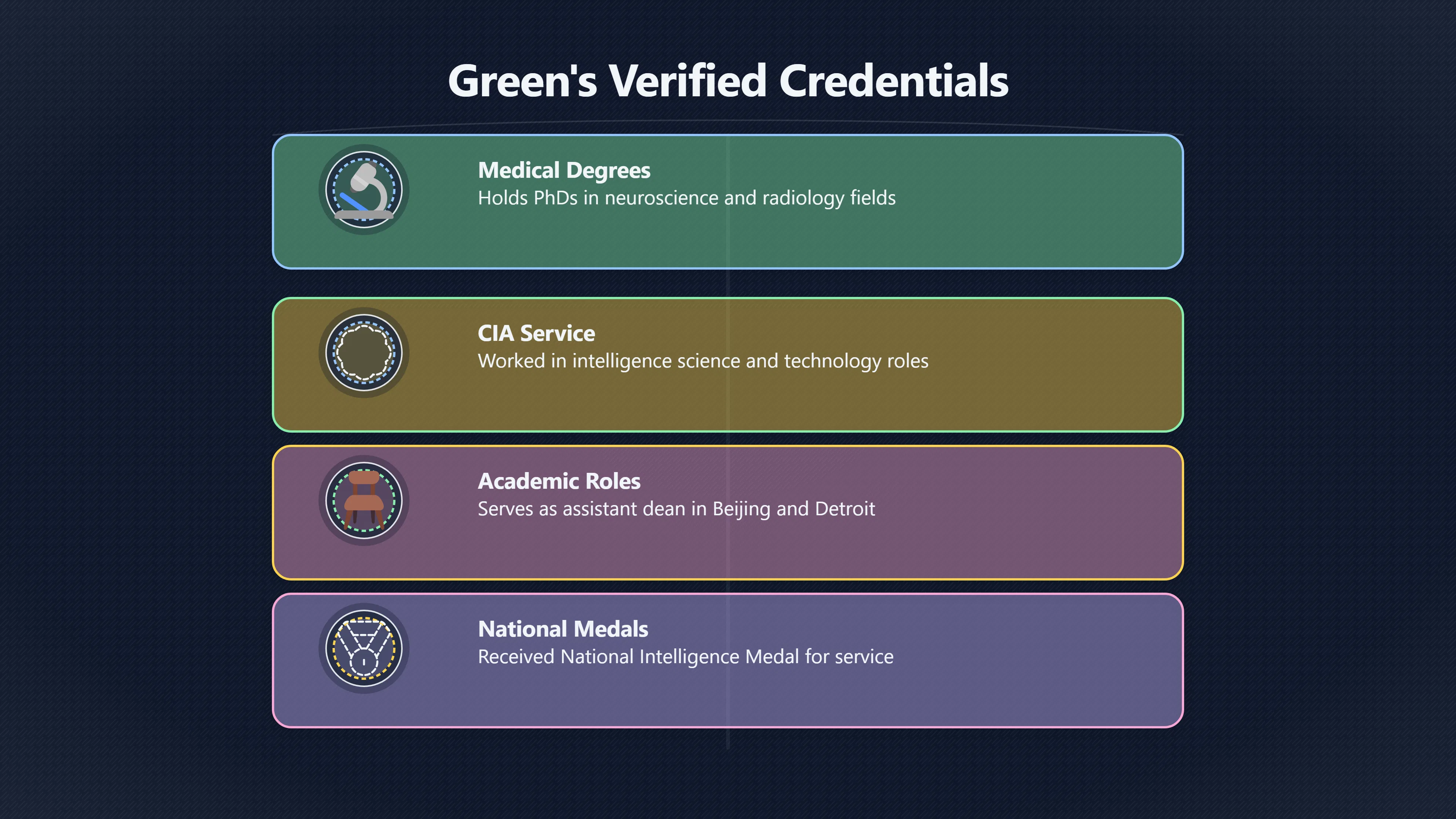
One of the strongest sceptical arguments about Kit Green is not that he lacks credentials, but that his credentials can be used too broadly. Green’s verified career is unusual: he worked in intelligence-related science and technology roles, held senior medical and research positions, and moved through circles that overlapped with national-security discussions about anomalous claims. Those facts are real and publicly documented.[NCBI]ncbi.nlm.nih.govNCBIBiographical Sketches of Committee MembersNIHChristopher C. Green, Chair, is the assistant dean for Asia Pacific of the Wayne State School of Medicine (SOM) in Beijing, China…[Bulletin of the Atomic Scientists]thebulletin.orgBulletin of the Atomic ScientistsChristopher GreenA neuroscientist, Green is a professor of psychiatry and radiology at Wayne State Unive…
 The sceptical concern is what happens next. In UFO and UAP debates, Green’s name is sometimes treated as a shortcut that allows a claim to bypass normal evidential scrutiny. A story may be weakly sourced, heavily second-hand, or lacking physical evidence, yet gain credibility simply because Green reportedly discussed it, investigated it, or took it seriously. Sceptics argue that this mechanism can make readers overestimate what has actually been established.
The question is therefore not whether Green had an impressive career. It is whether that career is being used as evidence for claims that still require independent proof.
What Green’s record really verifies
A sceptical reading starts by separating documented facts from inferred conclusions.
Public biographical records support that Christopher “Kit” Green held significant positions connected to medicine, neuroscience, intelligence analysis and science-and-technology policy. National Academies material identifies him as a senior medical and scientific figure, while other public biographies describe his CIA service and later academic and corporate roles.[PBS]pbs.orgUmbrella Assassin | Interview with Christopher CGreen3 Jun 2014 — At the CIA, Green studied how the brain responds to chemicals and neurological agents, while also investigating foreign…[NCBI]ncbi.nlm.nih.govNCBIBiographical Sketches of Committee MembersNIHChristopher C. Green, Chair, is the assistant dean for Asia Pacific of the Wayne State School of Medicine (SOM) in Beijing, China…[Bulletin of the Atomic Scientists]thebulletin.orgBulletin of the Atomic ScientistsChristopher GreenA neuroscientist, Green is a professor of psychiatry and radiology at Wayne State Unive…
Those records verify several important points:
- Green was not simply a UFO enthusiast operating outside professional institutions.
- He had legitimate access to government, intelligence and scientific environments.
- He possessed expertise in areas such as neurophysiology, toxicology, brain imaging and forensic medicine.
- He was involved in discussions about advanced science and national-security issues.[PBS]pbs.orgUmbrella Assassin | Interview with Christopher CGreen3 Jun 2014 — At the CIA, Green studied how the brain responds to chemicals and neurological agents, while also investigating foreign…[NCBI]ncbi.nlm.nih.govNCBIBiographical Sketches of Committee MembersNIHChristopher C. Green, Chair, is the assistant dean for Asia Pacific of the Wayne State School of Medicine (SOM) in Beijing, China…[Bulletin of the Atomic Scientists]thebulletin.orgBulletin of the Atomic ScientistsChristopher GreenA neuroscientist, Green is a professor of psychiatry and radiology at Wayne State Unive…
What they do not automatically verify is the truth of any particular UFO-related claim.
A common logical leap in UAP debates is:
- Green held important positions.
- Green examined a claim.
- Therefore the claim is probably true.
Sceptics regard that as a non sequitur. Investigating a claim is not the same as validating it. Intelligence analysts routinely examine uncertain, contradictory and sometimes false information. Scientists and physicians likewise investigate unusual reports without assuming the reports are correct.
This distinction becomes especially important when Green is linked to stories involving alleged recovered materials, biological evidence, human effects cases, remote viewing claims or purported insider testimony. His involvement may show that the claim was considered worth examining. It does not show that the claim survived examination.
How authority can inflate second-hand claims
The credibility-shortcut problem becomes most visible when Green appears several steps away from the original evidence.
Many UFO narratives are built from layered testimony:
- A witness claims an event occurred.
- An intermediary repeats the story.
- A researcher summarises it.
- A public figure comments on it.
- An audience member hears that the public figure was involved.
By the end of that process, Green’s name can become attached to the story more strongly than the underlying evidence itself.
A sceptic would ask a simple question: what exactly did Green personally verify?
That question often narrows the claim considerably.
For example, Green’s public reputation is frequently connected to alleged physiological injuries associated with anomalous encounters. In many discussions, this can evolve into an impression that Green confirmed exotic technology or non-human causes. Yet the stronger conclusion does not automatically follow from the weaker one. A physician can document symptoms, evaluate patients or consider unusual cases without proving what caused those symptoms.[UAPedia]uapedia.aiUnlocking New Realities DrChristopher “Kit” Green: A Forensic Neurologist at the…Dr. Christopher “Kit” Green bridges intelligence, neuroscience, and UAP researc… - Unlocking New Realities
The same pattern appears in stories involving classified briefings, insider rumours or alleged government knowledge. Green’s willingness to discuss a report may be interpreted by audiences as confirmation that the report was accurate. Sceptics argue that this confuses attention with validation.
In practical terms, Green’s reputation can function as a form of evidential multiplier. The original evidence remains unchanged, but the perceived credibility increases because a recognised insider is nearby.
Why intelligence credentials carry unusual weight
The effect is amplified because intelligence careers are difficult for outsiders to evaluate.
Most readers can assess a scientific paper, a photograph or a public document at least in principle. Intelligence backgrounds are different. Much of the relevant work is classified, inaccessible or only partially described in public.
That creates a temptation to fill gaps with assumptions.
When audiences hear that Green worked in intelligence-related science and technology roles, they may infer:
- hidden access to decisive evidence;
- knowledge that cannot be publicly revealed;
- confirmation of rumours circulating within government;
- awareness of classified programmes connected to UFO claims.
Some of those possibilities could theoretically be true. The sceptical position is that they remain possibilities rather than demonstrated facts.
The existence of classified access does not tell outsiders what was learned, how reliable the information was, whether competing interpretations existed, or whether the information was later rejected. Intelligence institutions themselves spend enormous effort separating credible reporting from rumours, deception, misunderstandings and analytical errors.[National Security Archive]nsarchive2.gwu.eduNational Security ArchiveScience, Technology and the CIAThe agency's S&T effort has had a dramatic impact on the collection and analysis…
As a result, sceptics argue that “former CIA scientist” can become a rhetorical substitute for evidence. The title carries genuine weight, but the evidential burden still remains where it always was: on documents, witnesses, materials and independently testable claims.
The difference between seriousness and correctness
One reason Green attracts attention is that he appears more serious and technically grounded than many traditional UFO personalities.
That distinction matters. It is reasonable for readers to conclude that Green approached unusual claims differently from someone whose only qualification is enthusiasm for UFOs.
However, sceptics stress that seriousness and correctness are not the same thing.
History contains many examples of highly qualified individuals investigating ideas that later proved mistaken, incomplete or unsupported. Expertise can improve judgement, but it does not eliminate uncertainty. This is particularly true in fields involving fragmentary evidence, classified information and extraordinary claims.
In UFO discussions, the transition from “a serious person considered this possibility” to “the possibility is probably true” often happens quietly. Green’s reputation can accelerate that transition because his professional background signals competence and insider status.
The sceptical warning is not that expertise is irrelevant. It is that expertise should influence how carefully a claim is examined, not determine the outcome before the evidence is reviewed.

A sceptical test for reputation-based evidence
When Green’s name appears in support of a UFO or UAP claim, sceptics typically apply a series of filtering questions.
What is Green’s direct involvement?
Did he witness the event, analyse material, interview participants, receive a briefing, or merely hear the claim from others?
Is the claim first-hand or second-hand?
Many controversial UFO narratives become less persuasive once the chain of transmission is mapped out.
What evidence exists independently of Green?
If Green’s reputation is removed from the story, does the remaining evidence still stand on its own?
Can the claim be checked?
Documents, physical samples, contemporaneous records and named witnesses generally carry more weight than recollections or anonymous reports.
Has Green publicly claimed certainty?
In some cases, audiences attribute stronger conclusions to him than he has personally stated.
This approach does not dismiss Green. Instead, it attempts to prevent reputation from performing the work that evidence is supposed to do.
Why this criticism matters in the wider Kit Green debate
The credibility-shortcut argument sits at the centre of sceptical assessments of Green.
Supporters often point to his career as evidence that unusual claims deserve attention. Sceptics largely agree with that narrower conclusion. A person with Green’s background can be a legitimate reason to look more closely at a subject.
Where the disagreement begins is over how far that inference should travel.
A documented intelligence and medical career can establish access, competence and seriousness. It cannot, by itself, establish alien technology, non-human bodies, secret crash-retrieval programmes or any other extraordinary conclusion frequently associated with modern UFO disclosure narratives.
For sceptics, that is the core lesson of Green’s reputation. His credentials may justify interest. They do not eliminate the need for evidence. When a claim appears convincing mainly because Green’s name is attached to it, rather than because the claim itself is well documented, sceptics see a warning sign that authority may be replacing verification.
Amazon book picks
Further Reading
Books and field guides related to When credentials become a shortcut to belief. Use these as the next step if you want deeper reading beyond the article.
The Demon-Haunted World
Directly addresses authority, evidence and scientific reasoning.
Why People Believe Weird Things
Explores why authority and anecdote can become substitutes for evidence.
eBay marketplace picks
Marketplace Samples
Example marketplace items related to this page. Use the search link to explore similar finds on eBay.



Endnotes
1.
Source: ncbi.nlm.nih.gov
Title: NCBIBiographical Sketches of Committee Members
Link:https://www.ncbi.nlm.nih.gov/books/NBK207949/
Source snippet
NIHChristopher C. Green, Chair, is the assistant dean for Asia Pacific of the Wayne State School of Medicine (SOM) in Beijing, China...
2.
Source: pbs.org
Title: Umbrella Assassin | Interview with Christopher C
Link:https://www.pbs.org/wnet/secrets/umbrella-assassin-interview-christopher-c-green/1557/
Source snippet
Green3 Jun 2014 — At the CIA, Green studied how the brain responds to chemicals and neurological agents, while also investigating foreign...
3.
Source: uapedia.ai
Title: Unlocking New Realities Dr
Link:https://www.uapedia.ai/wiki/dr-christopher-kit-green-a-forensic-neurologist-at-the-edge-of-the-uap-problem/
Source snippet
Christopher “Kit” Green: A Forensic Neurologist at the...Dr. Christopher “Kit” Green bridges intelligence, neuroscience, and UAP researc...
4.
Source: cia.gov
Link:https://www.cia.gov/readingroom/document/cia-rdp87m01007r000400810001-4
Source snippet
READINGS IN INTELLIGENCE | CIA FOIA (foia.cia.gov)Such a conception of the potential of the presidency is alien to most students of the A...
5.
Source: thebulletin.org
Link:https://thebulletin.org/biography/christopher-green/
Source snippet
Bulletin of the Atomic ScientistsChristopher GreenA neuroscientist, Green is a professor of psychiatry and radiology at Wayne State Unive...
6.
Source: nsarchive2.gwu.edu
Link:https://nsarchive2.gwu.edu/NSAEBB/NSAEBB54/index2.html
Additional References
7.
Source: Wikipedia
Link:https://en.wikipedia.org/wiki/Central_Intelligence_Agency
Source snippet
Central Intelligence AgencyA major member of the United States Intelligence Community (IC), the CIA has reported to the director of na...
8.
Source: fetzer-franklin-fund.org
Link:https://www.fetzer-franklin-fund.org/media/christopher-green/
Source snippet
Christopher Green | PersonAs Holder of the National Intelligence Medal, and Lifetime Member of the National Research Council and the Nati...
9.
Source: reddit.com
Link:https://www.reddit.com/r/UFOs/comments/pv5xx7/leaked_call_between_cia_dr_kit_green_psychic/
Source snippet
LEAKED call between CIA Dr. Kit Green & Psychic-...Here are the key notes: there exist a leaked phone call. It will be linked below. Rem...
10.
Source: nationalacademies.org
Link:https://www.nationalacademies.org/units/DEPS-AFSB
Source snippet
Intelligence Community Studies BoardThe Intelligence Community Studies Board (ICSB) will serve as the convening authority for the discuss...
11.
Source: facebook.com
Link:https://www.facebook.com/groups/481151978650301/posts/2569743463124465/
Source snippet
Skinwalker RanchInteresting post by George Knapp: Davis' NIDS colleague, Dr. Kit Green, the former CIA analyst with Life Sciences Divisio...
12.
Source: facebook.com
Link:https://www.facebook.com/fossbytes/posts/a-wall-street-journal-investigation-has-revealed-that-the-us-defense-department-/1147102957457747/
Source snippet
Department of Defense has reportedly spread UFO misinformation for years. Former...Read more...
13.
Source: intelligence.senate.gov
Title: sites default files commission report
Link:https://www.intelligence.senate.gov/wp-content/uploads/2024/08/sites-default-files-commission-report.pdf
Source snippet
of the National Commission2.1 The Office of the Director of National Intelligence must create a new joint program plan between the Direct...
14.
Source: youtube.com
Title: Here are the released videos from Pentagon’s first batch of UFO files
Link:https://www.youtube.com/watch?v=ADMcelTgWYo
Source snippet
The Pentagon report: UFO sightings left witnesses with burns, nerve damage video highlights how official reports tracking clinical sympto...
15.
Source: oversight.house.gov
Title: Written Testimony Shellenberger
Link:https://oversight.house.gov/wp-content/uploads/2024/11/Written-Testimony-Shellenberger.pdf
Source snippet
house.govWritten-Testimony-Shellenberger.pdf13 Nov 2023 — CIA urged the debunking of UFO sightings as cover of its efforts to develop cra...
16.
Source: facebook.com
Link:https://www.facebook.com/groups/ufoupdates/posts/10155939640796790/
Source snippet
Aviary and any evidence that they are involved with TTSA et al.Read more...
Topic Tree