Within Remote Viewing
Did Star Gate Validate Remote Viewing?
The Star Gate record shows official interest in remote viewing, while its scientific meaning remained sharply disputed.
On this page
- What the CIA programme actually tested
- Why Utts and Hyman disagreed
- How disputed results affect Green's credibility
Page outline Jump by section
Introduction
The Star Gate programme is frequently cited in UFO and UAP discussions as if it settled the question of remote viewing. It did not. What the declassified record actually shows is that parts of the US intelligence community funded and tested claims of anomalous perception for more than two decades, then commissioned an external review because they remained uncertain whether the results were real, useful, or both.[CIA]cia.govAN EVALUATION OF THE REMOTE VIEWING PROGRAMgoals, the CIA contracted with the American Institutes for Research to supervise and conduc…
 That distinction matters when assessing figures such as Kit Green. Green’s links to early remote-viewing networks can support the claim that he operated around genuine intelligence programmes investigating unusual subjects. They do not automatically support stronger claims that psychic perception was proven, operationally reliable, or scientifically validated. The central problem is not whether Star Gate existed. It did. The problem is what its mixed results actually mean.
What The CIA Programme Actually Tested
The public image of Star Gate often blurs together several different questions. The programme was not simply asking whether psychics existed. It was attempting to determine whether individuals claiming unusual perceptual abilities could provide information useful to intelligence operations under controlled conditions.
The effort evolved through multiple phases involving Stanford Research Institute (SRI), later contractors, military personnel, civilian participants, and different experimental protocols. Intelligence agencies wanted to know whether a person could describe a distant location, object, facility, or event without ordinary sensory access. If the phenomenon worked reliably enough, it could theoretically become an intelligence collection tool.[CIA]cia.govistics at the University of California/Davis, and Dr.Read more…[Wikipedia]WikipediaStargate Project (U.S. Army unitStargate Project (U.S. Army unit)The Stargate Project's work primarily involved remote viewing, the purported ability to psychically "…
This created two separate evaluation questions:
- Was there a measurable statistical effect in laboratory experiments?
- Did the effect produce actionable intelligence in real-world operations?
Those questions are often treated as identical in popular discussions, but the 1995 review treated them separately. A laboratory anomaly, even if genuine, would not necessarily mean intelligence usefulness. Conversely, a few apparently successful operational cases would not automatically prove a paranormal mechanism.[CIA]cia.govAN EVALUATION OF THE REMOTE VIEWING PROGRAMgoals, the CIA contracted with the American Institutes for Research to supervise and conduc…
The distinction became the centre of the programme’s final controversy.
Why Utts And Hyman Disagreed
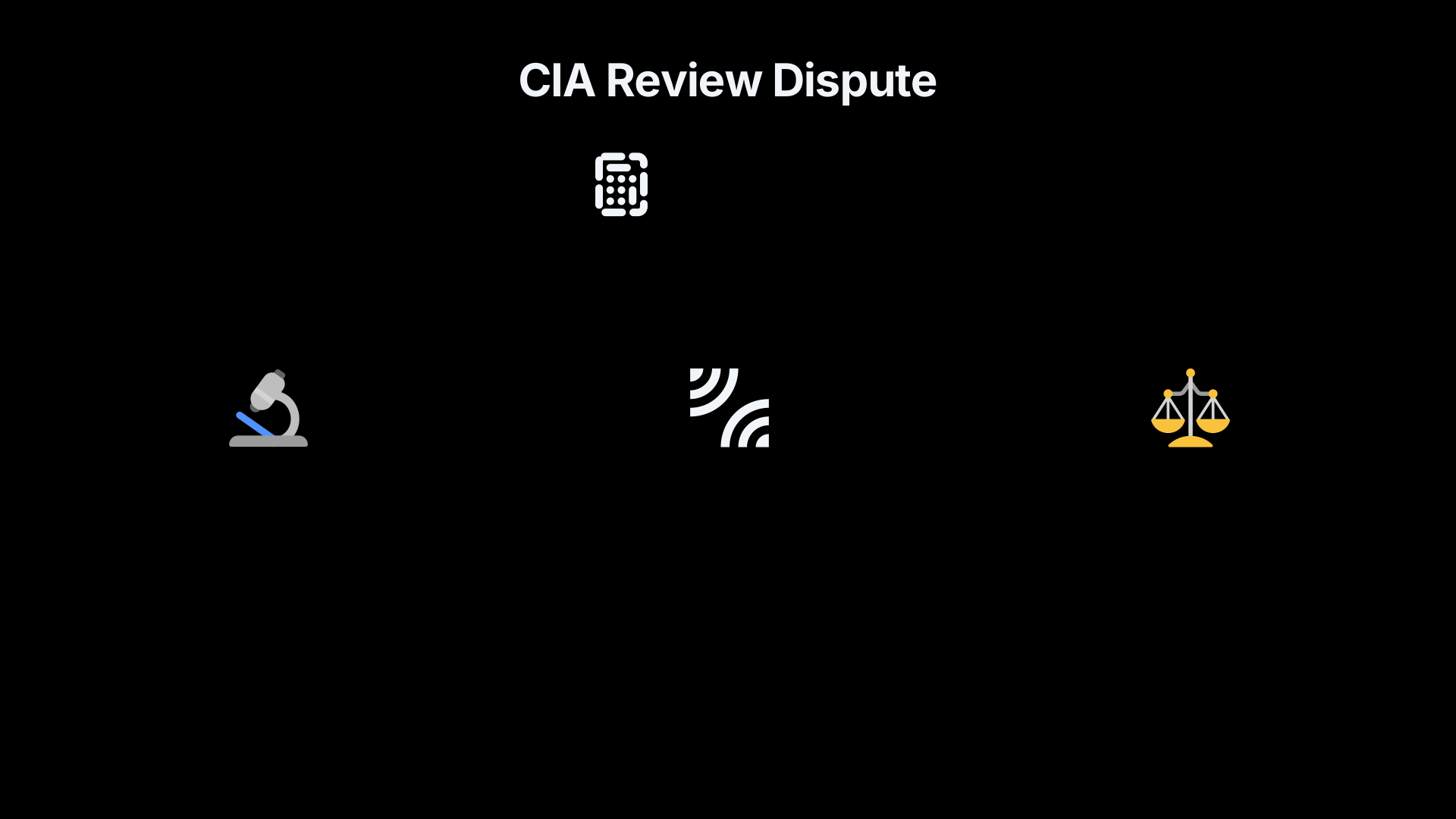
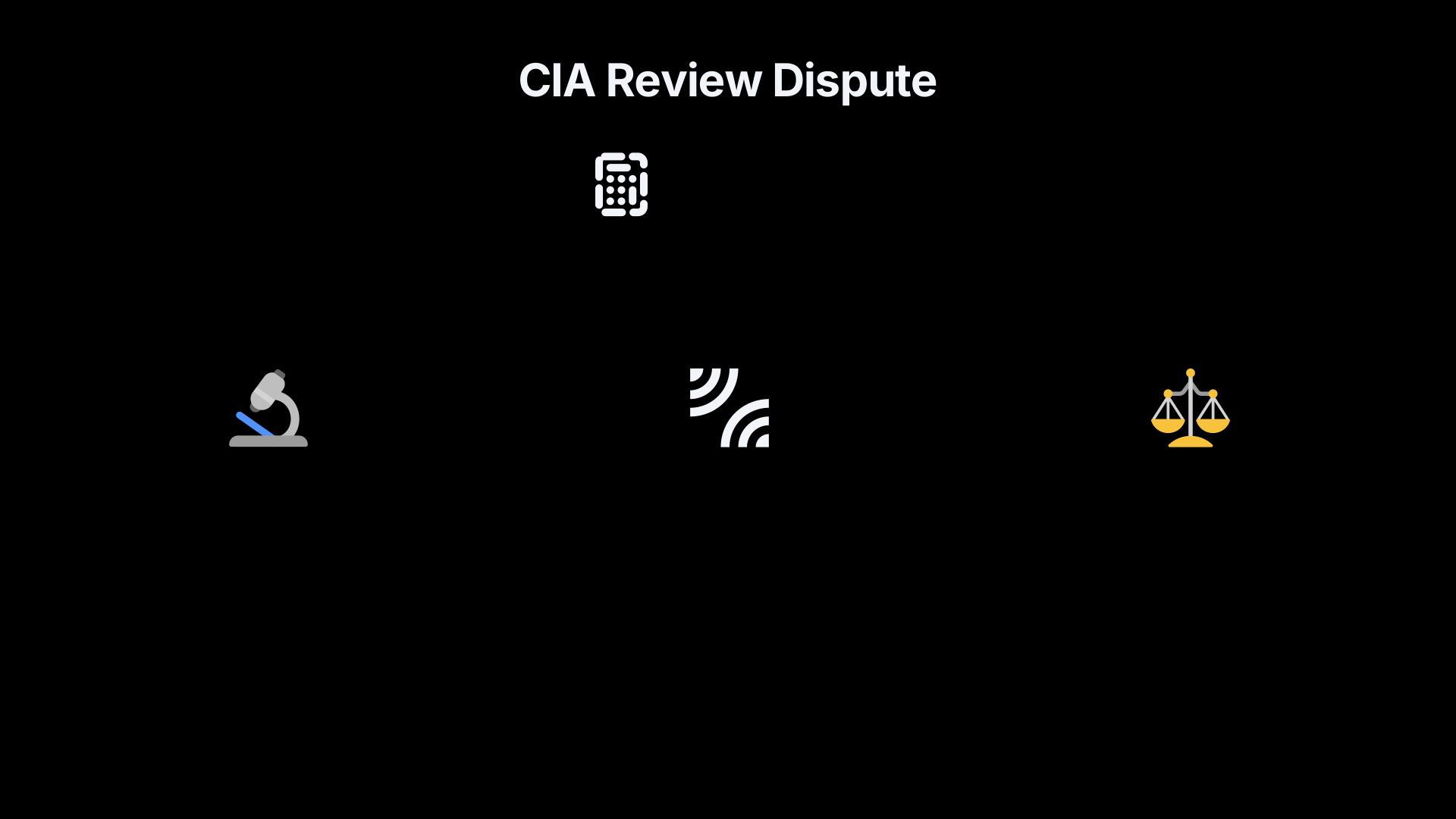
The most important public review came after the CIA commissioned the American Institutes for Research (AIR) to evaluate the programme in 1995. Two prominent academics were asked to examine the evidence: statistician Jessica Utts and psychologist Ray Hyman. Both accepted that some experimental results appeared statistically unusual. Their disagreement concerned interpretation.[CIA]cia.govistics at the University of California/Davis, and Dr.Read more…[CIA]cia.govistics at the University of California/Davis, and Dr.Read more…
Utts’ Argument: The Statistical Signal Was Real
Utts concluded that the accumulated laboratory data showed effects that were difficult to explain by chance alone. Her position was not simply that some experiments looked interesting. She argued that the statistical evidence met standards commonly accepted in other scientific fields and that a genuine anomalous effect appeared to be present.[alice.id.tue.nl]alice.id.tue.nlmumford rose goslin 1995Evaluation of Program in Anomalous Mental Phenomena". Jessica Utts. Division of…Read more…
From this perspective, the burden shifted away from proving that something unusual happened and toward explaining the mechanism. In other words, Utts believed the data justified taking the phenomenon seriously even if nobody understood how it worked.
This interpretation became influential among remote-viewing supporters because it came from a professional statistician reviewing a large body of government-funded research rather than from a paranormal advocacy organisation.
Hyman’s Argument: Statistical Anomalies Were Not Enough
Hyman accepted that some results looked unusual but argued that the evidence remained insufficient to establish psychic functioning. His criticism focused on methodological weaknesses, possible sensory leakage, inconsistent controls, replication concerns, and the broader problem that remote-viewing research lacked a convincing explanatory framework.[cdn.centerforinquiry.org]cdn.centerforinquiry.orgEvaluation of the Military's Twenty-Year Program on…by RAY HYMAN · 1996 · Cited by 8 — In 1995 the Central Intelligence Agency contrac…[Wikipedia For Hyman]WikipediaStargate Project (U.S. Army unitStargate Project (U.S. Army unit)The Stargate Project's work primarily involved remote viewing, the purported ability to psychically "…, a statistical deviation from chance was not equivalent to proof of extrasensory perception. He argued that extraordinary claims require stronger standards than simply showing unexpected numbers in experimental datasets.
This is why the debate never resolved into a simple “worked” versus “failed” verdict. Both reviewers looked at overlapping evidence and reached different conclusions about what level of proof had actually been achieved.[UC Davis]ucdavis.edupsychic spying research produces credible evidenceUC Davis'Psychic Spying' Research Produces Credible Evidence28 Nov 1995 — The main psychic ability tested in the research program is call…
The Validation Problem That Never Went Away
The Star Gate controversy ultimately became a problem of validation rather than existence.
The programme generated several layers of uncertainty:
- Some experiments appeared statistically positive.
- Many individual session descriptions were vague or open to interpretation.
- Apparent successes often stood beside obvious failures.
- Operational usefulness remained difficult to measure.
- Independent replication remained contested.
The AIR review ultimately concluded that the information generated by remote-viewing operations was not sufficiently specific, reliable, or consistently accurate for intelligence use. The reviewers found little evidence that remote-viewing reports had produced actionable intelligence outcomes.[National Security Archive]nsarchive2.gwu.eduNational Security ArchiveAn Evaluation of Remote Viewing: Research and…by MD Mumford · 1995 · Cited by 75 — In 1995, the CIA declassif…[CIA]cia.govistics at the University of California/Davis, and Dr.Read more…
This finding is often overlooked in UFO-related retellings. Public discussion frequently focuses on unusual laboratory results or dramatic anecdotes while paying less attention to the operational assessment. Yet from an intelligence perspective, operational utility was arguably the most important question.
A method that occasionally produces intriguing correlations but cannot reliably guide decisions presents a major validation problem. Intelligence agencies are not simply searching for anomalies. They need dependable information.
Why Official Funding Is Often Misread As Proof
One of the most persistent misunderstandings surrounding Star Gate is the assumption that government sponsorship equals government endorsement.
The historical record does not support that interpretation.
Cold War intelligence agencies investigated many possibilities that later proved ineffective, mistaken, or inconclusive. The fact that a programme received funding can demonstrate institutional interest, concern about adversaries, or uncertainty about potential threats. It does not demonstrate that the underlying claims were validated.[CIA]cia.govistics at the University of California/Davis, and Dr.Read more…
This point is especially important because Star Gate is frequently used rhetorically in UAP circles. The argument often runs as follows:
[cia]cia.govAN EVALUATION OF THE REMOTE VIEWING PROGRAMgoals, the CIA contracted with the American Institutes for Research to supervise and conduc… he CIA funded remote-viewing research.
- Therefore the CIA knew psychic phenomena were real.
- Therefore related anomalous claims deserve presumption of truth.
The declassified reviews do not support that chain of reasoning. The programme existed because intelligence officials wanted answers, not because they already possessed them.
The final evaluation itself illustrates this uncertainty. If remote viewing had already been conclusively validated, there would have been little reason to commission a major external review to determine whether the programme should continue.[CIA]cia.govistics at the University of California/Davis, and Dr.Read more…
How Disputed Results Affect Green’s Credibility
For Kit Green, Star Gate’s mixed legacy creates a complicated credibility signal rather than a straightforward positive or negative one.
On the positive side, Green’s association with early remote-viewing research is supported by historical accounts linking him to CIA interest in parapsychological investigations during the period when SRI experiments were being developed. This supports the narrower claim that he had access to real intelligence networks examining unconventional subjects.[Journal of Scientific Exploration]journalofscientificexploration.orgAmerican Institutes for Research. Mörck, N. C. (2018). Review of the book The Star Gate Ar-.Read more…
However, the unresolved status of Star Gate creates a credibility risk when evaluating later extraordinary claims connected to Green or to people within overlapping networks.
Several patterns repeat across both remote-viewing controversies and parts of modern UAP discourse:
- Reliance on insider testimony.
- Restricted access to underlying evidence.
- Appeals to classified knowledge.
- Difficulty separating anecdote from validated data.
- Strong disagreement among experts reviewing the same material.
The Star Gate record therefore weakens any argument that institutional involvement alone validates extraordinary claims. The programme itself demonstrates that highly educated officials, scientists, and intelligence personnel can spend years investigating a subject without reaching consensus about what the evidence actually shows. CIA[2cdn.centerforinquiry.org]cdn.centerforinquiry.orgEvaluation of the Military's Twenty-Year Program on…by RAY HYMAN · 1996 · Cited by 8 — In 1995 the Central Intelligence Agency contrac…
For Green’s credibility assessment, the strongest conclusion is also the most limited one: his proximity to remote-viewing research shows involvement with genuine government efforts to investigate anomalous claims. It does not demonstrate that those claims were proven true. The unresolved dispute between reviewers such as Utts and Hyman remains part of the story, and that unresolved status continues to shape how sceptics and supporters interpret Green’s wider connections to UAP-related narratives.
Amazon book picks
Further Reading
Books and field guides related to Did Star Gate Validate Remote Viewing?. Use these as the next step if you want deeper reading beyond the article.
The Science Fiction Hall of Fame, Volume Two A
Directly addresses programme goals, results and controversies.
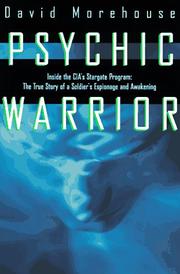
Psychic warrior
Represents the pro-remote-viewing perspective from inside the programme.
The Men Who Stare At Goats
Rating: 3.5/5 from 11 Google Books ratings
Explores both claims of success and reasons for skepticism.
The Demon-Haunted World
Offers a framework for evaluating disputed scientific claims and evidence.
eBay marketplace picks
Marketplace Samples
Example marketplace items related to this page. Use the search link to explore similar finds on eBay.



Endnotes
1.
Source: cia.gov
Link:https://www.cia.gov/readingroom/docs/CIA-RDP96-00791R000200180005-5.pdf
Source snippet
AN EVALUATION OF THE REMOTE VIEWING PROGRAMgoals, the CIA contracted with the American Institutes for Research to supervise and conduc...
2.
Source: Wikipedia
Title: Stargate Project (U.S. Army unit)
Link:https://en.wikipedia.org/wiki/Stargate_Project_%28U.S._Army_unit%29
Source snippet
Stargate Project (U.S. Army unit)The Stargate Project's work primarily involved remote viewing, the purported ability to psychically "...
3.
Source: cia.gov
Link:https://www.cia.gov/readingroom/docs/CIA-RDP96-00791R000200180006-4.pdf
Source snippet
istics at the University of California/Davis, and Dr.Read more...
4.
Source: alice.id.tue.nl
Title: mumford rose goslin 1995
Link:https://www.alice.id.tue.nl/references/mumford-rose-goslin-1995.pdf
Source snippet
"Evaluation of Program in Anomalous Mental Phenomena". Jessica Utts. Division of...Read more...
5.
Source: cdn.centerforinquiry.org
Link:https://cdn.centerforinquiry.org/wp-content/uploads/sites/29/1996/03/22165045/p21.pdf
Source snippet
Evaluation of the Military's Twenty-Year Program on...by RAY HYMAN · 1996 · Cited by 8 — In 1995 the Central Intelligence Agency contrac...
6.
Source: Wikipedia
Title: Remote viewing
Link:https://en.wikipedia.org/wiki/Remote_viewing
Source snippet
Remote viewingIn 1995, the CIA hired the American Institutes for Research (AIR) to perform a retrospective evaluation of the results g...
7.
Source: Wikipedia
Title: Jessica Utts
Link:https://en.wikipedia.org/wiki/Jessica_Utts
Source snippet
Jessica UttsInvestigation of remote viewing. edit. In 1995, the American Institutes for Research (AIR) appointed a panel consisting pr...
8.
Source: nsarchive2.gwu.edu
Link:https://nsarchive2.gwu.edu/NSAEBB/NSAEBB438/docs/doc_57.pdf
Source snippet
National Security ArchiveAn Evaluation of Remote Viewing: Research and...by MD Mumford · 1995 · Cited by 75 — In 1995, the CIA declassif...
9.
Source: ucdavis.edu
Title: psychic spying research produces credible evidence
Link:https://www.ucdavis.edu/news/psychic-spying-research-produces-credible-evidence
Source snippet
UC Davis'Psychic Spying' Research Produces Credible Evidence28 Nov 1995 — The main psychic ability tested in the research program is call...
10.
Source: journalofscientificexploration.org
Link:https://journalofscientificexploration.org/index.php/jse/article/view/3865/2573
Source snippet
American Institutes for Research. Mörck, N. C. (2018). Review of the book The Star Gate Ar-.Read more...
Additional References
11.
Source: skepsis.nl
Link:https://skepsis.nl/stargate/
Source snippet
CIA onderzoekt ESP / remote viewingDe skeptische psycholoog Ray Hyman van de Universiteit van Oregon was een van de twee hiervoor benader...
12.
Source: reddit.com
Link:https://www.reddit.com/r/HighStrangeness/comments/14x6pu0/the_cias_remote_viewing_documents_are_confusing/
Source snippet
The CIAs remote viewing documents are confusing as hellThe Stargate project produced zero evidence of remote viewing and that it's not re...
13.
Source: irp.fas.org
Link:https://irp.fas.org/program/collect/air1995.pdf
Source snippet
reportJavaScript is disabled. In order to continue, we need to verify that you're not a robot. This requires JavaScript. Enable JavaScrip...
14.
Source: researchgate.net
Link:https://www.researchgate.net/publication/403178755_The_Star_Gate_Archives_Reports_of_the_United_States_Government_Sponsored_Psi_Program_1972-1995_Volume_4_Operational_Remote_Viewing_Memorandums_and_Reports
Source snippet
1995. Ray Hyman. Jessica Utts and I were commissioned to evaluate the research on remote viewing and related phenomena which was...Read...
15.
Source: slideshare.net
Link:https://www.slideshare.net/slideshow/an-evaluation-of-remote-viewing-research-and-applications-air1995pdf/257460594
Source snippet
summary of a program review conducted by the American Institutes for Research (AIR) that evaluated the research and...
16.
Source: scribd.com
Title: Evaluation of Remote Viewing Program | PDFThe document provides an executive
Link:https://www.scribd.com/doc/92017954/Air-Report
Source snippet
summary of a review conducted by the American Institutes for Research (AIR) to evaluate the research program and...Read more...
17.
Source: kitemetric.com
Link:https://kitemetric.com/blogs/unveiling-the-stargate-project-a-deep-dive-into-remote-viewing-and-intelligence-gathering
Source snippet
history, explored the potential of remote viewing – a form of extrasensory perception...Read more...
18.
Source: ciaotest.cc.columbia.edu
Link:https://ciaotest.cc.columbia.edu/olj/sa/sa_jan02srm01.html
Source snippet
ls were trained to acquire such 'Remote Viewing' capabilities for collecting...Read more...
19.
Source: academia.edu
Link:https://www.academia.edu/95285973/The_Star_Gate_Operational_Remote_Viewing_Program_A_Human_Intelligence_HUMINT_Collection_Platform
Source snippet
Does the evidence indicate the presence of a statistically significant effect? · 2. Can the effects be attributed to paranormal phenomena...
20.
Source: reddit.com
Link:https://www.reddit.com/r/Psychic/comments/1s1n1b9/the_cia_spent_20_years_and_20_million_researching/
Source snippet
h she called statistically significant. The other reviewer...Read more...
Topic Tree