Within Remote Viewing
Could ordinary clues explain the results?
Critics argued that early SRI successes could be explained by weak controls, judging cues and subjective matching rather than psychic perception.
On this page
- How remote viewing judging worked
- Marks and Kammann's cueing criticism
- Why control disputes still matter for Puthoff
Page outline Jump by section
Introduction
The central sceptical challenge to Hal Puthoff’s remote-viewing work at Stanford Research Institute (SRI) is not that the experiments were obviously fraudulent. It is that apparently impressive results may have been produced by ordinary information leakage, subtle cueing and subjective judging rather than any paranormal ability. Critics argued that once those possibilities are taken seriously, the strongest early SRI successes become much less persuasive. Supporters responded that the experiments used shielding procedures and that later work improved the protocols. The dispute matters because it sits at the heart of Puthoff’s credibility problem: whether the SRI results revealed a genuine anomaly, or whether they demonstrated how difficult it is to eliminate hidden clues in experiments that depend heavily on interpretation.[CIA]cia.govCIA-RDP79-00999A000200010002-3So we conducted our experiments with sufficient control, utilizing visual, acoustic, and electrical shie…[Nature]nature.comSensory cues invalidate remote viewing experimentsby D MARKS · 1981 · Cited by 24 — Sensory cues invalidate remote viewing experime…
 For readers assessing Puthoff’s later role in UFO and UAP debates, this is more than a historical technicality. The argument over remote viewing became a long-running case study in how extraordinary claims can survive for decades when supporters and sceptics disagree not only about the results, but about whether the experimental controls were ever strong enough to justify those results in the first place.[CIA]cia.govAN EVALUATION OF THE REMOTE VIEWING PROGRAMUtts and Hyman were asked to prepare independent reports based on their review. In this rev…
How remote-viewing judging worked
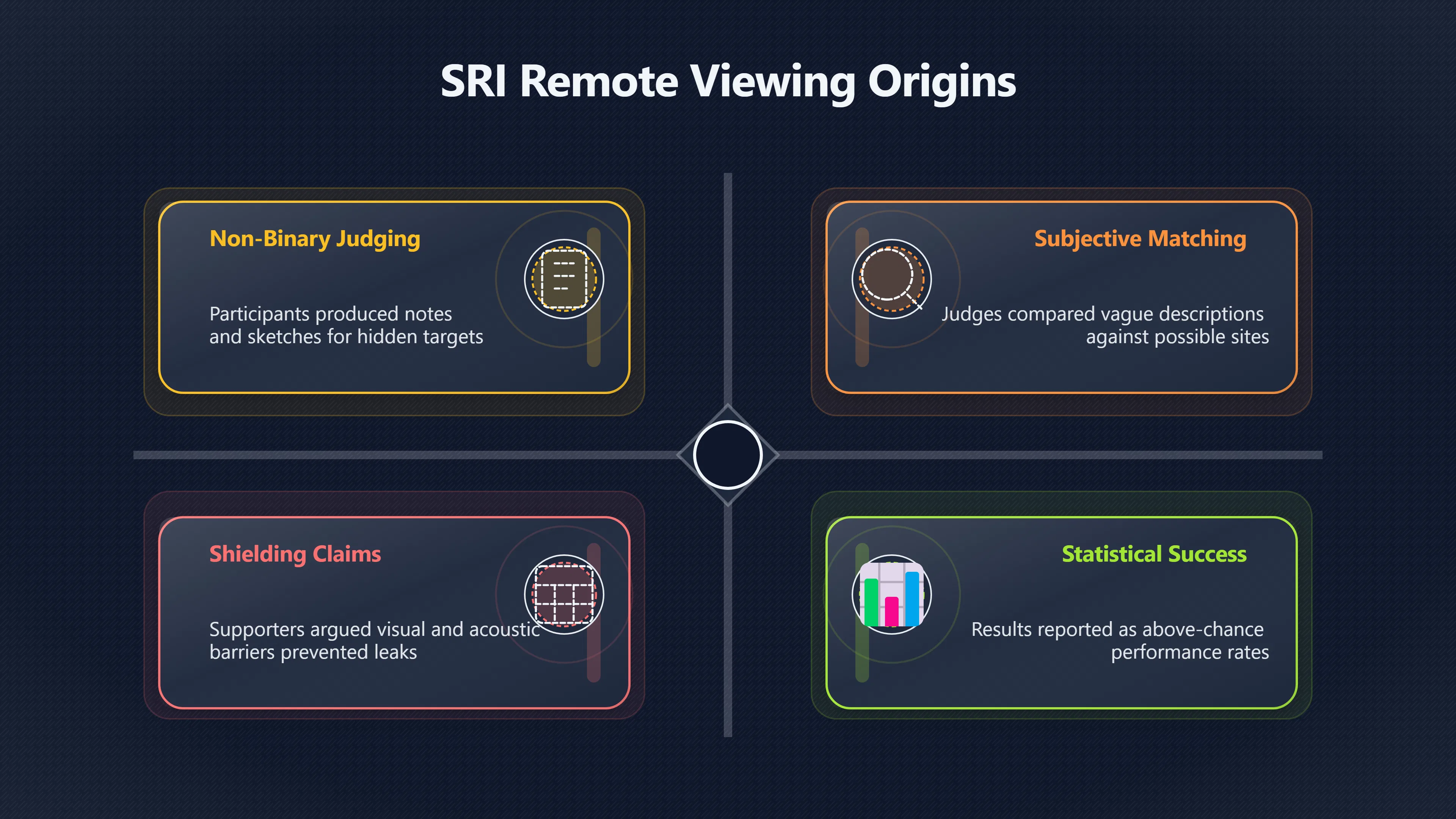
Many early SRI remote-viewing experiments did not involve a simple right-or-wrong answer. Instead, a participant would produce notes, sketches or verbal descriptions of a hidden target location. Judges would later compare those transcripts against several possible target sites and decide which matched best.[PhilPapers]philpapers.orgPhil Papers RTarg & Harold Puthoff, Remote Viewing of Natural Targetsby R Targ · 1975 · Cited by 8 — The First Decade of Remote Viewing Research and O…
That judging process became one of the most controversial parts of the programme. Even if a participant produced vague descriptions, a judge might perceive meaningful similarities between a transcript and a target after the fact. A sketch containing references to water, structures, open space or movement could potentially be matched to many locations. The stronger the role played by human interpretation, the more important it became to ensure that judges had absolutely no access to clues about which transcript belonged to which target.[Nature]nature.comInformation transmission in remote viewing experimentsby CT TART · 1980 · Cited by 55 — TART, C., PUTHOFF, H. & TARG, R. Informatio…
Sceptics argued that remote viewing created a perfect environment for unconscious pattern-matching. If judges knew anything about target order, dates, previous sessions or contextual details, they might make correct matches without realising they were using ordinary information. In that scenario, apparently successful remote viewing would not require paranormal perception at all.[Nature]nature.comSensory cues invalidate remote viewing experimentsby D MARKS · 1981 · Cited by 24 — Sensory cues invalidate remote viewing experime…
This distinction became crucial because the SRI studies often reported statistical success rates rather than dramatic single demonstrations. If a small amount of information leakage consistently nudged judges toward the correct target, the resulting statistics could appear impressive while still having an entirely conventional explanation.[Nature]nature.comInformation transmission in remote viewing experimentsby CT TART · 1980 · Cited by 55 — TART, C., PUTHOFF, H. & TARG, R. Informatio…
Marks and Kammann’s cueing criticism
The best-known attack on the SRI evidence came from psychologists David Marks and Richard Kammann. After failing to reproduce the claimed effects, they examined how the original judging process worked and argued that the transcripts contained unintended clues revealing target order.[Nature]nature.comInformation transmission in remote viewing experimentsby CT TART · 1980 · Cited by 55 — TART, C., PUTHOFF, H. & TARG, R. Informatio…
Their criticism focused on what they called sensory cues or cueing information. According to their analysis, some transcripts contained references that indirectly identified when a target had been visited. Examples reportedly included comments referring to earlier sessions, chronological details, dates on documents or other contextual markers. If a judge could reconstruct the sequence of targets, the matching task became dramatically easier.[Nature]nature.comInformation transmission in remote viewing experimentsby CT TART · 1980 · Cited by 55 — TART, C., PUTHOFF, H. & TARG, R. Informatio…
The most damaging aspect of the criticism was that Marks claimed he could correctly match transcripts to targets using these clues alone, without any psychic ability and without personally visiting the target sites. The implication was straightforward: if normal information was sufficient to generate successful matches, then the experimental results could not be taken as evidence for remote viewing.[Wikipedia]WikipediaSensory leakageSensory leakage
Marks later argued that when cueing information was removed, the apparent effect disappeared. His position was not merely that the experiments were imperfect, but that the imperfections provided a complete conventional explanation for the reported success rates.[Nature]nature.comInformation transmission in remote viewing experimentsby CT TART · 1980 · Cited by 55 — TART, C., PUTHOFF, H. & TARG, R. Informatio…
This became one of the most frequently cited sceptical arguments against the entire SRI programme because it targeted the mechanism by which success had been measured. Rather than arguing philosophically against psychic phenomena, Marks argued that the experimental design itself allowed ordinary information to contaminate the results.[Nature]nature.comInformation transmission in remote viewing experimentsby CT TART · 1980 · Cited by 55 — TART, C., PUTHOFF, H. & TARG, R. Informatio…
How Puthoff and his supporters responded
Puthoff and Russell Targ strongly rejected the claim that cueing explained the results. They argued that critics had misunderstood aspects of the protocol and published responses defending the research. In a 1981 rebuttal in Nature, they maintained that the experiments contained adequate controls and that the findings could not be reduced to simple sensory leakage.[PubMed]pubmed.ncbi.nlm.nih.govNature. 1981 Jul 23;292(5821):388. doi: 10.1038/292388a0. Authors. H Puthoff, R Targ.Read more…
Supporters also pointed to later re-analyses and subsequent experiments that they believed continued to show above-chance performance. Some researchers sympathetic to remote viewing argued that even after disputed transcripts were excluded, positive statistical patterns remained.[Nature]nature.comInformation transmission in remote viewing experimentsby CT TART · 1980 · Cited by 55 — TART, C., PUTHOFF, H. & TARG, R. Informatio…
However, this defence never fully settled the issue. Critics responded that once a protocol has been shown to permit leakage, confidence in the original findings is permanently weakened. The debate therefore shifted away from individual successful sessions and toward a broader methodological question: had the SRI researchers demonstrated a phenomenon, or had they underestimated how easily information can leak into complex experiments?[Nature]nature.comInformation transmission in remote viewing experimentsby CT TART · 1980 · Cited by 55 — TART, C., PUTHOFF, H. & TARG, R. Informatio…
An important feature of the dispute is that it was not merely an argument between believers and sceptics on the fringes of science. The exchanges appeared in major scientific journals, including Nature, giving the controversy an unusually visible and formal record.[Nature]nature.comInformation transmission in remote viewing experimentsby CT TART · 1980 · Cited by 55 — TART, C., PUTHOFF, H. & TARG, R. Informatio…[Nature]nature.comInformation transmission in remote viewing experimentsby CT TART · 1980 · Cited by 55 — TART, C., PUTHOFF, H. & TARG, R. Informatio…
Why ordinary leakage is such a serious challenge
The leakage argument remains powerful because it does not require proving fraud, deception or deliberate misconduct. It only requires showing that participants or judges could have obtained information through normal means without recognising that they had done so.[Nature]nature.comInformation transmission in remote viewing experimentsby CT TART · 1980 · Cited by 55 — TART, C., PUTHOFF, H. & TARG, R. Informatio…
Psychology provides many examples of people unconsciously using hints, expectations and contextual information. In experimental settings, tiny procedural weaknesses can produce apparently meaningful results. This is especially relevant in remote-viewing research because descriptions are often broad enough to permit multiple interpretations and because judging frequently involves subjective assessment rather than a clear binary outcome.[Center for Inquiry]cdn.centerforinquiry.orgThe remote-viewing effect could ap- parently be obtained by anybody and it required no special training or unique abilities…Read more…
The sceptical position therefore does not depend on proving that every successful remote-viewing session was explained by cueing. Instead, it argues that if the controls were not strong enough to exclude cueing, then the claimed paranormal explanation loses much of its evidential force. Extraordinary claims require eliminating ordinary explanations first.[Nature]nature.comInformation transmission in remote viewing experimentsby CT TART · 1980 · Cited by 55 — TART, C., PUTHOFF, H. & TARG, R. Informatio…
This logic later influenced official reviews of the programme. Even reviewers who acknowledged statistically unusual results often questioned whether methodological weaknesses and experimenter effects had been ruled out sufficiently to justify extraordinary conclusions.[CIA]cia.govof paranormal phenomena; the laboratory experiments.Read more…[CIA]cia.govAN EVALUATION OF THE REMOTE VIEWING PROGRAMA three-component program involving basic research, operations, and foreign assessment has bee…
Why control disputes still matter for Puthoff
For evaluating Hal Puthoff specifically, the control controversy is more important than the question of whether remote viewing was ever funded by intelligence agencies. That funding is well documented. The harder question is whether the research produced evidence strong enough to justify the confidence that Puthoff continued to place in it.[New Dualism Archive]newdualism.orgPuthoff and Russell Targ, "Perceptual Augmentation Techniques," SRI Progress Report No. 3 (31 Oct. 1974) and Final Report (1 Dec. 1975) t…
Supporters can fairly point out that Puthoff worked on a real government-backed programme, published in major journals and participated in a debate that some statisticians later viewed as more complicated than simple dismissal. The historical record is not one of immediate consensus rejection. Nature[PMC]pmc.ncbi.nlm.nih.govPMCFollow‐up on the U.SCentral Intelligence Agency's (CIA…by Á Escolà‐Gascón · 2023 · Cited by 10 — Reports on the declassified SRI and SAIC experiments were…
Sceptics, however, argue that the cueing controversy exposes a recurring weakness in Puthoff’s public reputation. They contend that he has repeatedly shown a willingness to interpret ambiguous or weakly controlled evidence as support for extraordinary possibilities. From that perspective, the unresolved arguments over information leakage are not a side issue but a warning sign about judgement standards.[Nature]nature.comInformation transmission in remote viewing experimentsby CT TART · 1980 · Cited by 55 — TART, C., PUTHOFF, H. & TARG, R. Informatio…
The result is a credibility picture that remains mixed. The SRI work demonstrates that Puthoff operated inside genuine research and intelligence-related programmes rather than inventing a fictional background. Yet the long-running dispute over sensory cues, judging methods and information leakage means that the most famous evidence associated with that work never achieved broad scientific acceptance. For critics of Puthoff, that failure is central. For supporters, it reflects a controversial field that may have been prematurely dismissed. Either way, the argument over controls remains one of the strongest reasons why remote viewing continues to divide assessments of his reliability. CIA 3Nature[PubMed]pubmed.ncbi.nlm.nih.govNature. 1981 Jul 23;292(5821):388. doi: 10.1038/292388a0. Authors. H Puthoff, R Targ.Read more…
Amazon book picks
Further Reading
Books and field guides related to Could ordinary clues explain the results?. Use these as the next step if you want deeper reading beyond the article.
The Demon-Haunted World
Directly relevant to evaluating cueing, bias and evidential standards.
The Men Who Stare At Goats
Rating: 3.5/5 from 11 Google Books ratings
Explores military interest in paranormal and remote-viewing programs.
eBay marketplace picks
Marketplace Samples
Example marketplace items related to this page. Use the search link to explore similar finds on eBay.



Endnotes
1.
Source: cia.gov
Link:https://www.cia.gov/readingroom/docs/CIA-RDP79-00999A000200010002-3.pdf
Source snippet
CIA-RDP79-00999A000200010002-3So we conducted our experiments with sufficient control, utilizing visual, acoustic, and electrical shie...
2.
Source: nature.com
Link:https://www.nature.com/articles/292177a0
Source snippet
Sensory cues invalidate remote viewing experimentsby D MARKS · 1981 · Cited by 24 — Sensory cues invalidate remote viewing experime...
3.
Source: cia.gov
Link:https://www.cia.gov/readingroom/docs/CIA-RDP96-00791R000200180005-5.pdf
Source snippet
AN EVALUATION OF THE REMOTE VIEWING PROGRAMUtts and Hyman were asked to prepare independent reports based on their review. In this rev...
4.
Source: cia.gov
Link:https://www.cia.gov/readingroom/docs/CIA-RDP96-00791R000200180006-4.pdf
Source snippet
of paranormal phenomena; the laboratory experiments.Read more...
5.
Source: philpapers.org
Title: Phil Papers R
Link:https://philpapers.org/rec/TARRVO
Source snippet
Targ & Harold Puthoff, Remote Viewing of Natural Targetsby R Targ · 1975 · Cited by 8 — The First Decade of Remote Viewing Research and O...
6.
Source: Wikipedia
Title: Sensory leakage
Link:https://en.wikipedia.org/wiki/Sensory_leakage
7.
Source: nature.com
Link:https://www.nature.com/articles/284191a0
Source snippet
Information transmission in remote viewing experimentsby CT TART · 1980 · Cited by 55 — TART, C., PUTHOFF, H. & TARG, R. Informatio...
8.
Source: pmc.ncbi.nlm.nih.gov
Title: PMCFollow‐up on the U.S
Link:https://pmc.ncbi.nlm.nih.gov/articles/PMC10275521/
Source snippet
Central Intelligence Agency's (CIA...by Á Escolà‐Gascón · 2023 · Cited by 10 — Reports on the declassified SRI and SAIC experiments were...
9.
Source: Wikipedia
Title: Remote viewing
Link:https://en.wikipedia.org/wiki/Remote_viewing
Source snippet
Remote viewingRemote viewing; The alleged paranormal ability to perceive a remote or hidden subject without support of the senses. ·...
10.
Source: Wikipedia
Title: Harold E. Puthoff
Link:https://en.wikipedia.org/wiki/Harold_E._Puthoff
Source snippet
Harold E. PuthoffHarold Edward Puthoff (born June 20, 1936), often known as Hal Puthoff, is an American electrical engineer and paraps...
Published: June 20, 1936
11.
Source: Wikipedia
Title: Parapsychology research at SRI
Link:https://en.wikipedia.org/wiki/Parapsychology_research_at_SRI
Source snippet
Parapsychology research at SRI... Puthoff and Targ's 1974 article in the journal Nature. This article described numerous remote viewin...
12.
Source: cia.gov
Link:https://www.cia.gov/readingroom/document/cia-rdp96-00791r000200180005-5
Source snippet
AN EVALUATION OF THE REMOTE VIEWING PROGRAMA three-component program involving basic research, operations, and foreign assessment has bee...
13.
Source: facebook.com
Link:https://www.facebook.com/quanticaudioyoutube/posts/controlled-laboratory-studies-on-remote-viewing-have-shown-statistically-signifi/1332869352198926/
Source snippet
“Controlled laboratory studies on remote viewing have shown...Introduction In the 1970s, physicists Russell Targ and Harold Puthoff cond...
14.
Source: pubmed.ncbi.nlm.nih.gov
Link:https://pubmed.ncbi.nlm.nih.gov/7254336/
Source snippet
Nature. 1981 Jul 23;292(5821):388. doi: 10.1038/292388a0. Authors. H Puthoff, R Targ.Read more...
15.
Source: cdn.centerforinquiry.org
Link:https://cdn.centerforinquiry.org/wp-content/uploads/sites/29/1982/07/22165420/p20.pdf
Source snippet
The remote-viewing effect could ap- parently be obtained by anybody and it required no special training or unique abilities...Read more...
16.
Source: pubmed.ncbi.nlm.nih.gov
Link:https://pubmed.ncbi.nlm.nih.gov/7242682/
Source snippet
Nature. 1981 Jul 9;292(5819):177. doi: 10.1038/292177a0. Author. D Marks. PMID: 7242682; DOI: 10.1038...Read more...
17.
Source: centerforinquiry.s3.amazonaws.com
Title: Remote Viewing Revisitedby DF Marks · Cited by 13 — Marks, D
Link:https://centerforinquiry.s3.amazonaws.com/wp-content/uploads/sites/29/1982/07/22165420/p20.pdf
Source snippet
F. 1981a. "Sensory Cues Invalidate Remote Viewing Experiments." Nature. 292:177. 1981b. "The Assessment of Parapsychological Studies on R...
18.
Source: newdualism.org
Link:https://www.newdualism.org/papers/H.Puthoff/CIA-Initiated%20Remote%20Viewing%20At%20Stanford%20Research%20Institute.htm
Source snippet
Puthoff and Russell Targ, "Perceptual Augmentation Techniques," SRI Progress Report No. 3 (31 Oct. 1974) and Final Report (1 Dec. 1975) t...
19.
Source: ics.uci.edu
Link:https://www.ics.uci.edu/~jutts/may.pdf
Source snippet
So even though Hyman had access to this group, he was denied access...Read more...
Additional References
20.
Source: reddit.com
Link:https://www.reddit.com/r/UFOs/comments/yt5emz/hal_puthoff_on_remote_viewing_efficacy/
Source snippet
Hal Puthoff on remote viewing efficacy: r/UFOsHal claims to have used remote viewing to consistently win on the stock market, creating a...
21.
Source: sixthsensereader.org
Link:https://sixthsensereader.org/about-the-book/abcderium-index/remote-viewing/
Source snippet
REMOTE VIEWINGby M Mowbray — Puthoff and Targ's initial experiments involved the testing of pre-selected subjects' (or percipients') abil...
22.
Source: sk.sagepub.com
Link:https://sk.sagepub.com/book/mono/download/psychology-and-the-paranormal/chpt/5-remote-viewing-psychic-staring.pdf
Source snippet
and the Paranormal: Exploring Anomalous...A fatal flaw with the original Targ–Puthoff RV series with Pat Price was that the transcripts...
23.
Source: researchgate.net
Link:https://www.researchgate.net/profile/Harold-Puthoff/publication/15945437_Rebuttal_of_criticisms_of_remote_viewing_experiments/links/57800d8b08ae01f736e49f90/Rebuttal-of-criticisms-of-remote-viewing-experiments.pdf
Source snippet
Kammann offer criticism of the SRI experiments in 'remote viewing', the abil- ity of certain individuals to access...Read more...
24.
Source: rviewer.com
Link:https://rviewer.com/a-review-of-the-cia-air-report-on-the-star-gate-remote-viewing-program/bologna-on-wry-bread-part-1-of-a-review-of-an-evaluation-of-remote-viewing-research-and-applications/
Source snippet
Utts and Hyman agreed that the experimental portion of STAR GATE indicated some sort of phenomenon existed, but...Read more...
25.
Source: davidfmarks.net
Link:https://davidfmarks.net/page/12/
Source snippet
319 of Nature can be used to invalidate the Pat Price series of remote viewing experiments, he literally...Read more...
26.
Source: theosophical.org
Link:https://www.theosophical.org/publications/quest-magazine/questioning-reality-a-physicists-view-of-psychic-abilities
Source snippet
son to accurately describe and experience places and events blocked from ordinary perception.Read more...
27.
Source: scispace.com
Title: rebuttal of criticisms of remote viewing experiments 1j3arh0xxi
Link:https://scispace.com/pdf/rebuttal-of-criticisms-of-remote-viewing-experiments-1j3arh0xxi.pdf
Source snippet
Rebuttal of criticisms of remote viewing experiments23 Jul 1981 — He claims that sensory cues in the subject-generated RV transcripts pro...
28.
Source: researchgate.net
Title: 15839349 Information transmission in remote viewing experiments
Link:https://www.researchgate.net/publication/15839349_Information_transmission_in_remote_viewing_experiments
Source snippet
Information transmission in remote viewing experiments27 May 2016 — TARG AND PUTHOFF1-3 have described investigations of an extrasensory...
Published: May 2016
29.
Source: slideshare.net
Link:https://www.slideshare.net/slideshow/an-evaluation-of-remote-viewing-research-and-applications-air1995pdf/257460594
Source snippet
iews with those involved in intelligence gathering operations using...Read more...
Topic Tree