Within Lacatski
What Did KONA BLUE Actually Show?
KONA BLUE weakens the argument that programme proposals alone prove possession of anomalous materials.
On this page
- What AARO says KONA BLUE was
- Why the proposal mattered
- What it does and does not disprove
Page outline Jump by section
Introduction
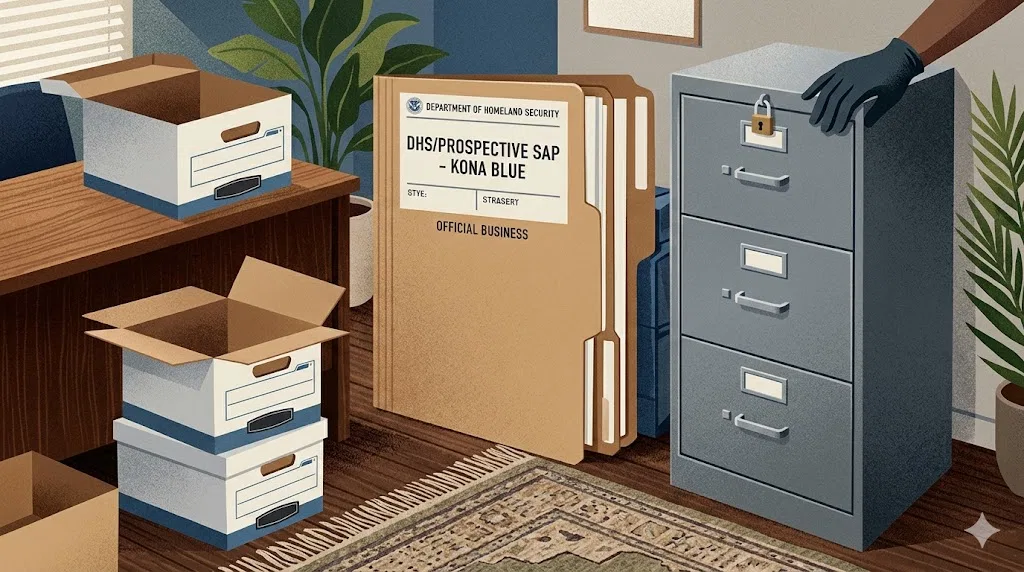
KONA BLUE matters because it is one of the clearest tests of a common inference in the James Lacatski story: if officials proposed a protected programme for recovered UAP materials, does that mean such materials had already been verified? The best public answer is no. KONA BLUE shows that some officials and programme advocates believed a recovered-materials problem existed and tried to create a Department of Homeland Security structure to handle it. It does not, on the public record, prove that anomalous craft, bodies, biological samples or exotic materials were ever delivered to that programme. AARO says KONA BLUE was proposed, gained some initial bureaucratic traction, but was not approved as a functioning Special Access Program, received no funding or materials, and rested on assumptions by its advocates rather than collected evidence.[aaro.mil]aaro.milHistory and Origin of KONA BLUEHistory and Origin of KONA BLUE
For Lacatski’s credibility, that distinction is crucial. KONA BLUE strengthens the case that Lacatski and allied figures were involved in real government-facing UAP initiatives after AAWSAP. It weakens the argument that the mere existence of a proposal, code name or prospective compartment proves possession of recovered non-human technology.
What AARO says KONA BLUE was
AARO’s public account describes KONA BLUE as a proposed Department of Homeland Security Prospective Special Access Program, or PSAP. A Special Access Program is a highly restricted government security compartment used for especially sensitive information; a prospective SAP is a proposal or preparatory step, not proof that a fully operational compartment existed. According to AARO, multiple interviewees initially described KONA BLUE as a DHS sensitive compartment established to protect retrieval and exploitation of “non-human biologics”, but AARO says its own research found something narrower: KONA BLUE had been proposed to DHS leadership, was never approved or formally established, received no materials or funding, and left no public evidence beyond the proposal presentation bearing the KONA BLUE name.[aaro.mil]aaro.milUAP RecordsUAP Records
AARO traces KONA BLUE back to the DIA-managed AAWSAP/AATIP effort, which ran from 2009 to 2012 and was executed primarily by Bigelow Aerospace. When DIA cancelled that programme, several people involved in or supportive of the effort advocated for DHS to take over a new version under the KONA BLUE name. The proposed lines of work would have continued investigations into sensitive materials and technologies, including advanced aerospace vehicles. DHS Science and Technology leadership initially established KONA BLUE as a PSAP in 2011 on the basis that relevant information and material were claimed to exist, but the Deputy Secretary of DHS disapproved it as a SAP roughly six months later, citing inadequate justification and insufficient information about central elements such as staffing and budget.[aaro.mil]aaro.milDHS Kona BlueDHS Kona Blue
That sequence is easy to overread. It shows that the proposal reached a serious bureaucratic stage; it does not show that DHS possessed the materials in question. AARO’s one-page KONA BLUE history states directly that no data or material of any kind was transferred to or collected by DHS under KONA BLUE, and that information from AAWSAP/AATIP remained in DIA archived holdings.[aaro.mil]aaro.milAARO Historical Record Report VolAARO Historical Record Report Vol

Why the proposal mattered
KONA BLUE mattered because it converted a belief about hidden UAP technology into a bureaucratic plan. The proposal was not merely a casual memo saying “look into UFOs”. AARO says it would have restarted UAP investigations, paranormal research, alleged “human consciousness anomalies”, and reverse-engineering of any recovered off-world spacecraft the advocates hoped to acquire. It also included an oral-history effort aimed at gathering information from retired government, armed services, contractor and intelligence-community figures about the location of advanced aerospace technology and biological samples, including records, reports, photographs and physical samples.[U.S. Department of War]media.defense.govU.S. Department of War AARO Historical Record Report Volume 1U.S. Department of War AARO Historical Record Report Volume 1(#endnote-8 “Endnote 8”)
| That makes KONA BLUE important to readers assessing Lacatski. It is a bridge between three things that often blur together in public discussion: AAWSAP’s earlier government-funded UAP/paranormal investigation, later claims that hidden recovered materials existed inside government or contractor channels, and attempts to create an official compartment to pull those alleged materials into a more accountable structure. In supporter accounts, this is treated as evidence that serious insiders were trying to regularise access to something real. In sceptical accounts, it is evidence of the opposite problem: a group of committed UAP advocates tried to build a programme around material they expected or believed existed, without first producing public proof that it did.[Liberation Times]liberationtimes.comSource details in endnotes. | Reimagining Old News |
| The public dispute became sharper because Lacatski himself has been associated with a stronger recovered-craft claim. Reporting on his 2023 public statements and book material says he affirmed that the US government possessed a craft of unknown origin and had access to its interior, describing a 2011 Capitol meeting in which that claim was allegedly raised.[Liberation Times]liberationtimes.comSource details in endnotes. | Reimagining Old News KONA BLUE is therefore not an isolated acronym; it sits beside Lacatski’s broader claim that the US had access to an anomalous craft. The evidential question is whether the DHS proposal independently corroborates that claim, or merely shows that Lacatski and allied figures were attempting to create a mechanism around the same belief. |
AARO’s answer is the latter. Its report says KONA BLUE advocates were convinced the US government was hiding UAP technologies and believed that creating the programme under DHS would allow alleged technology and knowledge to be moved under KONA BLUE, where it could be governed and monitored by congressional oversight committees. But AARO also says the craft and bodies were “only assumed to exist” by KONA BLUE advocates and anticipated contractors.[U.S. Department of War]media.defense.govU.S. Department of War AARO Historical Record Report Volume 1U.S. Department of War AARO Historical Record Report Volume 1(#endnote-8 “Endnote 8”)
The recovered-materials inference
The recovered-materials inference runs like this: officials would not draft a compartment for recovered UAP technology unless they had already confirmed that such technology existed. KONA BLUE complicates that inference because the proposal’s existence is real, but its evidential content appears much weaker than believers often suggest.
There are several reasons the inference is not strong on the current public record.
First, a proposal can be built around claimed material rather than verified material. AARO’s wording is explicit: some DHS personnel believed relevant information and material would be delivered once a SAP existed, but no data or material was ever transferred to or collected by DHS under KONA BLUE.[aaro.mil]aaro.milHistory and Origin of KONA BLUEHistory and Origin of KONA BLUE That means the proposed security container came before the publicly documented chain of custody, not after it.
Second, the programme’s design seems to have relied heavily on testimony and access-seeking. The oral-history component aimed to gather claims, locations, records, photographs and physical samples from previously placed officials and contractors. That is an investigative starting point, not the same thing as a verified inventory of recovered craft.[U.S. Department of War]media.defense.govU.S. Department of War AARO Historical Record Report Volume 1U.S. Department of War AARO Historical Record Report Volume 1(#endnote-8 “Endnote 8”)
Third, AARO frames KONA BLUE as part of a broader pattern of circular reporting. Its historical report says modern allegations that the US government is reverse-engineering extraterrestrial technology largely came from a consistent group of individuals involved in UAP-related efforts since at least 2009, many connected to AAWSAP/AATIP or the attempt to re-establish it under DHS. AARO says those advocates did not provide empirical evidence to support their claims.[U.S. Department of War]media.defense.govU.S. Department of War AARO Historical Record Report Volume 1U.S. Department of War AARO Historical Record Report Volume 1(#endnote-8 “Endnote 8”)
Fourth, AARO says named aerospace companies denied, on the record, that they had recovered, possessed or reverse-engineered extraterrestrial technology, and that an alleged off-world metal sample it examined was a manufactured terrestrial alloy with no exceptional qualities.[U.S. Department of War]media.defense.govU.S. Department of War AARO Historical Record Report Volume 1U.S. Department of War AARO Historical Record Report Volume 1(#endnote-8 “Endnote 8”) Those findings do not disprove every possible hidden-material claim, but they do weaken the specific public argument that KONA BLUE is itself confirmation of a contractor-held recovered-craft programme.
The strongest supporter reading
The strongest pro-Lacatski reading of KONA BLUE is not that it proves recovered craft. It is that it shows senior-enough people took the allegation seriously enough to explore a protected government mechanism. AARO acknowledges that KONA BLUE gained initial traction at DHS, that a PSAP was officially requested, and that Senators Harry Reid and Joe Lieberman were associated with the push for a protected structure and possible additional funding.[U.S. Department of War]media.defense.govU.S. Department of War AARO Historical Record Report Volume 1U.S. Department of War AARO Historical Record Report Volume 1(#endnote-8 “Endnote 8”)
From that perspective, KONA BLUE is significant because it looks like an attempted remedy to an alleged governance failure. The claimed problem was not simply “there are strange objects in the sky”; it was that information, materials or biological samples might be outside ordinary oversight channels. A DHS SAP would have been a way to bring alleged hidden knowledge into a compartment with formal security rules and congressional visibility. A supporter could reasonably say that this is a more serious institutional footprint than ordinary UFO folklore.
| Supporter-aligned reporting also argues that witnesses who spoke about crash retrievals could not have confused KONA BLUE with a real storage programme because KONA BLUE never became operational. George Knapp, Lacatski’s co-author, is quoted as arguing that anyone who told AARO about crash-retrieval hardware must have been referring to something other than KONA BLUE, precisely because KONA BLUE had no budget, building, debris or bodies.[Liberation Times]liberationtimes.comSource details in endnotes. | Reimagining Old News This is a coherent rebuttal to a narrow sceptical overclaim: if AARO treats KONA BLUE as the answer to every recovered-materials allegation, that would not by itself resolve claims about other alleged programmes. |
But that supporter reading still has a gap. It preserves the possibility that some other programme or contractor-held material existed; it does not produce public chain-of-custody evidence for that other programme. KONA BLUE can show that certain insiders believed in, searched for or tried to manage such material. It cannot, by itself, show that the material was real.
The strongest sceptical reading
The strongest sceptical reading is that KONA BLUE is a textbook example of proposal inflation: an unverified claim becomes a programme concept, the programme concept becomes a code name, and the code name is later cited as if it were proof of the original claim. AARO’s public language supports this concern. Its report says KONA BLUE was proposed by people who believed the US government was hiding off-world technology, but that the programme was never approved and its supporters did not provide empirical evidence.[U.S. Department of War]media.defense.govU.S. Department of War AARO Historical Record Report Volume 1U.S. Department of War AARO Historical Record Report Volume 1(#endnote-8 “Endnote 8”)
This matters for Lacatski because his credibility is strongest when assessed as a real programme insider and weakest when his most extraordinary claims are treated as proven by institutional proximity. KONA BLUE confirms proximity: he and the AAWSAP network were close enough to government processes to push a successor proposal into DHS channels. It does not confirm the central recovered-craft assertion in the way a materials inventory, lab report, custody record, contractor admission or declassified programme file would.
The Guardian’s interview with former AARO director Sean Kirkpatrick captured the sceptical theory bluntly: AARO regarded many modern crash-retrieval claims as emerging from a small, interlinked UAP network, and Kirkpatrick argued that some claims arose when sensitive national-security programmes or ordinary materials were misread through a UAP lens.[The Guardian]theguardian.comSource details in endnotes. That account is not neutral scripture; AARO itself is a contested actor in the disclosure debate. Still, it is directly relevant because it explains why KONA BLUE weakens the “proposal equals possession” argument.

What KONA BLUE does and does not disprove
KONA BLUE does not disprove Lacatski’s broader claim that some part of the US government had access to a craft of unknown origin. A failed DHS proposal cannot logically rule out a different classified programme, a contractor-held artefact, a misfiled legacy project or an inaccessible compartment elsewhere. AARO also acknowledged that some claims remained under evaluation even while saying it had disproved the majority of interviewee claims using verifiable information.[U.S. Department of War]media.defense.govU.S. Department of War AARO Historical Record Report Volume 1U.S. Department of War AARO Historical Record Report Volume 1(#endnote-8 “Endnote 8”)
What KONA BLUE does disprove, or at least strongly undercuts, is a narrower public argument: that the existence of a proposed KONA BLUE compartment proves recovered non-human materials had already been acquired by DHS or by the proposed programme. AARO says the programme never received materials or funding, no data or material was transferred to DHS, and no extraterrestrial craft or bodies were ever collected under KONA BLUE.[aaro.mil]aaro.milUAP RecordsUAP Records
It also undercuts the idea that every official-sounding UAP code name should be treated as evidence of a successful reverse-engineering programme. In the same section, AARO discussed a later intelligence-community Controlled Access Program whose scope was expanded in 2021 to include UAP reverse-engineering language, but said that programme never recovered or reverse-engineered any technology and was disestablished for inactivity, lack of mission need and lack of merit.[U.S. Department of War]media.defense.govU.S. Department of War AARO Historical Record Report Volume 1U.S. Department of War AARO Historical Record Report Volume 1(#endnote-8 “Endnote 8”) The pattern is important: bureaucratic language can exist without recovered hardware.
Bottom line for Lacatski’s credibility
KONA BLUE leaves Lacatski in a mixed position. It reinforces that he operated in a real, consequential government-adjacent UAP environment, not merely in media speculation. It shows that the AAWSAP network tried to create a successor mechanism and that recovered-materials claims were taken seriously enough by some officials to generate a protected-programme proposal. Those are meaningful facts for assessing him as an insider figure.
But KONA BLUE also narrows the evidential value of that insider status. The public documents show a proposed container for alleged materials, not verified possession of those materials. They show belief, advocacy, access-seeking and bureaucratic initiative, not a publicly demonstrated chain of custody. For readers assessing James Lacatski, the careful conclusion is that KONA BLUE makes his story more institutionally grounded but not more empirically proven. It is evidence that recovered-materials claims influenced policy proposals; it is not, on the present public record, evidence that recovered non-human materials were actually in hand.
Amazon book picks
Further Reading
No matched book cards were available for What Did KONA BLUE Actually Show?, so this fallback keeps a direct Amazon reading path visible.
Topical books
UFO research books
Browse books, explainers and reference titles related to this topic.
Search AmazonRelated search
UFO sightings books
Browse books, explainers and reference titles related to this topic.
Search AmazonRelated search
UAP books
Browse books, explainers and reference titles related to this topic.
Search AmazoneBay marketplace picks
Marketplace Samples
Example marketplace items related to this page. Use the search link to explore similar finds on eBay.


Endnotes
1.
Source: aaro.mil
Title: History and Origin of KONA BLUE
Link:https://www.aaro.mil/Portals/136/PDFs/UAP_RECORDS_RESEARCH/History_and_Origin_of_KONA_BLUE_FINAL_508.pdf
2.
Source: liberationtimes.com
Link:https://www.liberationtimes.com/home/kona-blue-insiders-reveal-how-us-agencies-allegedly-involved-in-legacy-ufo-programs-rattled-department-of-homeland-security-officials
3.
Source: liberationtimes.com
Link:https://www.liberationtimes.com/home/former-head-of-us-government-ufo-program-confirms-government-possesses-advanced-craft-of-unknown-origin
4.
Source: aaro.mil
Title: UAP Records
Link:https://www.aaro.mil/UAP-Records/
5.
Source: aaro.mil
Title: DHS Kona Blue
Link:https://www.aaro.mil/Portals/136/PDFs/UAP_RECORDS_RESEARCH/AARO_DHS_Kona_Blue.pdf
6.
Source: aaro.mil
Title: AARO Historical Record Report Vol 1 2024
Link:https://www.aaro.mil/Portals/136/PDFs/AARO_Historical_Record_Report_Vol_1_2024.pdf
7.
Source: dhs.gov
Title: 25 0723 foia dhs st foia log fy2024
Link:https://www.dhs.gov/sites/default/files/2025-07/25_0723_foia_dhs-st-foia-log-fy2024.pdf
8.
Source: media.defense.gov
Title: U.S. Department of War AARO Historical Record Report Volume 1
Link:https://media.defense.gov/2024/Mar/08/2003409233/-1/-1/0/DOPSR-2024-0263-AARO-HISTORICAL-RECORD-REPORT-VOLUME-1-2024.PDF
9.
Source: theguardian.com
Link:https://www.theguardian.com/us-news/2024/mar/22/ufologists-sean-kirkpatrick-pentagon-report-uaps
10.
Source: theguardian.com
Title: pentagon ufo report hiding aliens
Link:https://www.theguardian.com/world/2024/mar/08/pentagon-ufo-report-hiding-aliens
11.
Source: x.com
Link:https://x.com/michaelshermer/status/1766163627550429291
Additional References
12.
Source: youtube.com
Title: Pentagon acknowledges secret UFO project, the Kona Blue program | Vargas Reports
Link:https://www.youtube.com/watch?v=35iibl5W1OQ
Source snippet
UFO research: Scientists, spies and push for disclosure | UFO Mysteries...
13.
Source: youtube.com
Title: Dr. James Lacatski
Link:https://www.youtube.com/watch?v=tFkNVqBugnE
Source snippet
The UFO Lie: Shocking truth of Pentagon AAWSAP program | The Basement Office...
14.
Source: youtube.com
Title: UFO research: Scientists, spies and push for disclosure | UFO Mysteries
Link:https://www.youtube.com/watch?v=ahTxgnexVjM
Source snippet
Skinwalker Ranch, Oak Island curse and Kona Blue | Reality Check...
15.
Source: youtube.com
Title: Skinwalker Ranch, Oak Island curse and Kona Blue | Reality Check
Link:https://www.youtube.com/watch?v=kNEJaw-Erks
Source snippet
Dr. James Lacatski - This Is Ufo Disclosure, As Far As It Can Go...
16.
Source: sott.net
Link:https://www.sott.net/article/490859-Kona-Blue-insiders-reveal-how-US-agencies-allegedly-involved-in-legacy-UFO-programs-rattled-Department-of-Homeland-Security-officials
17.
Source: x.com
Link:https://x.com/DoD_AARO/status/1780336742240809181
18.
Source: scribd.com
Link:https://www.scribd.com/document/887820635/Kona-Blue-Press-Report-by-Liberation-Auth-Chris-PDF
19.
Source: facebook.com
Link:https://www.facebook.com/8NewsNOW/posts/dr-james-lacatski-proposed-designed-and-managed-the-largest-us-government-funded/1316337927194434/
20.
Source: reddit.com
Link:https://www.reddit.com/r/UFOs/comments/1p101mo/dr_james_t_lacatskis_admissions_on_kona_blue/
21.
Source: facebook.com
Title: just in a newly released pentagon review of decades of us government investigati
Link:https://www.facebook.com/ABCNews/posts/just-in-a-newly-released-pentagon-review-of-decades-of-us-government-investigati/801330021853880/
Topic Tree
Follow this branch
Parent topic
LacatskiRelated pages 7
- AARO Rebuttal Why Does AARO Dispute The Story?
- AAWSAP Scope Was AAWSAP Really A UFO Programme?
- Craft Claim Did The US Possess An Unknown Craft?
- Insider Books How Much Should The Books Count?
- Official Role What Was Lacatski's Real Government Role?
- Skinwalker Does Skinwalker Ranch Help Or Hurt Him?
- Speculative Papers Do The Technical Papers Prove Anything?