Within Kelleher
Why The AAWSAP AATIP Confusion Matters
The disputed AAWSAP-AATIP relationship matters because it changes how readers should understand Kelleher's insider status.
On this page
- How the names became blurred
- What formal records appear to support
- How label confusion affects credibility
Page outline Jump by section
Introduction
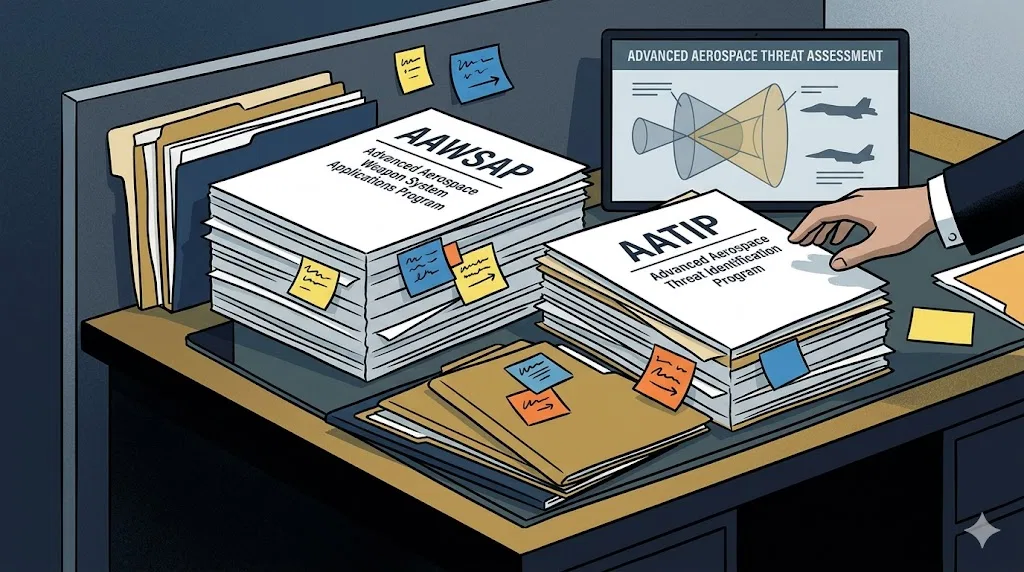
The AAWSAP-AATIP confusion matters because it changes what Colm Kelleher’s “insider” status actually proves. The strongest version is straightforward: Kelleher held a real contractor-side management role in BAASS, the Bigelow company that executed the Defense Intelligence Agency’s AAWSAP contract. The weaker, often blurred version is the idea that all later “AATIP” claims, informal Pentagon UAP work, Skinwalker Ranch investigations and public disclosure campaigning can be treated as one continuous official programme. They cannot. Official records show overlap in naming, but also important differences in status, scope, authorisation and evidential weight. For Kelleher, that distinction is not a technicality. It supports his proximity to a funded government project, while limiting how far that proximity can be used to validate wider claims about paranormal phenomena, recovered materials, hidden programmes or later AATIP-branded narratives.
How the names became blurred
The confusion begins with the fact that even official documents did not use the labels cleanly. A 2009 Department of Defense memorandum on Senator Harry Reid’s request for special access protection refers to “AATIP” in the subject line, but then states that the programme Reid was referring to was officially the Advanced Aerospace Weapon System Application Program, or AAWSAP, a DIA-managed contract. The same document says Reid’s office referred to AAWSAP as the “Advanced Aerospace Threat and Identification Program”.[Defense Intelligence Agency]dia.milDefense Intelligence Agency
That is the first credibility trap. A reader may assume that if “AATIP” appears in a government document, every later claim attached to AATIP inherits the same official footing. The records do not support that shortcut. They show a named DIA contract, congressional funding, a private contractor and a technical research frame. They also show that the AATIP wording was used in and around official correspondence, sometimes as an alternate label, not necessarily as a separately authorised, fully staffed Pentagon office.
The second source of confusion came from the 2017 media breakthrough. Major reporting introduced the public to a Pentagon UFO-related effort, the $22 million figure, Luis Elizondo, Navy videos and Bigelow Aerospace, often under the AATIP label. The Washington Post described AATIP as a low-key Defense Department operation to collect and analyse reported UFO sightings, while noting that the funding officially ended in 2012 and that no programme manager had claimed conclusive proof of extraterrestrial visitors.[The Washington Post]washingtonpost.comSource details in endnotes. Axios, summarising the simultaneous New York Times and Politico revelations, also framed the story as a Pentagon-confirmed $22 million UFO programme and highlighted the credibility boost it gave to UFO advocates.[Axios]axios.comInside the Pentagon's multi-million dollar program to explore UFOsInside the Pentagon's multi-million dollar program to explore UFOs
That publicity made “AATIP” the public-facing name. “AAWSAP”, by contrast, was less memorable, more bureaucratic and tied more directly to contract documents. For a mainstream reader, the names seemed interchangeable. For credibility assessment, the difference is crucial.
What formal records appear to support
The documentary baseline is strongest for AAWSAP. Released DIA material describes a July 2008 supplemental appropriation to study foreign advanced aerospace weapon threats up to 40 years into the future, $10 million in FY08 funds, a Bigelow Aerospace contract to study technical areas, and an emphasis on unconventional technologies.[Defense Intelligence Agency]dia.milDefense Intelligence Agency A contract-status slide says Bigelow Aerospace Advanced Space Studies was in full compliance with contract HHM402-08-C-0072, had submitted extensive monthly status reports, 12 project management plans and 26 detailed research reports by June 2009.[Defense Intelligence Agency]dia.milDefense Intelligence Agency
That matters for Kelleher because his role is not merely self-advertised. Rice University’s Archives of the Impossible profile identifies him as programme manager for AAWSAP and a DIA contractor, and says that in 2008 he became deputy administrator of BAASS, leading day-to-day operations in executing the AAWSAP contract with DIA.[Title of Site | Rice University]impossiblearchives.rice.eduSource details in endnotes. This is the solid centre of his insider claim: he was close to the contractor-side execution of a real DIA-funded programme.
However, the same records narrow the claim. The 2009 memorandum says the contract was for unclassified research in technical areas and delivery of technical reports. It also says James Clapper recommended against establishing a Special Access Program, because DIA and staff review found no justification based on the deliverables or anticipated FY10 work.[Defense Intelligence Agency]dia.milDefense Intelligence Agency In other words, the official paper trail supports “funded DIA contractor work on advanced aerospace topics”; it does not, by itself, support “validated secret access to extraordinary UAP truth”.
AARO’s 2024 historical review complicates the picture further. It states that AAWSAP was established by DIA and “also known as AATIP”, but then adds a key note: the names had been used interchangeably in official documentation, while AATIP itself was never an official DoD programme. AARO says that after AAWSAP was cancelled, the AATIP label was used by some people in an informal, unofficial UAP community of interest within DoD, with no dedicated personnel or budget.[AARO]aaro.milUnclassified Final DSD AARO Historical ReportUnclassified Final DSD AARO Historical Report
That is the central distinction. Kelleher’s most verifiable role sits on the AAWSAP/BAASS side. Later AATIP-branded public narratives may be related, but they are not automatically equivalent in formal status.

Where Kelleher fits in the AAWSAP side of the story
Kelleher’s credibility gains from the fact that he was not simply a television commentator or outside enthusiast. He had a scientific background, had previously led the National Institute for Discovery Science team at Skinwalker Ranch, and then moved into BAASS during the DIA contract period. Rice’s profile states that his AAWSAP talk focused on the programme’s examination of UAP effects on people, including medical, physiological, psychological and paranormal effects, and describes the resulting material as a very large UAP database.[Title of Site | Rice University]impossiblearchives.rice.eduSource details in endnotes.
That framing helps explain why Kelleher’s public work often sounds broader than a conventional aerospace-threat study. From his perspective, AAWSAP did not merely look at objects in the sky; it also gathered reports about human effects and unusual phenomena associated with encounters. Supporters see this as a sign that he was involved in a more ambitious and data-rich investigation than the public initially understood.
Sceptics read the same facts differently. AARO says the contractor conducted UFO research with the support of a DIA programme manager even though UFO/UAP investigation was not specifically outlined in the contract’s statement of work. It also says the work included older Blue Book cases, observer interviews, proposals to examine recovered materials, and investigations at a Utah property owned by the head of the private-sector organisation, including reports of shadow figures, creatures, remote viewing and consciousness anomalies. AARO adds that DIA did not seek or specifically authorise this work, even though a DIA employee set up and managed the contract.[AARO]aaro.milHistory and Origin of KONA BLUEHistory and Origin of KONA BLUE
For Kelleher, the credibility effect is mixed. His account that AAWSAP was broader than a dry technical paper exercise is consistent with later descriptions of the programme. But the more the work expands into Skinwalker Ranch, paranormal effects and consciousness claims, the more it depends on unreleased databases, private reports and interpretation rather than public, independently testable evidence.
How label confusion affects credibility
The label problem changes three things a reader should ask before weighing Kelleher’s claims.
First, it changes the question from “Was he connected to the Pentagon’s UFO programme?” to “Which part of which programme was he connected to?” The answer is strongest for BAASS and AAWSAP contract execution. It is weaker if stretched to imply authority over all later AATIP-labelled activity, Navy video releases, informal DoD UAP networks or post-2017 disclosure claims.
Second, it affects evidential chain of custody. If a claim comes from AAWSAP contract materials, the reader can ask whether it appears in released DIA records, contract slides, technical-report lists or identifiable BAASS deliverables. If it comes from later AATIP discourse, the reader must ask whether it was part of an official programme, an informal community of interest, a personal recollection, a media claim or a secondary retelling. AARO’s distinction between official AAWSAP and informal post-AAWSAP AATIP usage makes that separation unavoidable.[AARO]aaro.milUnclassified Final DSD AARO Historical ReportUnclassified Final DSD AARO Historical Report
Third, it affects how much weight to give institutional proximity. Kelleher’s real contractor role increases his credibility on what BAASS attempted, what kinds of cases it collected, and how insiders understood the project. It does not automatically validate the strongest conclusions associated with the project. AARO’s review says the AAWSAP/AATIP contract produced exploratory papers in the tasked scientific areas, but that those papers were never thoroughly peer reviewed; it also says AARO had not uncovered other substantive UAP case work beyond reviews of older and private cases, observer interviews and unrelated paranormal work at the Utah property.[AARO]aaro.milHistory and Origin of KONA BLUEHistory and Origin of KONA BLUE
This is where supporters and critics talk past each other. Supporters point to the documents and say: there really was a funded programme, Bigelow really was the contractor, and Kelleher really helped run the contractor-side operation. That is fair. Critics point to the same documentary trail and say: the official contract frame was narrower than the public mythology, special-access protection was rejected, and later AATIP language has been used too loosely. That is also fair.

Why the stakes are higher than a naming dispute
The AAWSAP-AATIP distinction matters because modern UAP credibility often turns on a subtle rhetorical move: a documented government programme becomes proof of a wider hidden reality. In Kelleher’s case, the documented programme proves access, not conclusion. It shows that he was close to a real, funded, unusual government-contractor effort. It does not show that every extraordinary interpretation emerging from that effort has been independently validated.
The KONA BLUE episode shows why this matters. AARO says that after DIA cancelled AAWSAP/AATIP, several people involved advocated for the Department of Homeland Security to take over a new version under the code name KONA BLUE. AARO says DHS considered a prospective special access programme, but it was later disapproved and terminated; no data or material was ever transferred to or collected by DHS under KONA BLUE.[AARO]aaro.milHistory and Origin of KONA BLUEHistory and Origin of KONA BLUE AARO’s broader report says many modern claims about hidden reverse-engineering programmes stem from a consistent group of individuals involved in UAP-related efforts since at least 2009, including people linked to the cancelled DIA programme and the failed KONA BLUE attempt.[AARO]aaro.milHistory and Origin of KONA BLUEHistory and Origin of KONA BLUE
That does not prove bad faith by Kelleher or anyone else. It does show why clean labelling is essential. If AAWSAP, AATIP, informal networks and proposed successor programmes are merged into one seamless “Pentagon UFO programme”, the public may overestimate the official status of claims that were actually contractor-side, informal, rejected, cancelled or never fully established.
For Kelleher’s credibility, the balanced conclusion is specific. The AAWSAP record strengthens him as a serious insider to a real government-funded contractor project. The AATIP confusion weakens any argument that his proximity alone settles the truth of the broader claims attached to that world. His strongest footing is operational: he helped manage a historically important BAASS/AAWSAP effort. His weakest footing is evidential: many of the most consequential claims associated with that effort remain dependent on restricted archives, contested interpretations, second-hand accounts and material not available for ordinary public verification.
Amazon book picks
Further Reading
Books and field guides related to Why The AAWSAP AATIP Confusion Matters. Use these as the next step if you want deeper reading beyond the article.
Hunt for the Skinwalker
Shows the broader investigative background feeding into AAWSAP narratives.
eBay marketplace picks
Marketplace Samples
Example marketplace items related to this page. Use the search link to explore similar finds on eBay.



Endnotes
1.
Source: dia.mil
Title: Defense Intelligence Agency
Link:https://www.dia.mil/FOIA/FOIA-Electronic-Reading-Room/FileId/170015/
2.
Source: axios.com
Title: Inside the Pentagon’s multi-million dollar program to explore UFOs
Link:https://www.axios.com/2017/12/16/inside-the-pentagons-multi-million-dollar-program-to-explore-ufos-1513445795
3.
Source: dia.mil
Title: Defense Intelligence Agency
Link:https://www.dia.mil/FOIA/FOIA-Electronic-Reading-Room/FileId/170018/
4.
Source: impossiblearchives.rice.edu
Link:https://impossiblearchives.rice.edu/flash-talk-speakers/colm-a-kelleher
5.
Source: aaro.mil
Title: Unclassified Final DSD AARO Historical Report
Link:https://www.aaro.mil/Portals/136/PDFs/AARO_Historical_Record_Report_Vol_1_2024.pdf
6.
Source: aaro.mil
Title: History and Origin of KONA BLUE
Link:https://www.aaro.mil/Portals/136/PDFs/UAP_RECORDS_RESEARCH/History_and_Origin_of_KONA_BLUE_FINAL_508.pdf
7.
Source: news.rice.edu
Title: archives impossible conference explores cultivation impossibility
Link:https://news.rice.edu/news/2023/archives-impossible-conference-explores-cultivation-impossibility
8.
Source: dia.mil
Link:https://www.dia.mil/FOIA/FOIA-Electronic-Reading-Room/FileId/237642/
9.
Source: dia.mil
Title: FOIA Request Log 2022
Link:https://www.dia.mil/Portals/110/Documents/FOIA/All%20PDFs/FOIA_Request_Log_2022.pdf
10.
Source: dia.mil
Title: FY 2023 FOIA Log
Link:https://www.dia.mil/Portals/110/FY%202023%20FOIA%20Log.pdf
11.
Source: dia.mil
Title: FOIA Request Log 2018
Link:https://www.dia.mil/Portals/110/Documents/FOIA/All%20PDFs/FOIA_Request_Log_2018.pdf
12.
Source: dia.mil
Title: FOIA Request Log 2021
Link:https://www.dia.mil/Portals/110/Documents/FOIA/All%20PDFs/FOIA_Request_Log_2021.pdf
13.
Source: dia.mil
Title: FOIA Request Log 2019
Link:https://www.dia.mil/Portals/110/Documents/FOIA/All%20PDFs/FOIA_Request_Log_2019.pdf
14.
Source: dia.mil
Title: FOIA Request Log 2019.2
Link:https://www.dia.mil/Portals/110/Documents/FOIA/All%20PDFs/FOIA_Request_Log_2019.2.pdf
15.
Source: washingtonpost.com
Link:https://www.washingtonpost.com/world/national-security/head-of-pentagons-secret-ufo-office-sought-to-make-evidence-public/2017/12/16/90bcb7cc-e2b2-11e7-8679-a9728984779c_story.html
16.
Source: intownmag.com
Title: archives of the impossible
Link:https://www.intownmag.com/2025/03/archives-of-the-impossible/
Additional References
17.
Source: youtube.com
Title: George Knapp on the AAWSAP and AATIP Branding Confusion
Link:https://www.youtube.com/watch?v=l_a-S3Z45vI
Source snippet
Documenting Government UAP Research Programs...
18.
Source: youtube.com
Title: The DIA Contract: Separating AAWSAP from AATIP
Link:https://www.youtube.com/watch?v=9QJ-FfG24eQ
Source snippet
George Knapp on the AAWSAP and AATIP Branding Confusion...
19.
Source: reddit.com
Link:https://www.reddit.com/r/UFOs/comments/1kio3m1/advanced_aerospace_weapon_system_applications/
20.
Source: dokumen.pub
Link:https://dokumen.pub/download/skinwalkers-at-the-pentagon-an-insiders-account-of-the-secret-government-ufo-program.html
21.
Source: uapedia.ai
Link:https://uapedia.ai/wiki/colm-a-kelleher-phd-biochemist-field-investigator-and-architect-of-aawsap/
22.
Source: researchgate.net
Link:https://www.researchgate.net/publication/381923973_On_the_AAWSAP-AATIP_Confusion
23.
Source: capradio.org
Link:https://www.capradio.org/news/npr/story?storyid=571446881
24.
Source: reddit.com
Link:https://www.reddit.com/r/UFOs/comments/rgm3oi/skinwalkers_at_the_pentagon_foia/
25.
Source: audible.co.uk
Link:https://www.audible.co.uk/pd/Skinwalkers-at-the-Pentagon-Audiobook/B0BT6LD49L
26.
Source: amazon.co.uk
Link:https://www.amazon.co.uk/Skinwalkers-Pentagon-Insiders-Account-Government-ebook/dp/B09J484KYD
Topic Tree
Follow this branch
Parent topic
KelleherRelated pages 7
- AAWSAP Role What Did Kelleher Actually Do For AAWSAP?
- Background Does Kelleher's Science Career Help His Case?
- Debate Why Supporters And Sceptics Disagree On Kelleher
- Documents What Do The Public Records Really Prove?
- Hitchhikers What Is The Hitchhiker Effect Claim?
- Human Effects Should UAP Research Include Human Effects?
- Skinwalker Why Skinwalker Ranch Defines Kelleher's Reputation